



Formula 1 is currently going through a phase of transformation that touches every area of the car, and to truly understand it, it’s essential to tell the story through the words of those who are experiencing it from the inside.
It’s often said that mastering tyre usage is fundamental, since it is the car’s only contact with the asphalt, but in the search for that perfect alchemy, ingenious solutions continue to emerge.
Autosport discussed all of this with Dario Marrafuschi, Pirelli’s head of motorsport, looking both at the present, particularly at how teams and drivers are adapting to this new technical cycle to extract the most from the tyres, and at the future, examining what will change for 2027.
In fact, it can already be revealed that there will be no C6; instead, the range will still consist of five revised compounds aimed at widening race strategies.
Autosport: Let’s start with a topic that directly relates to Pirelli: the supply agreement with Formula 1 has been extended by another season, through 2028. Receiving such a vote of confidence from the FIA and Formula 1 must be particularly gratifying.
Dario Marrafuschi: “Correct. Our commitment to Formula 1, aside from having started in 1950, meaning from the very first race in Silverstone with Nino Farina in an Alfa Romeo, has been a constant presence over the last 15 years. Since 2011, we have been a supplier, a technical partner, and a global partner for F1. Receiving this one-year extension certainly stands as a testament to our ongoing commitment and the reputation we have built over these years.
“Formula 1 is a highly technical environment dominated by technology and innovation, but it goes beyond that. It is also about the trust we earn with all stakeholders and every entity we interact with, particularly Formula One Management, the FIA, and all the teams to whom we supply tyres and provide engineering consultancy services during race weekends. All of this makes us extremely proud of the work we have accomplished.”
Speaking of the future, a new technical cycle has just begun and is set to run until 2030. Would you like to remain in Formula 1 until 2030, and perhaps even beyond?
DM: “We are global partners and, above all, technical partners. Therefore, if the FIA and Formula 1 were to express an interest in continuing the relationship with Pirelli, we would certainly discuss it in due course. Right now, it is far too early to decide how to outline the future beyond 2028. Just as we have always done in the past, respecting the timing and requests of Formula One Management and the FIA, we will definitely do so in the near future as well.”
Let’s move back to the present for a moment, setting the future aside. In Canada and Monaco, two circuits that put very little energy into the tyres, you observed a trend where lap times turned out quicker than expected, likely because track and asphalt conditions exceeded the teams’ predictions. Is this something you’ve noticed elsewhere, or was it an isolated case? And if it happens again, how will you respond over the rest of the season?
DM: “The low-energy aspect is certainly a significant technical factor, but as far as those two races are concerned, I believe they were exceptional and isolated cases. Since the start of the season, the cars have undergone very significant development by the teams. For those two specific races, we had made assumptions based on simulations that had not yet been updated with data from the latest aerodynamic packages brought to the track by the teams.
“Therefore, it’s a combination of factors. The asphalt and track conditions make a huge difference. The temperatures we encounter during a race weekend play a fundamental role, as do the upgrades brought by the teams, for which we might not have received their latest updated simulation yet. It’s a series of marginal gains, maybe a tenth of a second here, a tenth there, and in the end, you find yourself with higher performance than expected.
Nico Hulkenberg, Audi Revolut F1 R26
Photo by: Erik Junius
“We then saw things get back in line at Silverstone, precisely because we encountered our design window conditions, with track temperatures around 40 to 44 degrees. The air temperature was around 25 to 26 degrees, which I imagine was also ideal for the power units’ cooling packages. Since these were our design conditions and the track was in excellent shape, we found exactly the performance we expected. Minor discrepancies in certain races can happen, and they are usually due to slight mismatches in data supply and the forecasts we make.”
Let’s go back to the Monaco GP, because this year we saw something different compared to the past: an extra preparation lap. From Pirelli’s point of view, do you think this comes down to the cars generating less downforce than last year’s models? Will it take more time to bring the tyres up to temperature on low‑energy circuits?
DM: “To put it simply, these cars generate less energy; they put less temperature into the tyre due to a combination of factors. First of all, the overall downforce level is lower compared to last year, and then there is active aerodynamics, because on the straights, when the wing opens, downforce is reduced, and consequently, the tyres are not pushed down onto the track at high speeds as much as they were last year. Also, the energy recovery parts, by exerting braking force through electric motor regeneration, transfer less heat through the brake discs into the wheel rim, and therefore into the tyre.
“So there is a lower thermal regime and the tyre’s thermal balance is different compared to last year. This was one of the effects considered during the design phase. The tyres are smaller than the 2025 ones, with different geometries and materials compared to last year. However, Monaco, being a low-severity track, is one of those circuits where the tyre warm-up phase takes a bit longer. Furthermore, the C5 compound level has been recalibrated, but it’s a C5 that needs to be usable on other tracks too, not just in Monaco. Therefore, during the Monaco race weekend, the so-called preparation lap was adopted by pretty much all the teams.”
Is the issue getting the tyre up to temperature, or rather keeping it within that 3% window of grip?
DM: “It’s a matter of getting the tyre up to temperature, and I would also differentiate between the front and rear axles. More often than not, you have to find the right energy input and the proper procedure during the out-lap to warm up and bring both the front and rear axles into the correct window. This is something we’ve seen at several tracks. Generally speaking, there is more work to be done to get the fronts up to temperature compared to the rears.”
Staying on a related topic, wheel‑rim designs are open again this year, and teams are working to reduce operating pressures. For safety reasons, you naturally provide both the minimum starting pressures and the running pressures once the tyres stabilise. What have you observed on this and how are teams achieving these effects given that the regulations limit how much hot air can be released from the brake ducts?
DM: “The open wheel rim regulations are indeed an opportunity for the teams, perhaps not very visible on television for the general public, but highly significant. The design of the wheel rim has changed a lot compared to last year; we’ve seen rims with hollow spokes, which some teams call pockets, and this is precisely to facilitate heat exchange with the cooling of the brake ducts, so to speak. We actually see differences among the various teams in who manages to, I wouldn’t say manage it better, but manage it differently. For one team, the goal might be to heat it up, while for another team, it’s to cool it down, depending on the car’s balance. So, we see differences, and it is a significant performance lever.
“They can effectively govern the pressure build-up, from the starting pressure to the stabilised running pressure, in an efficient way. Sometimes, when we look at performance and see a certain consistency in lap times, especially during a long run, it is also determined by how well the team manages to control the pressures, keeping them within the optimal window throughout the stint thanks to these devices.”
The teams are following two different paths. Some teams are trying to warm up the tyres by targeting higher temperatures, while others are aiming for lower pressures and cooler running conditions. Is it simply a matter of certain teams being more efficient than others at keeping operating pressures and temperatures down, or are there genuinely two different philosophies at play, with some deliberately seeking higher temperatures to make tyre warm‑up easier?
DM: “Generally speaking, running lower pressures is an advantage for grip. However, depending on race pace or vehicle performance, some teams actually struggle to keep pressures low because, by going very fast, they put a lot of heat into the tyres, while other teams might face the exact opposite problem. Not everyone is doing the same thing. That said, the design of the brake ducts, the brake drums and the wheel rims provides an engineering lever to get the car to operate the tyres in their optimal window.”
Let’s start moving towards 2027 while staying on this topic. Since this could trigger a development war, do you think the FIA might consider stepping in to restrict wheel rim development? Especially considering that, as a reminder, managing the procedures when teams change rims already involves a significant amount of extra work for Pirelli as well.
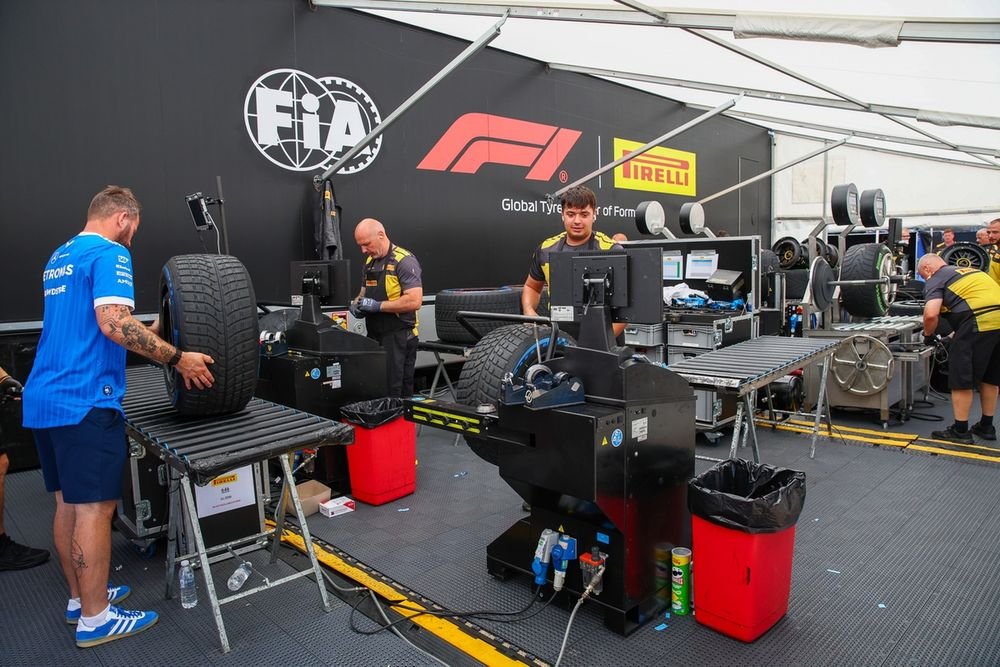
DM: “I don’t want to comment on decisions that don’t fall under Pirelli’s responsibility. We can handle the wheel‑rim developments that teams propose; everything is regulated. When wheel rims are changed, the FIA is obviously informed and, speaking strictly within Pirelli’s remit, we are informed as well, for a very simple reason. Slick tyres are fitted at the track, with new sets mounted at every race. Wet tyres, on the other hand, if they are not used, especially during European rounds, are transported by Pirelli already mounted on the rim; they are not disassembled.

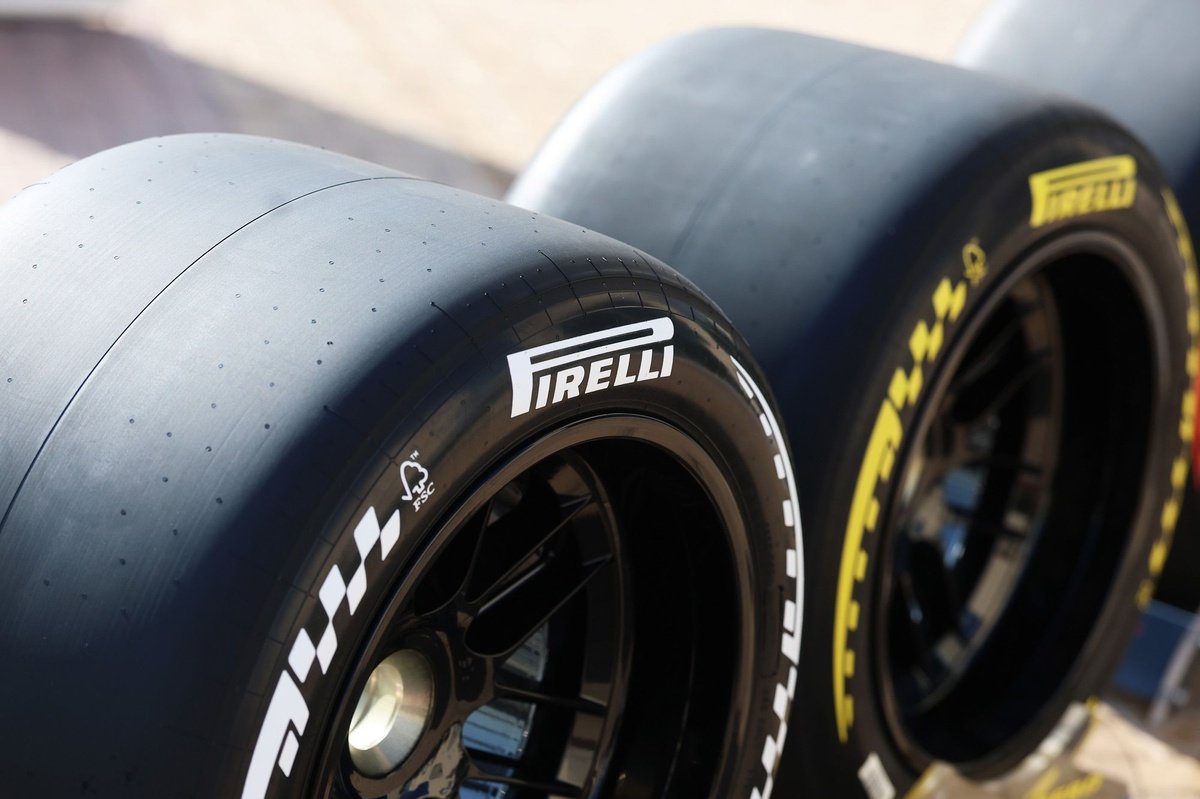
Pirelli tyres
Photo by: Paul Foster
“We will soon be heading to Spa. If a team wants to change their wheel rim specification for Spa, this operation is carried out on-site by Pirelli by stripping the tyre, changing the rim, and also informing the FIA. This is because – and this is behind-the-scenes technical information – the FIA is aware of a unique association between the tyre, the rim, and the pressure sensor mounted on the rim itself. It’s a connection referred to as ‘pairing’, just like when you pair Bluetooth earphones with a computer. The moment a rim is changed, the FIA must be informed. Therefore, it is a regulated process that is sustainable for Pirelli within the appropriate rules dictated by the federation. Consequently, if wheel rim development were to be restricted, it certainly wouldn’t be Pirelli asking for it; it would be due to other reasons that don’t fall under Pirelli’s responsibility.”
Looking at your data, have you noticed that some teams have already reached the downforce levels predicted for the end of 2026, and that the FIA is now discussing a reduction in downforce for the 2027 cars? How could this reduction affect your work, especially considering that you must be close to the homologation deadline for next year’s construction, or have you already worked in advance?
DM: “We have already worked on these topics, which are fundamental to the design for the coming year. There is a lot of communication between Pirelli, the FIA, FOM and the teams. Any regulatory change proposed by the FIA is then approved by the F1 Commission, meaning these regulation changes are subsequently approved by the teams as well. The FIA’s goal is precisely to have a car package that is sustainable for all parties involved, such as aerodynamics, the power unit, tyres, and the braking system, because everything in the vehicle is closely interconnected.
“A major shift in aerodynamics would affect all parameters, obviously including the tyres, which is why we are kept informed of regulatory choices. Coming to the point, this move by the FIA was a choice to essentially confirm the spirit of the current regulations, keeping the cars within a performance balance that was the target for 2026/2027. Since it became apparent that the teams had taken an exponential curve in aerodynamic development, they are trying to keep it within the car’s design window, so that all the technical partners involved can work knowing what the objective will be.”
Regarding the compounds for 2027, do you expect the situation to remain largely unchanged from what we have today or will something change?
DM: “Compounds are always being developed, and we have already done some baseline work on this in previous tests, a foundational stage regarding what the new material packages for next year could be in terms of compounds. Once the structure is finalised, we will then optimise the compound scaling for next year based on the results already achieved. I can already reveal that there will still be five levels; we won’t be adding or removing a level. We did think about and discuss whether to add another compound level, but looking at Monaco, in the end, we saw that most cars started on the C4, which was the medium.
“Qualifying, even with an extra preparation lap, was thrilling with the C5 in the final minutes of the session. That is why we believe adding a softer compound is not necessary. We saw a great race in Monaco as well, and if we were to use a C6 in Monaco, it would be useless for the rest of the season. Because of this, we will rescale the five compound levels based on next year’s target performances. The goals are always to have a clear performance differentiation between the five levels in terms of peak lap time, along with proportional degradation, so we can make choices that generate slightly overlapping strategies at every grand prix.
“This was the case in Barcelona, and also in Austria, where the two-stop strategy was very similar to the three-stop one. At Silverstone, the one-stop and two-stop strategies were far apart, but looking ahead to next year, we will work, for example, to make them much closer to each other. This way, barring any safety cars or neutralisations, there will be room for teams and drivers to choose different strategies, perhaps managing tyre degradation in the most optimal way for their specific car, and creating more strategies.”
Let’s return to a topic related to the current tyres and the tyre behaviour. With the switch to 18‑inch tyres in 2022, the combined phase, when the driver brakes and turns at the same time, became more complicated because of the lower sidewall. This year, Andrea Stella explained that their data shows differences in how the tyres behave in that phase. What have you observed, considering that the tyres are also narrower this season?
DM: “This is a physiological, or rather physical, matter for the tyre. The moment you move from 13 to 18 inches, the tyre sidewall height is reduced, and as a consequence of all this, the contact patch is shorter. If you imagine the rolling of the tyre in the longitudinal direction, the length of the contact patch is shorter, and with a shorter contact patch, the transition in driving feel between having grip and losing it is more sudden. This is why we understand the drivers’ comments; it was expected that these difficulties would arise during corner entry in managing adhesion, exactly because the snap gives you less warning.
“Clearly, work has been done to compensate for this effect, but as I said, it is a fairly physiological trait. This year’s size change also influenced this effect slightly, though not as dramatically as the switch from 13 to 18 inches. As for McLaren being more sensitive to it, I would attribute that to the characteristics of their car. Without going into details, for sure fans have noticed that McLaren has a very different car compared to the others; they chose a very different development path. Therefore, it is possible that their car is more sensitive to certain aspects while capitalising on others, because they made a definitive choice to gain specific advantages, but it comes with trade-offs, just as other teams have had their own advantages and trade-offs.”
Oscar Piastri, McLaren
Photo by: Steven Tee / LAT Images via Getty Images
Remaining on this topic, Stella was also referring to the drivers’ driving styles and pointed out differences in how Antonelli and Russell use the steering wheel on corner entry. Have you noticed these differences as well when looking at the data?
DM: “Let me give you an example. To react precisely to that difficulty in reading the car on corner entry, some drivers tend to saturate the front tyres entering the turn. Saturating the front means they might enter the corner by giving a very sharp, quick steering input, so that the front end experiences a step-input towards a high steering angle, which causes the car to tend to go straight. What does tending to go straight actually mean? It means it stabilises the rear more, and the front gains grip progressively. This driving style of oversaturating the front inevitably reflects on tyre wear and temperatures as well. I can confirm that when we analyse the tyres for each team, at every race and every session, we measure the wear and we do see differences.
“Clearly, these differences are then blended into other set-up choices as well, because at the same time, it’s not just down to driving style. Maybe a team goes for a more understeer-biased set-up, or adjusts camber angles, perhaps reducing the front camber angle to stabilise the rear, and as a result, we see a difference in tyre usage through the wear patterns. And that is exactly the beauty of the competition. This is precisely why we provide technical assistance to the teams during races; we offer our perspective on how the tyre itself is working for that specific car, that set-up and that driving style.”
Let’s switch to the topic of the ‘super‑intermediate’, the tyre we discussed at the start of the year as a possible option for 2027. We’re now in July: do you think it could still be under consideration for next season, especially given how few opportunities you’ve had to run in wet conditions this year?
DM: “The super-intermediate is under development; it is something we are actively pursuing. We haven’t abandoned this path. We are always very open to technology and innovation, evaluating products that offer an improvement over the current ones, so that is definitely a route. I must say that, unfortunately, we lost an initial wet-weather test, specifically the one in Bahrain, which we weren’t able to carry out, and at the same time, we don’t have feedback yet on how these current cars behave in the wet with the existing product. Consequently, development in wet conditions is inevitably slightly slowed down compared to our original plans. We are now evaluating whether we can recover at least one day of wet testing, perhaps over the summer, but clearly, not having run a wet event yet means we are missing an important piece of information.
“So, we are still working on the super-intermediate. As for freezing the development of the super-intermediate for 2027, I don’t feel in a position to confirm that right now, due to the delays and the lack of wet races we’ve had so far. In any case, these wet-weather developments are obviously always shared with the FIA and Formula 1 to make the best technologically available choice.”
Let’s finish with a question related to this season. There’s currently a proposal on the table to make up for a cancelled race in the coming months. From a logistical standpoint, how complex would it be for Pirelli to organise everything in time, especially considering that this wouldn’t be a European event but one in the Middle East?
DM: “This is quite a puzzle, because unfortunately, when it comes to the Middle East, it’s still impossible to predict how stable the Strait of Hormuz area will be. There are two logistical bottlenecks we have to deal with: the Strait of Hormuz itself, and the Houthi‑controlled area off Yemen, which creates difficulties for cargo‑ship transit. We’ve mapped out a few scenarios. If we had to reach the Middle East under the current conditions, we would need to circumnavigate Africa.
“We’re talking about roughly four months’ notice, it takes around 15 weeks of lead time to organise a transport of that scale. There are other alternatives as well: we could go through the Suez Canal and then cross Saudi Arabia from Jeddah towards the rest of the Middle East, provided that route is viable and efficient. Fortunately, we have very reliable logistical partners, and the routes we use are exactly the same ones used by the rest of the F1 world. If there are no tyres, there are no cars either. In short, we’re part of a huge logistical ecosystem, and a grand prix is never added unless the logistics have been fully assessed.
“In the worst‑case scenario, we’re looking at 15 to 16 weeks; in the best‑case scenario, about six weeks. Right now, unfortunately, uncertainty is the dominant factor, and I couldn’t say how long it would take to reach a potential race in the Middle East, also because, even assuming we could circumnavigate Africa, we would still need to know whether the Strait of Hormuz is open.”
We want to hear from you!
Let us know what you would like to see from us in the future.
Take our survey
– The Autosport.com Team
Read the full article here