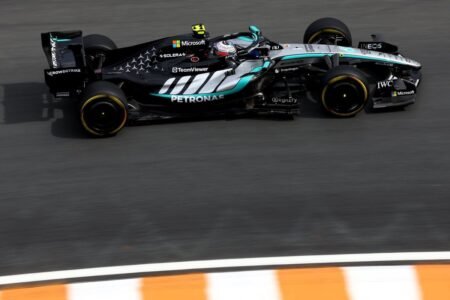





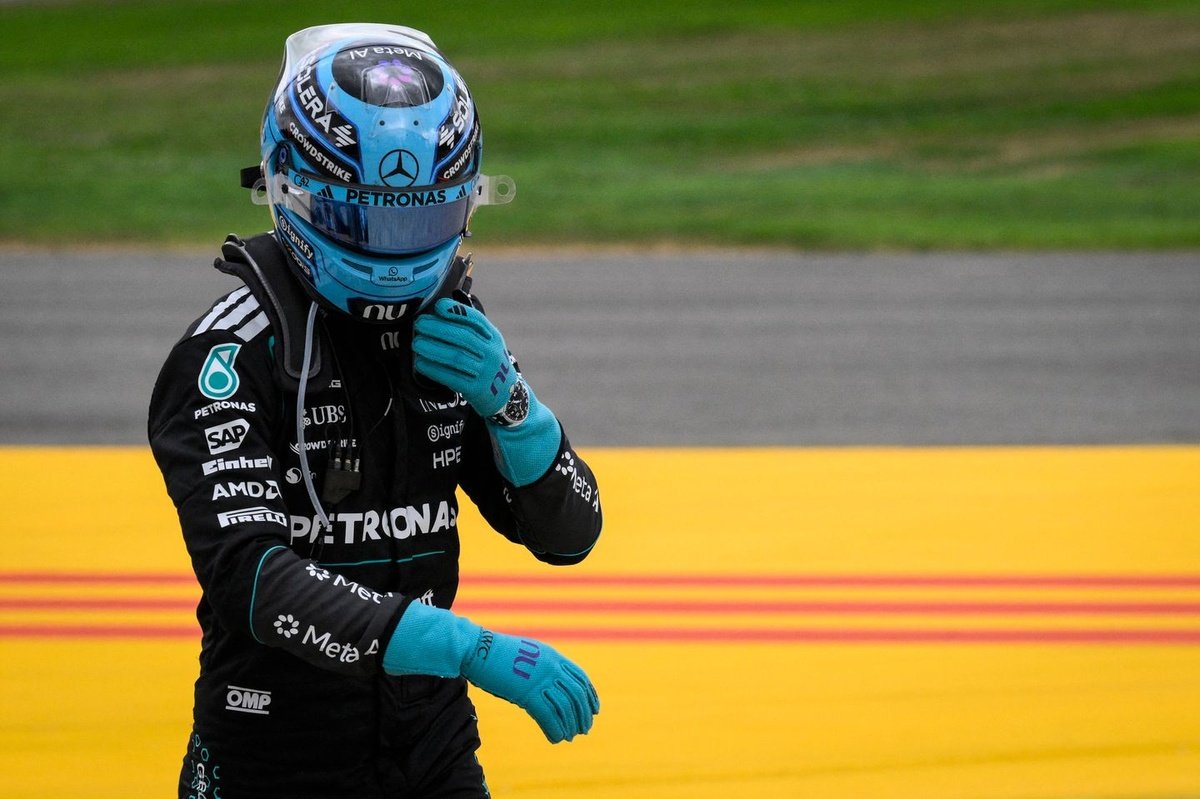
Mercedes is still trying to figure out why George Russell had more energy deployment issues at Formula 1’s Belgian Grand Prix despite tweaking his driving style, after he kept losing time to his team-mate on the straights.
Russell’s side of the Mercedes garage has been mystified by a lack of energy deployment and hence top speed on power-sensitive circuits, which already manifested itself in Silverstone but was also a big factor at Spa.
In Belgium there was a clear top speed deficit between Russell and team-mate Kimi Antonelli through practice and to a lesser extent in qualifying, with the championship leader qualifying on pole and Russell fourth.
When asked by Autosport about how powerless he felt after qualifying, Russell replied: “My whole focus for the last 36 hours has been on straightline speed. It hasn’t been focusing on the set-up, the tyres or anything, because we’re all trying to solve what is going on.
“Even on my last lap, for some reason I lost another tenth and a half to myself, just on the straight. You’re watching on your steering wheel, just losing speed when you’re full gas on the straight. You feel powerless. We don’t know what’s going on. I don’t think it’s the power unit, to be honest. But there’s something slowing us down in the straights.”
Spa qualifying was extra frustrating because Russell had hoped he could remedy the problem by adapting his driving style and his throttle application, which was the outcome of Mercedes’ investigation after Silverstone.
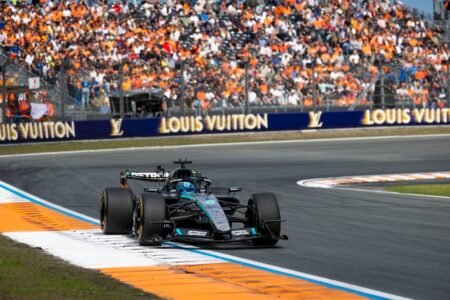
Hamstrung by an empty battery, George Russell immediately came under pressure from the two Ferraris at the start
Photo by: Alex Bierens de Haan / LAT Images via Getty Images
Mercedes’ deputy technical director Simone Resta says the Brackley squad is “still struggling to understand every single contributor” to Russell’s energy deployment deficit after the Briton’s work to adapt his driving style didn’t fully eradicate the problem.
“We’ve had some problems with the deployment on George’s car that we really need to understand and bottom out going to the next event,” Resta explained ahead of this weekend’s Hungarian GP. “All that started in Silverstone, where we started to see some deployment differences between our two cars.
“We’ve been doing a lot of analysis, and we came to the conclusion that one of the major contributors was related to a difference in driving style between the two cars. George studied that quite a lot and was able to change it and adapt going into Spa, but still, we can still see some difference in the deployment between these two cars.”
He added: “We are working with a brand-new set of regulations, we are just at the 10th race over these regulations, and we are still struggling to understand every single contributor. We are not the only ones in this condition because we can see that many teams are still learning and adapting to this new regulation, so we’ll do our best to really find out what’s the main reason for this difference and to be best prepared for Hungary.”
Unrelated to the driving style question, both Mercedes cars also suffered a poor start in Spa after running out of electric energy on the Kemmel Straight, which especially cost Russell as he was swallowed by the chasing Ferraris. It ultimately contributed to contact with Lewis Hamilton at Turn 5, which knocked Russell out of the race.
Resta confirmed a software glitch led to both cars reaching their energy harvest limit out of Turn 1, leaving them without energy to deploy on the following straight.
“Essentially we’ve been having a software issue with both our cars, which basically meant that we hit the harvesting limit at Turn 1,” Resta added. “Basically, we had a boost issue on both cars from Turn 1 to Turn 5. This has affected both George and Kimi and we’ve seen both of them losing ground after a good start.”
We want to hear from you!
Let us know what you would like to see from us in the future.
Take our survey
– The Autosport.com Team
Read the full article here