



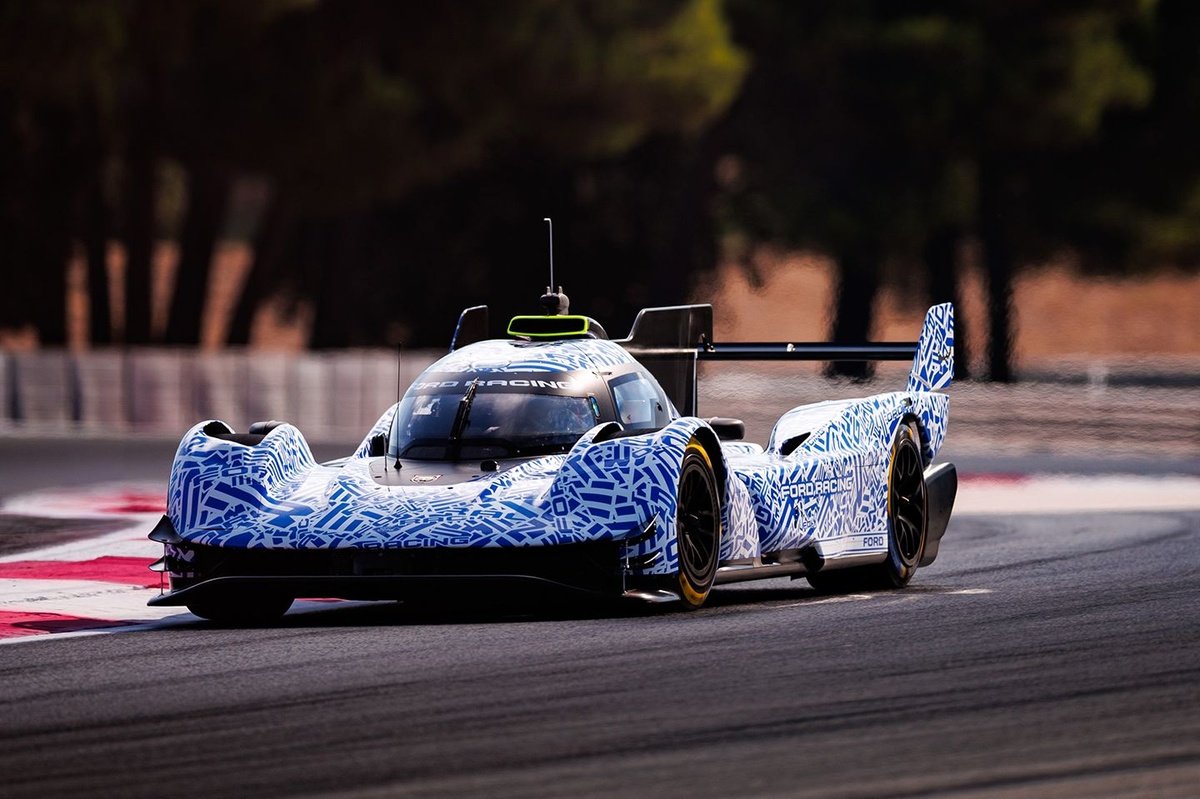
Ford’s brand-new LMDh car performed its maiden shakedown at Le Castellet on Monday ahead of its World Endurance Championship debut in 2027.
Circuit Paul Ricard was chosen for the shakedown as it is close to the headquarters of manufacturer ORECA, whose chassis forms the basis of the unnamed Ford prototype.
The 5.4-litre naturally-aspirated V8 engine derived from the Coyote, built and tested at the Dearborn facility, was fitted to the chassis and started up for the first time last month.
“Testing of the Hypercar began on Wednesday 5 August, starting with several days of running-in tests, which went smoothly and according to plan,” the Ford Racing statement explained.
“The team methodically followed a comprehensive programme to activate and verify every control system; these are now all fully operational and ready for the first track tests scheduled for this week and next.”
Works drivers Matt Campbell and Logan Sargeant took turns at the wheel of the car, with team-mates Tom Blomqvist and Mike Rockenfeller to follow in the coming days. The initial test sessions had been entrusted to those drivers too, except Sargeant. Nick Yelloly and Sebastian Priaulx will also take part in the project ahead of Ford’s Hypercar debut next year.
Ford Hypercar test
Photo by: Ford Racing Technology
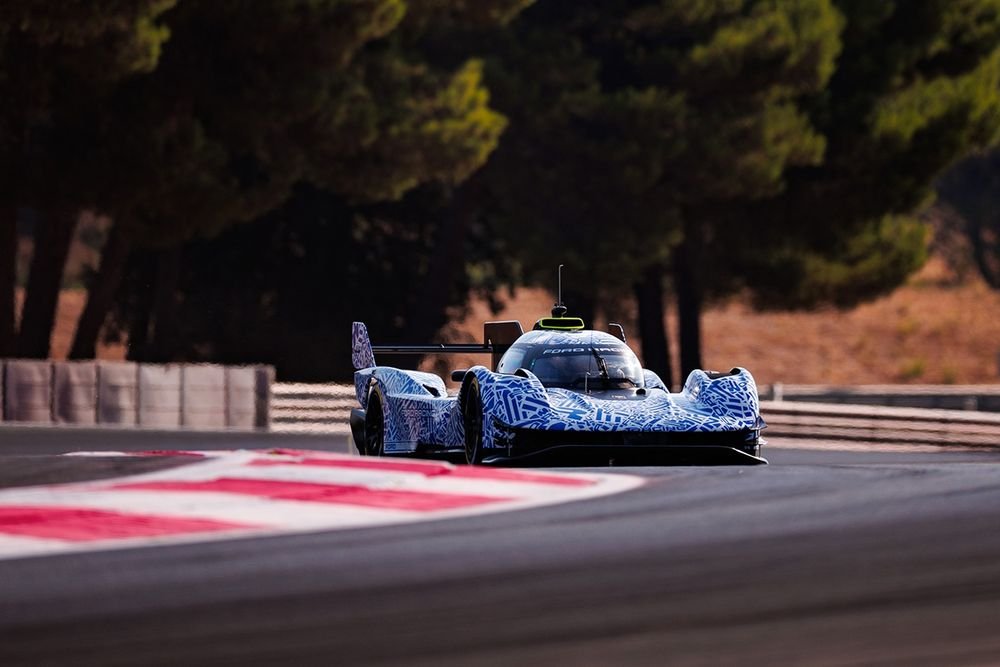
The car featured a blue-and-white camouflage design with “Ford Racing” lettering and a black fin. The Ferrari 499P-style nose is very low (albeit without the wing running across the top on other ORECA-based models), while the raised, contoured splitter is connected to the ‘nose’ that protrudes from beneath the bodywork in the centre. On the sides, there are two aerodynamic flaps, known as ‘flicks’.
The front mudguard features some contoured sections above the area where the headlights will be fitted (still obscured by the paintwork), with the classic opening above the wheels. On the sides, there is a ‘tunnel’ between the wheel arch and the side skirts to channel the airflow from the front opening beneath the bodywork.
At the rear, the side wing supports are attached to the end of the wheel arch, which takes on an unprecedented hollowed-out shape, connecting to the central section of the bodywork (where the horizontal LED strip for rear lights is visible).
The curved lower panels also merge with the diffuser section, which is wider and more squared-off in the centre.
Finally, the bonnet fin features a very similar design to the Porsche 963’s, with a large air intake visible through the yellow outline on the cockpit cover.

Ford Hypercar test
Photo by: Ford Racing Technology
We want to hear from you!
Let us know what you would like to see from us in the future.
Take our survey
– The Autosport.com Team
Read the full article here