

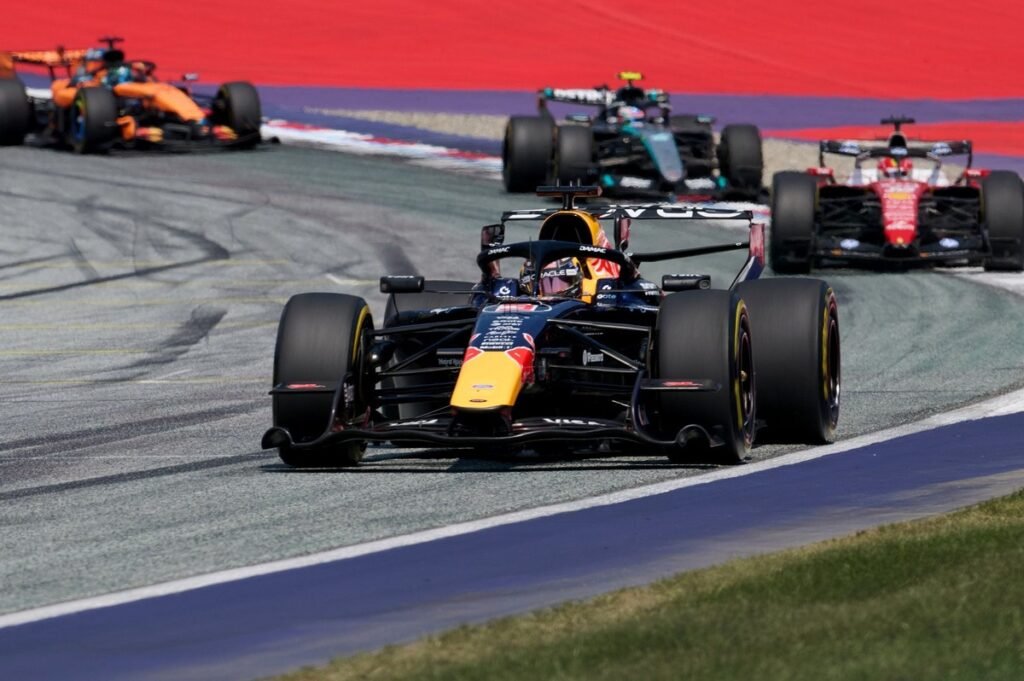
One of the most eye-catching innovations of the first half of the 2026 Formula 1 season has been the rotating rear wing, quickly dubbed the Macarena wing by Ferrari team principal Frederic Vasseur.

Ferrari was the first to unveil the concept during winter testing and managed to surprise several rivals – including McLaren – with the innovative solution.

At that point, Red Bull was already working on its own version behind the scenes. Technical director Pierre Wache stressed that the inspiration had not come from Ferrari and that Red Bull’s concept works differently, which is indeed the case as, among other things, it rotates in the opposite direction.

Red Bull simply did not manage to get its rotating wing fully operational in time for the start of the season, meaning it was first used in Miami.

The initial race weekends passed without problems for both the Ferrari and Red Bull designs, but the Macarena wings came under increased scrutiny following Verstappen’s two consecutive crashes in Spielberg and Silverstone.

The FIA subsequently asked both Red Bull and Ferrari for additional information. That was not specifically directed at the Scuderia, but was simply a way of treating both teams equally, as they were the two outfits that had raced with the concept up to that point.

Moreover, it was important for the FIA to fully understand the specifics of both systems, as more and more teams are developing their own versions. McLaren has already tested a rotating wing and plans to race it during “one of the first weekends after the summer break”.

Nikolas Tombazis says the FIA is happy for the novel wings to stay in F1

Photo by: Kym Illman / Getty Images

The FIA has now told a select group of media, including Autosport, that it will not take action against the overall Macarena wing concept.

“When the first such design appeared, we wanted to make sure that it is entirely safe,” FIA single-seater director Nikolas Tombazis said. “And that consisted of various requirements, as in many complicated systems and engineering teams deploying what is called an FMEA analysis, which is failure mode.”

That assessment was not only about the prescribed closing time, but also the subsequent behaviour of the wing and the rest of the car – as the closing time alone is not sufficient and the airflow does not immediately reattach after the wing closes.


“We went into quite a lot of dialogue to ensure that we felt that these designs were safe,” Tombazis said. “Mainly, we wanted to be sure that there was never a risk of, let’s say, a hydraulic failure, meaning that the wing is staying open and could not come back to a closed position.

“And also, we wanted to make sure that it does so in a very short amount of time. That it doesn’t go through a very slow movement, which can then unsettle the car.”

The outcome of those discussions is that the overall concept is considered acceptable, although some additional work was required in Red Bull’s case.

Ferrari was the first to bring its 180 degree wing to the track

Ferrari was the first to bring its 180 degree wing to the track

Photo by: Andy Hone/ LAT Images via Getty Images

According to Tombazis, that does not mean the FIA formally told Red Bull to make changes, but rather that the technical team led by Wache realised on the basis of those discussions – and, logically, the crashes – that there was still more homework to be done.

“So, we have been discussing these things, and on the basis of those discussions Red Bull wanted to do some more work,” Tombazis continued.

“We haven’t specifically told them ‘no, you cannot race it’, but they needed to do a bit more work to be sure, because ultimately, they also want their car to be safe. I don’t think anyone wants their car to be crashed.”

That additional work to address the problems – which Wache said were mechanical in nature – meant Red Bull temporarily had to revert to a more conventional specification in Belgium, before the rotating rear wing could be used again by Verstappen and Isack Hadjar in Hungary.

Read Also:

We want to hear from you!

Let us know what you would like to see from us in the future.

Take our survey

– The Autosport.com Team

Read the full article here

Share.