




Anthony Joshua turning to Ben Davison to crack the Tyson Fury code is a flawed strategy built on outdated history. While Joshua balances visits to Oleksandr Usyk’s team in Spain and Derrick James in Texas, Davison’s presence in camp is being sold as an inside track on Fury. In reality, Davison’s playbook offers nothing useful against the Kronk fighter Fury became years ago.
Joshua recently spent time in Spain working around Team Usyk, yet he has returned to Davison’s gym in Essex while keeping ties with Derrick James open. Eddie Hearn has refrained from naming a single head trainer or confirming a permanent camp base, although he took steps to remove doubt surrounding Davison’s presence.
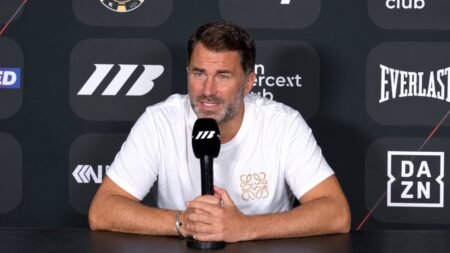
“I think in some capacity he’ll stay close to them,” Hearn stated regarding Joshua’s ties to Usyk’s team. “He’s always been, even when Ben wasn’t his principal trainer, working with him strategically, talking all the time. I think he respects Ben a lot. Obviously, there’s probably a feeling that Ben Davison knows Tyson Fury extremely well. I don’t know AJ’s final decision to where he’s going to locate his training camp, but Ben Davison will definitely be involved in that camp and that process.”
Davison’s familiarity with Fury cuts both ways. Fury knows how Davison schemes, how he sequences combinations, and how he reacts when a fight slips away from the whiteboard. Any blueprint reliant on years past will run into a fighter who knows the playbook just as well.
The bigger problem is that Davison worked with a completely different fighter. Davison guided the elusive version of Fury who completed a comeback and survived Deontay Wilder across twelve rounds in 2018. That fighter was a survival project built on light jabs, lateral evasion, and snatching rounds from the outside. Fury realized the limitations of that safety-first approach, parted ways with Davison in late 2019, and went to SugarHill Steward to resurrect the Kronk style.
Under Steward, Fury abandoned the backfoot bouncing, added twenty pounds of solid bulk, and committed to walking opponents down. He uses heavyweight bullying to control the ring: collar ties, framing with the forearms, turning opponents in the clinch, and dropping his upper body weight over their neck and shoulders. Davison never coached that style, never cornered Fury while he executed it, and was abandoned because Fury outgrew the light-hitting system Davison specializes in.
Preparing Joshua for the 2018 iteration of Fury is a trap. The modern Fury will not waste energy trying to outbox Joshua cleanly from the outside. He will lean his massive frame on Joshua, tie up his arms, and make every round an exhausting physical grind.
Consulting Team Usyk brings its own tactical contradictions. Usyk neutralized Fury using rapid lateral escapes, constant rhythm disruption, and cruiserweight agility. Joshua is a muscular, upright heavyweight who moves in straight lines. Forcing Joshua to mimic Usyk’s fluid footwork while executing Davison’s mechanical combinations will only leave him disjointed.
Trainer hopping has defined Joshua’s post-McCracken career. Moving through Robert Garcia, Derrick James, Davison, and Team Usyk points to a fighter looking for external solutions to internal doubts. When Joshua faces adversity, conflicting philosophies will paralyze him.
Joshua does not need a committee of trainers offering polite suggestions. He needs a single corner authority with absolute control over the strategy. If Joshua carries multiple voices into the ring, the hesitation will give Fury all the openings he needs.
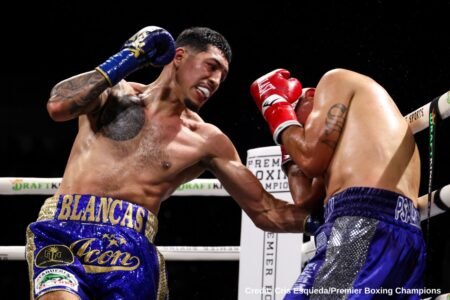
The recent disaster with Moses Itauma against Filip Hrgovic exposed the exact same systemic flaws that showed up when Daniel Dubois ran right through Joshua at Wembley. Davison builds intricate, lab-tested game plans for the opening bell, but the moment a heavyweight fight turns into an ugly, grueling dogfight, his system breaks down.
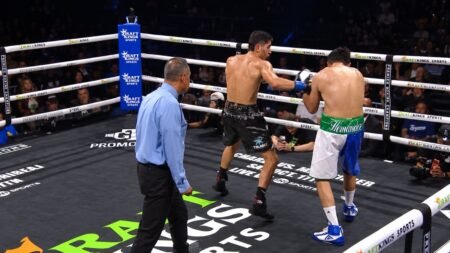
Against Hrgovic, Itauma had everything going his way early, scored a knockdown, and swept rounds, yet the tank emptied completely because the conditioning foundation was not built for deep waters. When the crisis hit, Davison had no Plan B, telling a gassed 21-year-old to take deep breaths instead of giving him a practical survival strategy.
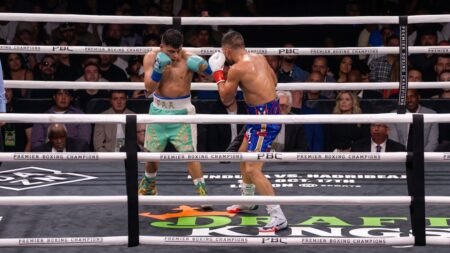
That identical corner paralysis was on full display against Dubois. Joshua walked out stiff, mechanical, and completely unprepared for a fighter charging forward with bad intentions. When Dubois clipped him in the first round, Davison looked lost. There were no adjustments to clinch, buy time, or change the target. Joshua was left wandering into right hands until the fifth-round finish.
The fact that Joshua kept Davison after the Dubois demolition shows a fighter desperately clinging to the comfort of Davison’s praise rather than demanding hard-nosed accountability. Joshua believes Davison holds the secret blueprint to beat Fury because Davison was in Fury’s corner years ago.
Relying on Davison to outscheme Fury is a massive tactical error. Fury knows Davison’s limitations better than anyone, which is why Fury left him for SugarHill Steward in the first place. If Joshua walks into a fight against Fury depending on Davison’s whiteboard tactics, he is walking into the exact same trap that cost Itauma his undefeated record and left Joshua flat on his back against Dubois.
Read the full article here