
Follow Boxing News 24 on Google News

“That’s horrendous,” Ade said. “What? Because he can sell grills, all of a sudden he can fight?”

He then assigned almost all the Rumble in the Jungle’s importance to Muhammad Ali, arguing that Ali could have faced someone else and produced the same event.

“I’d never heard anything about Foreman,” Oladipo said. “That is all Muhammad Ali.”

During his interview with Helwani, Oladipo first claimed the clip had been taken out of context. He described the original exchange as a light argument over the most famous boxer ever, with Gough bringing up the Foreman grill while Oladipo defended Ali. That account softened the substance of his own remarks.

“It wasn’t necessarily anti-George Foreman. I think it was so pro-Ali that I was like, ‘No, no, my guy,’” Oladipo told Ariel Helwani. “I was just saying my guy is numero uno, and by defending my guy kind of shot down others… I certainly didn’t mean to be disrespectful to the late, great George Foreman… I was just trying to back my guy, and I think maybe I batted a bit too hard.”

That is closer to an admission than a defense. Oladipo knew while recording the segment that his remarks might generate criticism. He now accepts that Foreman was one of the greatest heavyweights ever and that he unfairly diminished him while arguing for Ali.

Before making that concession, Oladipo spent several minutes attacking his critics. He called them jealous, dismissed some as “minions” and suggested members of the boxing media were using the clip to pursue his broadcasting position. He also complained that boxing expects commentators to possess the equivalent of a university doctorate in the sport’s history.

Born in 1981, Oladipo was not around for Foreman’s rise. He never experienced the sequence of an Olympic gold medalist developing into boxing’s most destructive heavyweight, wiping out established champions and arriving in Zaire with the aura of an unbeatable force.

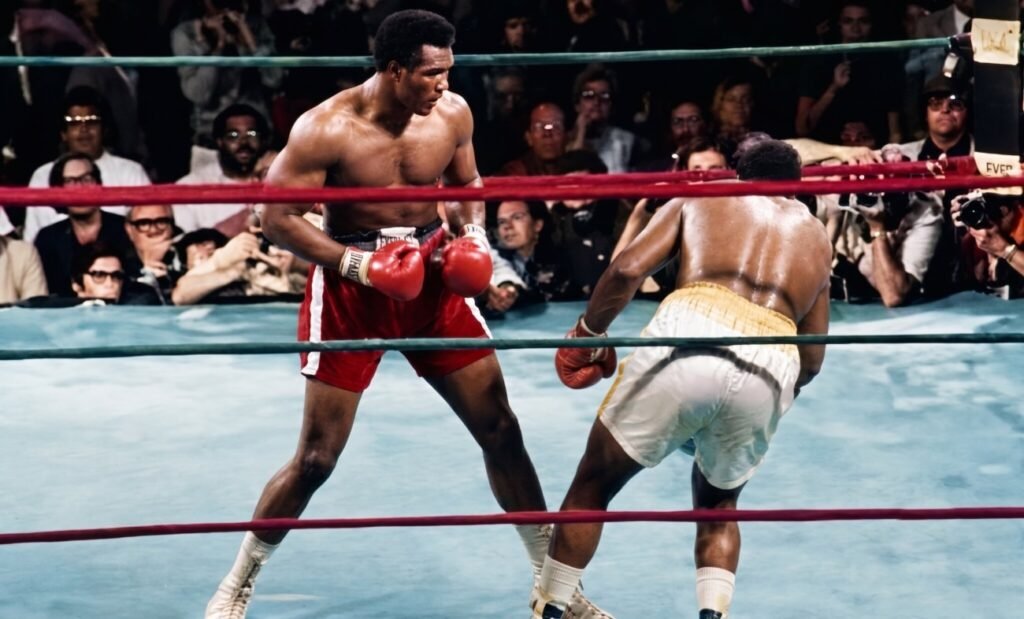
Foreman’s 1973 destruction of Joe Frazier remains among boxing’s most memorable title changes. Howard Cosell’s repeated cry of “Down goes Frazier” entered American sports culture as Foreman dropped the champion six times in two rounds.

Frazier had defeated Ali two years earlier. Ken Norton had broken Ali’s jaw and beaten him in 1973. Foreman needed only two rounds to destroy Norton, then later stopped Frazier for a second time.

He was the Mike Tyson of an earlier generation. Spectators watched because Foreman’s knockouts carried a frightening inevitability. Ali supplied unmatched personality and global celebrity in Zaire, while the champion across from him represented terrifying physical danger.

Claiming that Ali could have fought anyone in Kinshasa and created the same spectacle also reduces Ali’s accomplishment. The Rumble in the Jungle achieved immortality because Ali conquered the undefeated destroyer whom many believed might seriously hurt him. Replace Foreman with a routine contender and the event becomes another Ali title fight rather than a defining moment in sports history. Foreman’s reputation was not incidental to the legend. It was the obstacle that made Ali’s victory extraordinary.

The grill argument reverses the cause and effect. Foreman’s fame did not originate with kitchen appliances. Their enormous commercial success relied on a recognizable former heavyweight champion with an extraordinary personal story. Modern casual fans may associate the older, smiling Foreman with television commercials, but audiences in the 1970s knew him as an intimidating knockout artist.

His second career further weakens Oladipo’s dismissal. Foreman returned after a decade away, rebuilt himself in public and knocked out Michael Moorer in 1994 to regain the heavyweight championship at age 45. That accomplishment introduced him to another generation and completed a remarkable reinvention. His popularity rested on the combination of his terrifying first reign, historic comeback, and transformed personality. The grill capitalized on that story; it did not create it.

A broadcaster does not need personal memories of every boxing era. Curiosity is supposed to fill that absence. Foreman’s rise is not obscure material from 1922, as Oladipo’s comparison suggested. The heavyweight era containing Ali, Foreman, Frazier and Norton is foundational knowledge for anyone paid to discuss boxing professionally.

Calling critics jealous avoids that distinction. They were not demanding expertise in forgotten bare-knuckle champions. The criticism followed because a prominent broadcaster showed limited preparation on one of the sport’s central figures, then treated the reaction as an attempt to take his job.

The mistake was not choosing Ali as the more famous man. It was mistaking the older George Foreman Oladipo knew for the young fighter the world feared. Blaming the reaction on missing context and professional jealousy does not correct that historical blind spot.

Youtube video


Read the full article here

Share.