




As you glance up at the wattage on the screen while churning out a hard session on Zwift, the thought has probably crossed your mind: couldn’t all this energy be put to better use, saving me some cash? After all, energy for our homes no longer comes cheap, and with millions of people now riding indoor bikes for fitness, it seems logical that some of that human power could be harnessed for everyday electricity. So why aren’t our indoor workouts lighting our homes or boiling our kettles?
The main reason is that the modern home is just too power-hungry. Even if it could be harnessed, our cycling power would struggle to make a dent in our household energy use. The average UK home consumes roughly eight to 10 kilowatt-hours (kWh) of electricity per day. By comparison, a strong cyclist producing 300 watts for one hour generates just 0.3kWh of energy. In other words, you would need to keep that 300 watts going 24/7 and even then you’d only push out 7.2kWh, failing to cover your household’s daily demand. Hitting the target would require 417 watts all day and all night long – even Pogi would wince at that.
Human-powered machines were once common – from treadle sewing machines to foot-powered lathes – but as technology advanced and electricity became cheap and abundant, muscle power largely disappeared from domestic life. Nonetheless, for households already feeling the squeeze, the idea of generating even a small amount of electricity at home may sound appealing.


The typical UK household currently pays around £1,800 a year for gas and electricity, or roughly £5 a day, under the energy price cap. Mick Wall, founder of Energy Stats UK, says many households are still recovering from the recent spike in prices. “UK households are still reeling from the energy crisis of 2021 to 2023. Even though prices have eased from those peaks, a typical dual-fuel bill at the price cap is still roughly double what people were paying in the late 2010s. For most people, around 60% of their energy bill goes on heating the home.”
“The average UK home consumes roughly eight to 10 kilowatt-hours (kWh) of electricity per day. That’s the equivalent of 417 watts all day and all night”
The outlook may remain uncertain. Wholesale gas prices have already jumped as a result of escalating conflict in the Middle East, and analysts warn that UK household bills could rise again later this year as global markets react to the disruption. “World affairs have made the whole energy market volatile and uncertain,” Wall adds. “The markets are now easily spooked, and energy prices are one of the first things to be affected.”
Pedal-power potential
Indoor cycling is big business. In 2025, the global home exercise bike market was worth roughly £450 million, and is projected to grow to around £720 million by 2034. Exercise bikes account for about 31% of all home cardio equipment, making them one of the most common pieces of fitness kit in people’s homes. With more than 25 million people worldwide riding indoors, it raises an obvious question: if millions of cyclists are already generating power through their workouts, why aren’t manufacturers and riders doing more to capture that energy?
Turning pedal power into electricity is straightforward in theory. As you ride, a generator converts the motion of the pedals into electrical energy. In practice, however, much of that effort never becomes usable power. “At 120 watts of electrical output, the alternator is about 52% efficient,” says Andrew Smalley, CEO of Systemic Creative, who has built experimental generator bikes (see below). “The other 48% goes into electrical resistance, friction and drag, mostly lost as heat.”
Another challenge has to be overcome before that energy can be used: to be genuinely useful, it needs to be stored in batteries or capacitors, adding further complexity and energy loss.
In 2015, Indian-American entrepreneur Manoj Bhargava unveiled the Free Electric generator bike, boldly claiming that “one hour of pedalling gives you electricity for 24 hours.” But the details were vague: the projected output was only enough to run a few lights, a small fan and charge a phone in a rural household. Unsurprisingly, the idea never gained much traction. Others have been more realistic and had modest success.
In the US, business owner Jim Gregory built the Pedal PC, allowing him to exercise while powering part of his home office. Gregory pedals for about three and a half hours a day, generating roughly 65 watts. “That’s about 10 times the power a laptop uses when its battery is full, or about 1.5 times when it’s charging,” he says. “I use the surplus electricity to run our internet gateway, home server and recharge batteries.” The savings are minimal. Over a full day, Gregory produces just under 0.25kWh of electricity – around 4% of his household’s daily use, worth only a few pence. But he has powered his workspace this way for more than 14 years. The real benefits, he says, are exercise, warmth and a useful backup during power cuts.
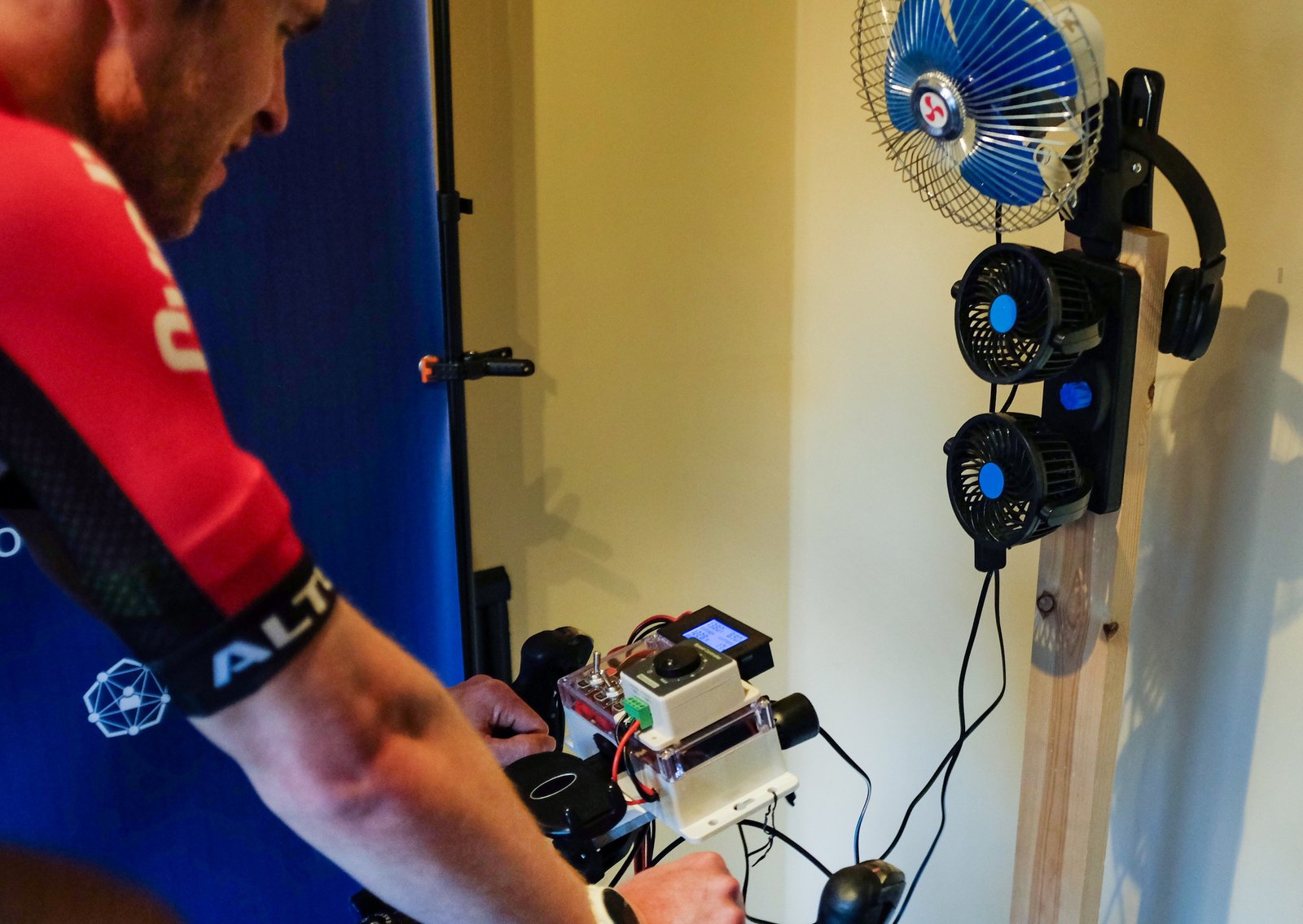

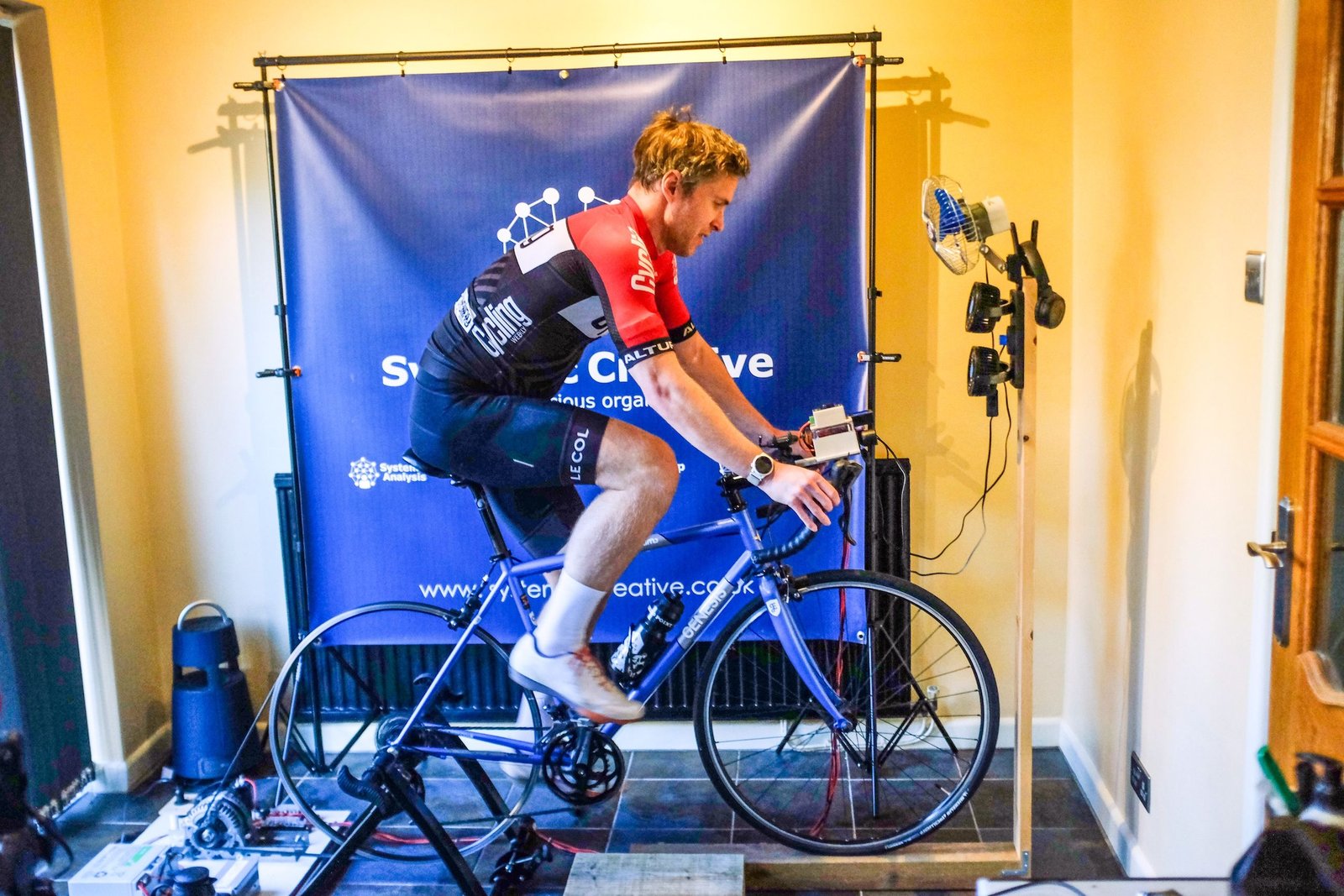
CW’s David Bradford has a go on Systemic Creative’s turbo trainer-cum-generator – with the aim of boiling a kettle
(Image credit: Anton Thompson-McCormick)
Some companies are already putting pedal power to work. London-based Electric Pedals builds human-powered energy systems for events, inviting the public to generate electricity for outdoor cinemas and lighting installations simply by cycling. A more permanent example is Revolt Cycling, billed as London’s first sustainable cycling studio, which opened in 2025. Founded by Celeste Blakey, the concept aims to combine fitness with environmental awareness- what she calls “wellness with consequences”. The studio’s bikes convert the mechanical energy from each pedal stroke into electricity, which is captured in an on-site storage system and used to power parts of the building in real time.
A perk for riders is seeing the watts they produce on the bikes’ Halo screens. “After a class, a QR code displayed on the screen links riders to a breakdown of their ride data, allowing them to see their contribution beyond just fitness performance,” says Blakey. “Many say it adds an extra layer of motivation; perhaps pushing harder feels more meaningful when you know you’re powering the space around you.”
The system is not intended to replace mains electricity entirely, but to reduce overall demand. As Blakey explains, “While the exact savings fluctuate based on class frequency and rider output, it has so far meaningfully lowered energy usage over time and protected the studio from rising energy costs.”
Revolt uses Re: Gen bikes from Energym, which convert pedalling energy into electricity and feed it into an on-site energy storage system. Will Flint, CEO of Energym, says, “The ride still feels like a premium studio bike – the difference is you’re generating something tangible with every watt you put down. The energy generated in class can be stored and fed back into the building, helping reduce overall consumption.”
The same technology can also work at home. Flint says, “The power is stored in a removable Ohm [portable storage] battery pack that locks onto the bike and can be taken off afterwards to charge devices.” According to Flint, a typical 30-minute ride can fully charge the Ohm battery, storing around 90 watt-hours- enough to recharge a smartphone roughly 10 times, or a laptop once or twice.
Shifting expectations
Looking ahead, if energy costs continue to squeeze households, could pedal-powered electricity become more common? Blakey does not anticipate widespread adoption any time soon, though attitudes are shifting. “There is a broader shift in consumer expectations,” she says. “Brands are becoming more conscious of their impact, and fitness is following suit, and I do think that [energy generation] will increasingly be something people expect to see embedded in exercise machines.”
Pedalling to produce electricity remains, for now, more novelty than solution. A single rider simply cannot generate enough wattage to significantly reduce household energy costs. Yet that may not be the point. In studios, gyms and public spaces, the appeal lies in making energy visible – turning effort into something tangible.
As Flint puts it: “Member expectations are shifting. Multiple industry reports show that sustainability increasingly influences brand perception and loyalty, particularly among younger, values-led consumers.” The same motivation may make energy generation an attractive add-on for the makers of smart trainers. “End-users want to see visible, authentic action rather than passive claims,” adds Flint. Recharging your phone from your Zwift session – well, why not?
HOME BREW: BOILING A KETTLE THE HARD WAY
Cycling Weekly’s David Bradford took a busman’s holiday to Burnley to try out a specially adapted turbo trainer built by a have-a-go innovator
The idea of using cycling power to run household appliances had intrigued me for years. Then, in 2025, I heard about a clever tinkerer up north who had built his own bike generator. A Christmas hiking trip to the Calder Valley provided the perfect opportunity – the inventor, Andrew Smalley, lived just up the road in Burnley.
We arrive on a freezing January morning. Smalley welcomes us in, apologising for the mess – he’s about to move home-but amid the boxes he has left the homemade generator set up in the kitchen.
“I was studying for an Open University physics degree and doing lots of riding on the turbo to help me concentrate,” he explains. “I thought, all this energy is going to waste- | should find a way to use it.”
His first attempt was (to him) very basic: an alternator and a single power output. The mark-two version I’ll be sampling today is far more sophisticated, allowing Smalley to adjust the electrical load and therefore the resistance.
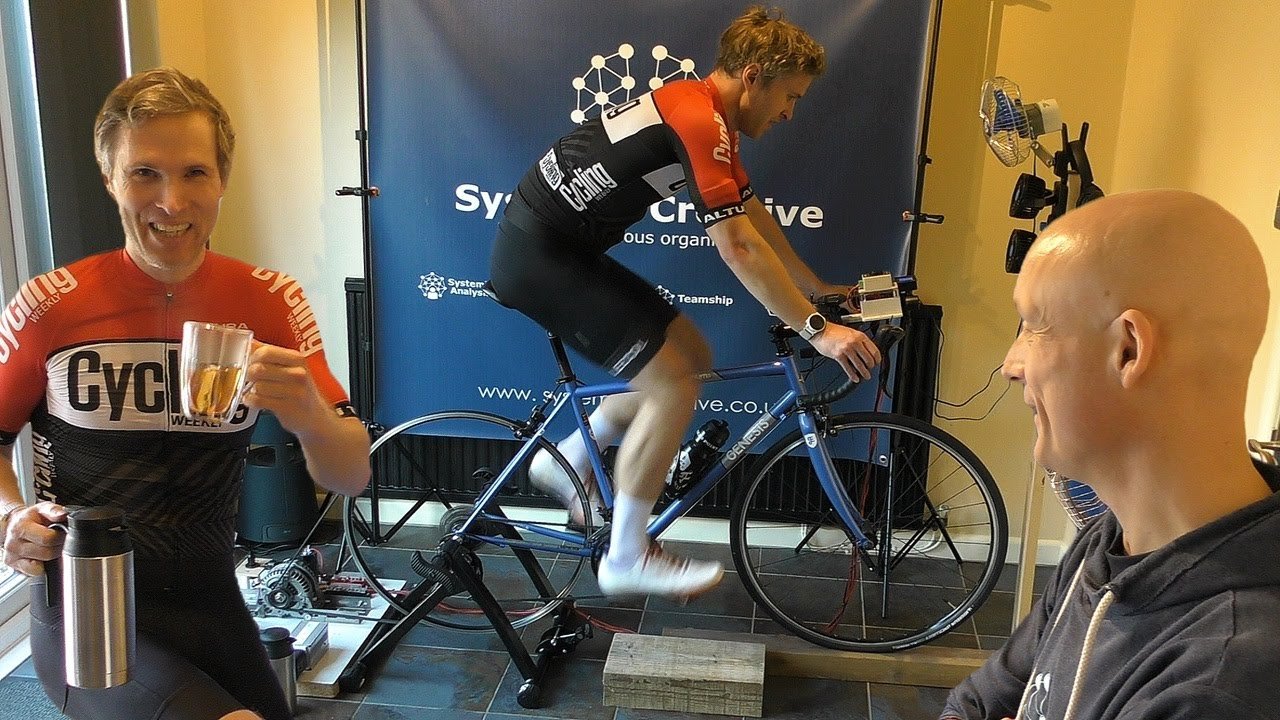
My task is simple enough: boil 250ml of water – enough for one cup of tea in a small insulated travel kettle using pedalling power alone. I clip in and start turning the pedals. Smalley instructs me to hold a steady cadence and warns that it will require a hefty effort. The kettle, he says, draws a constant 112 watts, but roughly half the energy my legs are producing is being lost through heat and system inefficiency. That means I need to sustain just over 250 watts.
As I settle into a rhythm, I have just enough breath left to ask why systems like this aren’t yet, at least -commercially available. “It depends what people want from a bike generator,” he says. “It’s easy to make a trainer that powers itself and its peripherals, fans and a screen. But for additional power generated, you’d need storage – probably an enormous battery. It’s not straightforward.”
Pedalling the ‘biogenerator’ feels smoother than I’d expected, almost like a normal trainer – but this is solid Zone 3 for me. After 15 minutes, though I’m beginning to steam, the kettle is showing no such weakness. A full eight minutes later, the resistance suddenly drops. My work is done: the kettle has boiled.
Smalley’s partner Rebecca hands me a mug and a teabag, and I pour the steaming water to brew the most satisfying, hard-earned cuppa I’ve ever tasted.
Watch the challenge on Systemic Creative’s YouTube channel:

Watch On
This feature was originally published in the 26 March 2026 print edition of Cycling Weekly magazine – available to buy on the newsstand every Thursday (UK only) while digital versions are available on Apple News and Readly. Subscriptions through Magazine’s Direct.
Read the full article here