




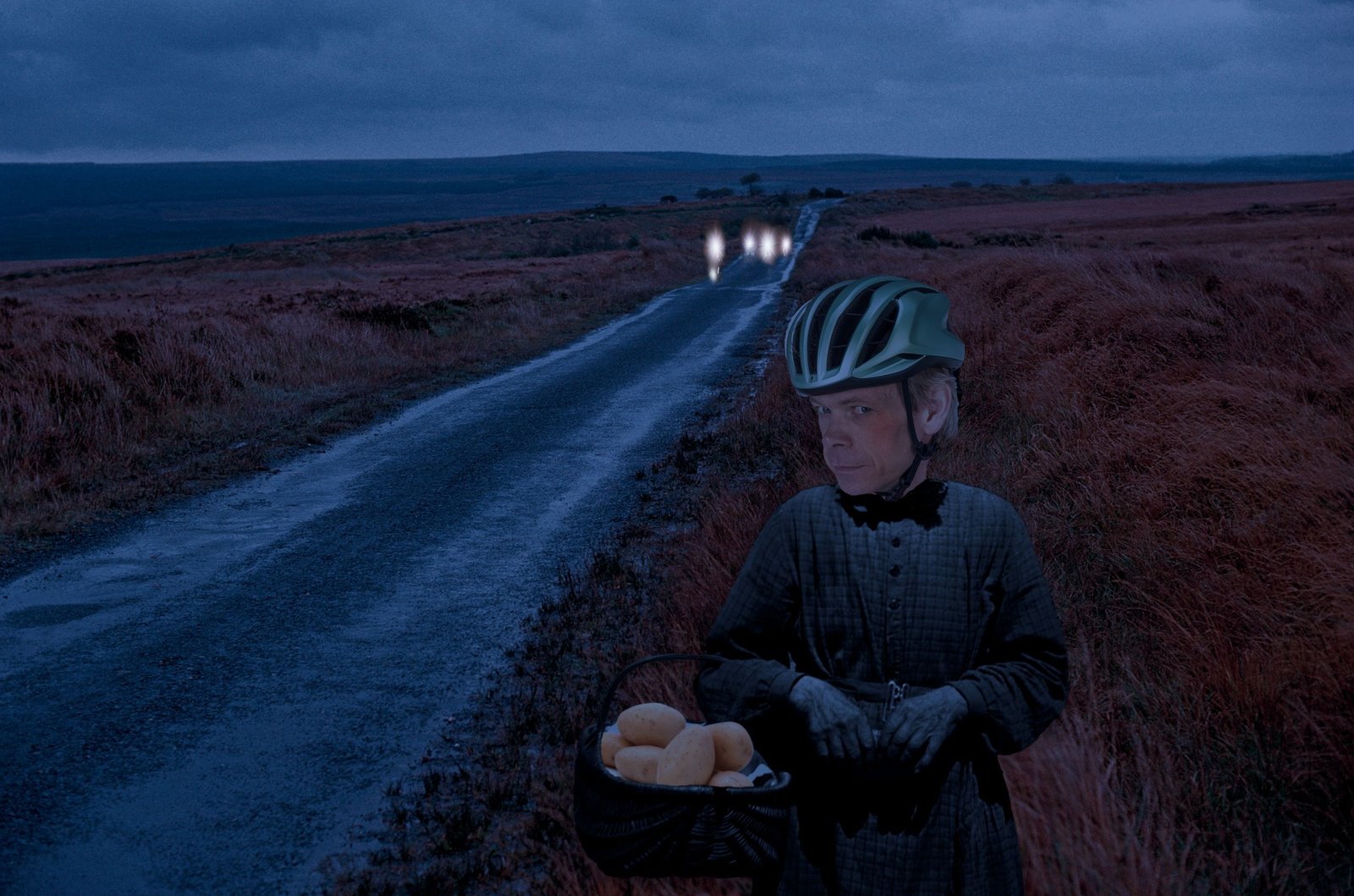
One of my favourite ancient anecdotes concerns a group of country women in County Galway on Ireland’s west coast in the 1870s. They were making their way home shortly after dusk on an evening with baskets of produce, when coming towards them they saw half-a-dozen glowing lights, hovering mysteriously above the bogland.
Multiple national champion on the bike and award-winning author Michael Hutchinson writes for CW every week
I sometimes wonder to myself what would be the best item of modern bike kit to take back in time if you wanted to cause maximum astonishment. I always end up deciding it’s bike lights. You could take your Garmin to 1975 and by the time you’d explained what it was most people would have fallen asleep out of boredom. But take a 2025 LED light of any significant spec back to any era before the 1990s and you would be universally acclaimed and feared as a god who was carrying the sun around in a small box.


Oil lamps from the 19th century like the Galway CC’s were almost useless – I bought one in an antique shop, and it produces a soft glow but no actual illumination of the road at all. Early 20th-century carbide lamps were brighter, but finickity and a little dangerous. (Incidentally, the misuse of carbide led my great uncle to blow up his shed during the Second World War, causing the great Ballymoney “The Germans are coming!” panic of 1941.)
The electric lights of the 1960-2000s were easy to use, but unless you got involved in huge batteries that sat in a bottle cage and were wired to the bars, they didn’t provide much more actual light than an old oil lamp.
Modern lights are different. They’ve changed the way many of us ride – I’m not alone in regularly doing training rides in the dark without a second thought, even in winter.
I have found one small limitation. Recently, for the first time, I persuaded my friend Bernard to come for a winter evening ride. I thought it was going to be lovely. In the dark, after rush hour, there’s less traffic, and the drivers that are out there seem to give you more space. I suppose an anonymous light gets more respect than a human being. (Not new, really. The Galway spuds only started flying when the riders themselves became visible.)
All was fine till I singled out behind him to let a car pass. There are things that benefit from floodlighting, but it turns out Bernard’s rear aspect is not one of them. At first I was blinded. Then, as my eyes adjusted, I realised that if you shine a bright enough light at Lycra that’s been worn beyond its reasonable life expectancy, it takes on a slight translucence. That was the point where I wished I was blind again.
But when I got the hang of adjusting the light output quickly, I found that group riding at night is perhaps even more pleasant than riding alone. Two lights are better than one, there’s a feeling of adventure about being out on an evening, and somehow the closeness of the darkness took our usual antagonistic competitiveness out of the ride.
If you haven’t tried it, I recommend it. Just think before you single out.
Read the full article here