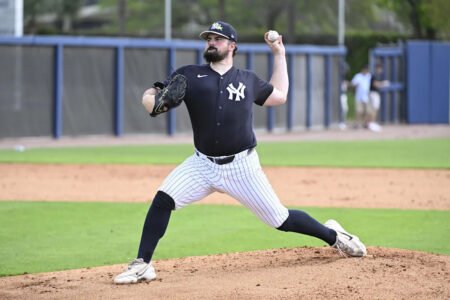






The Rays claimed Jesse Scholtens in August 2025 after he was designated for assignment by the White Sox. Despite a fairly significant overhaul of the roster this offseason, Scholtens was able to hang on to a coveted 40-man roster spot, and has performed well in his limited time with the major league club — maintaining a 3.77 ERA / 3.59 FIP in 31 IP since 2025.
With injuries impacting the pitching staff, Scholtens may now be leaned on this summer in a starting role, where he has the tools to be a solid backend rotation option.
Control and Command
All Scholtens has done with the Rays is throw strikes. His 65.4 strike rate since 2025 ranks in the 78th percentile in the majors (min 500 pitches thrown). He strikes all five pitches in his arsenal at least 50% of the time, and even gets a pair of his secondaries above 60% in his cut-slider and offspeed pitch. The data here suggests above-average control.
Scholtens isn’t just a thrower; he does a good job of commanding his pitches too. He pitches in the zone without catching the heart of the plate better than 73% of major leaguers since 2025. His location consistency data and heatmaps further support his above-average command.
Scholtens has a solid three-pitch mix that allows him to adequately vary his sequencing to each side of the plate:
-
Four-seam, cut-slider, offspeed for lefties
-
Two-seam, cut-slider, breaking ball for righties
His four-seamer is a fairly standard cut-ride shape with low 90s velocity. His cut-slider sits in the upper 80s and he has plus feel for throwing it to both righties and lefties – it also gets more break than others thrown with similar velocity and vertical movement. Scholtens also throws a two-seam fastball in the low 90s with a bit more ride than expected from his slot. His low 80s breaking ball gives him a third velocity band but doesn’t have any outlier movement. On pure shape, most of his pitches grade out as average or below, with the cut-slider standing out as his most reliable offering. His above-average extension and slightly lower release height help everything play up a tick.
The separator in Scholtens’s profile is an outlier offspeed pitch that flashes plus. It gets optimal VAA separation from his four-seamer thanks to his above average command of both pitches. VAA separation correlates strongly with chase, while velocity separation tends to drive in-zone whiff. The Rays helped him shave some vertical movement off his offspeed pitch this winter and the velocity separation is already better than average, so the performance of the pitch will be something to monitor in a larger sample.
Despite strong VAA and velocity separation, most models likely grade the pitch poorly due to its unconventional movement profile. Below is a graph of how his offspeed shape compares to others in a similar arm-angle bucket (from 30 to 45 degrees, Scholtens sits at roughly 38 degrees when throwing his offspeed pitch):
We can see that Scholtens gets below-average vertical and horizontal movement compared to offspeed pitches from a similar arm angle. In particular, his horizontal break sits roughly two standard deviations below average – making it a true outlier. Combine this with the VAA and velocity separation he gets on the pitch compared to his fastball, and he’s got a unique offspeed pitch.
His grip resembles a split-finger with a spiked middle finger – closer to a kick-change variation:




While we can’t publicly observe seam orientation (evident in the grainy images of his grips shared above), the shift in spin direction from more backspin in 2025 to more sidespin in 2026 suggests he’s altered the seam orientation of the pitch to shift it toward more horizontal break and less vertical movement.
Horizontal separation matters less for whiff and chase than vertical and velocity separation, so trading some of it off for better VAA and velocity difference is a logical adjustment.
Scholtens is still developing his feel for this relatively new offspeed shape, and that may be the reason behind its limited usage so far. However, there’s a case for increasing its usage to roughly 25–30% against lefties as he gets more comfortable with the pitch given the VAA and velocity separation mentioned earlier. The outlier shape also suggests it could be an effective taste-breaker against righties occasionally.
The arsenal is fairly average overall, but his strike-throwing ability and uniquely effective offspeed pitch give Scholtens a clear path to outperform that profile.
Conclusion
Although Scholtens doesn’t overwhelm hitters with raw stuff, he succeeds through control and command, sequencing, and a subtle pitch design advantage that helps his outlier offering play up. That’s a valuable profile to have on the 40-man — especially for a team that’s navigating multiple injuries to the starting rotation — and with Matz sidelined at least two starts, he should get a significant opportunity in the month of May to show if he can hold his own.
Read the full article here