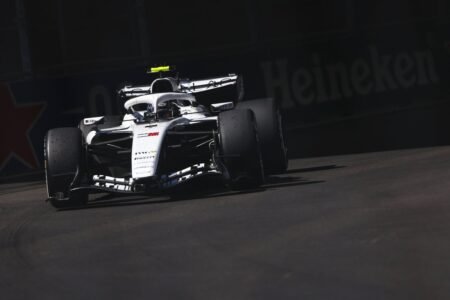





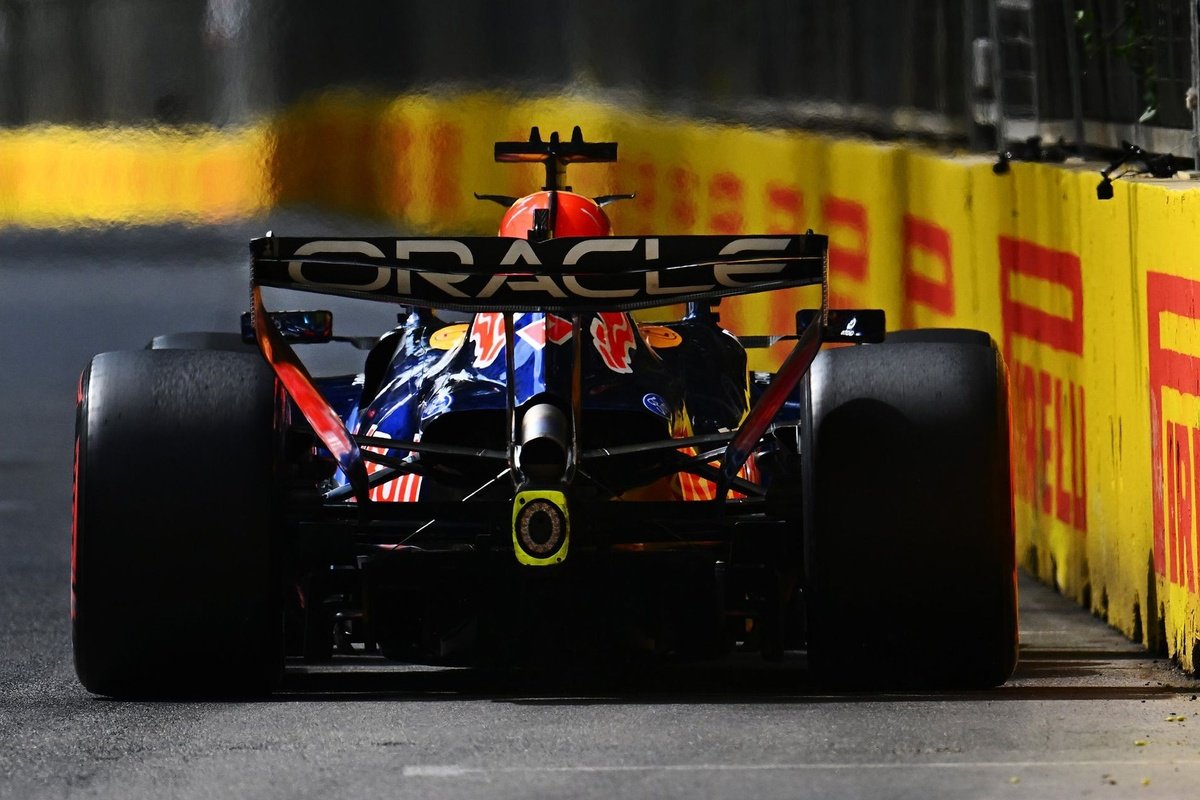
After setting the fastest time in final practice and feeling good about the upgrades, Verstappen hoped to pull off a surprise in Baku, but an engine problem threw a spanner in the works.
Initially, it appeared to be related to deployment issues and therefore problems on the electrical side of the power unit, but speaking to the (very small) group of Dutch media in the Baku paddock, Verstappen clarified what was actually going on.
“Throughout qualifying, already from Q1, I had a problem with the engine, which meant I was losing at least half a second compared to my team-mate. And it only got worse. In Q2 and Q3 it was a complete disaster, so I think we clearly have a problem with the engine.”
When asked by Autosport, Verstappen clarified that the problem was initially not about deployment – as it perhaps seemed – but rather the internal combustion engine.
“No, not on the electrical side. In Q1, we immediately saw a problem. Of course, at that point you still think, ‘What could it be? Is the engine too cold or actually too hot?’ All of that is possible, because it is all very sensitive nowadays. But later it became clear that we really did have a problem with the ICE. It only got worse and in Q3 that engine was no longer working properly at all.”
How the initial issue led to further setbacks
That problem with the combustion engine subsequently caused numerous other issues, leaving Verstappen going from one problem to another on Friday afternoon.
“The top speed just became less and less. On that second lap in Q3, my battery wasn’t charging either, but that was obviously because the combustion engine had a problem. That causes a lot of misfires and a lot of other problems, and it confuses the system completely.”
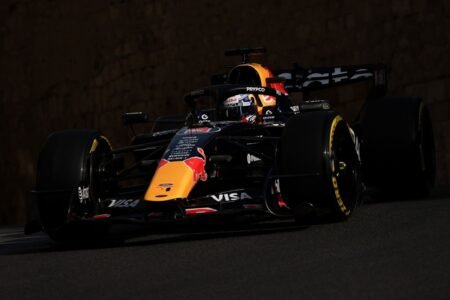
Max Verstappen, Red Bull Racing
Photo by: Guido De Bortoli / LAT Images via Getty Images
The latter was clearly visible in the onboard footage. Between Turns 15 and 16, Verstappen’s head suddenly jolted forward, whereas this would normally be a straightforward flat-out section.
“Yeah, because my battery switched off there”, the Dutchman explained. “Because you’re so slow on the straights, you obviously use more battery coming out of the corners to try to compensate for that. As a result, you go into super clipping in some places, and that clip is quite aggressive.
“The whole system was just confused. You spend longer on a straight because you’re going slowly and as a result you use more battery. That’s the same as what happens with Honda, you also see them clipping a lot more than everyone else because they have to spend longer at full throttle on the straights.”
Besides the engine problems themselves, this also disrupted the run plan. Verstappen had to abort his second flying lap – or what should have been a flying lap – which in turn had consequences for the remainder of the session.
“I had to abort that lap, but then you lose so much tyre temperature, which is actually very important around here. You could see everyone pushing all the time and continuing to weave”, Verstappen said, pointing out that almost everyone in Q3 completed just one long run – unlike in a normal Q3 session.
Only McLaren opted for a visit to the pitlane, but Verstappen continued: “You can see that it wasn’t really a success for them either, so we just kept going.
“But if you have to abort a lap, then you don’t have the right tyre temperature for the very last lap. And the engine is basically breaking down, and then there was a yellow flag on my final lap as well”, he said, referring to the moment involving Lando Norris. “So I had to leave at least two tenths on the table in that corner.”

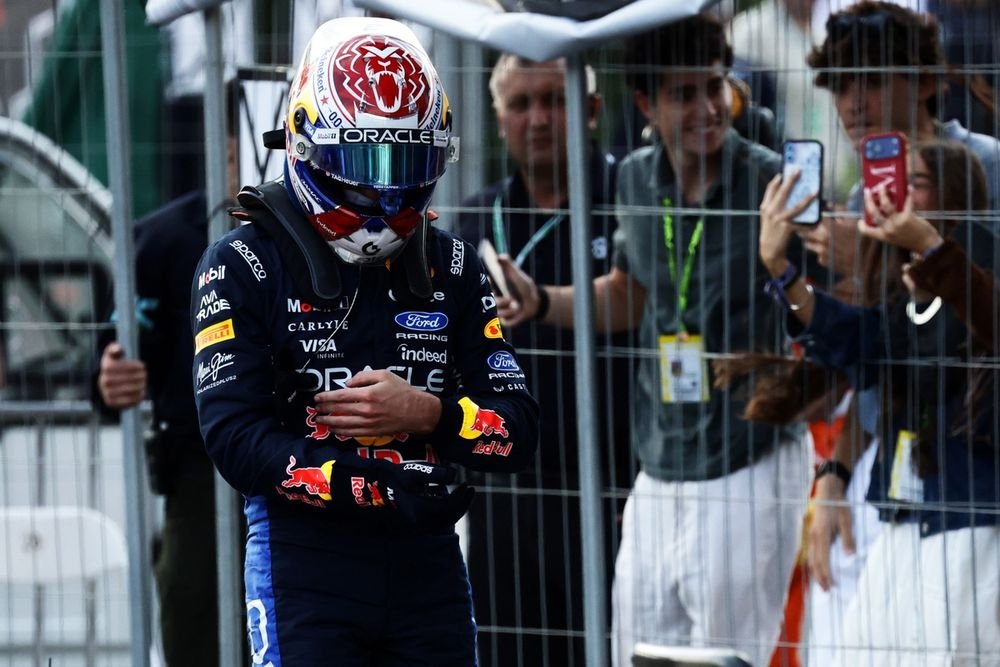
Max Verstappen, Red Bull Racing
Photo by: Mark Thompson / Getty Images
An engine change, but no grid penalty for Verstappen?
Red Bull is currently investigating the engine problem further, but Verstappen’s story makes it seem unlikely that he will start Saturday’s race with the same ICE. However, the four-time world champion immediately makes clear that such an engine change will not result in a grid penalty.
“Well, if there are still question marks, we have to replace the engine. But we still have another engine available in the pool.”
A grid penalty will follow later in the year, however, the Red Bull driver confirmed when asked by this website. “Yeah, there definitely has to be a penalty at some point.”
In theory, Baku appeared to be quite a good place to take one, as overtaking seems possible, but Verstappen puts that into perspective.
“The problem is that everyone completely drains the battery on the long straight. So you can’t really use the battery to overtake someone, because going from 100 to zero is the same for everyone.”
It means Verstappen retains his eighth starting position and will still be aiming for the podium on Saturday, although he believes he could otherwise have started from the front row.
“It’s obviously a real shame, because it had been going well this week. Maybe I wouldn’t have matched George’s time, but there’s such a big gap between P1 and P2, we definitely would have been somewhere in between.”
We want to hear from you!
Let us know what you would like to see from us in the future.
Take our survey
– The Autosport.com Team
Read the full article here