



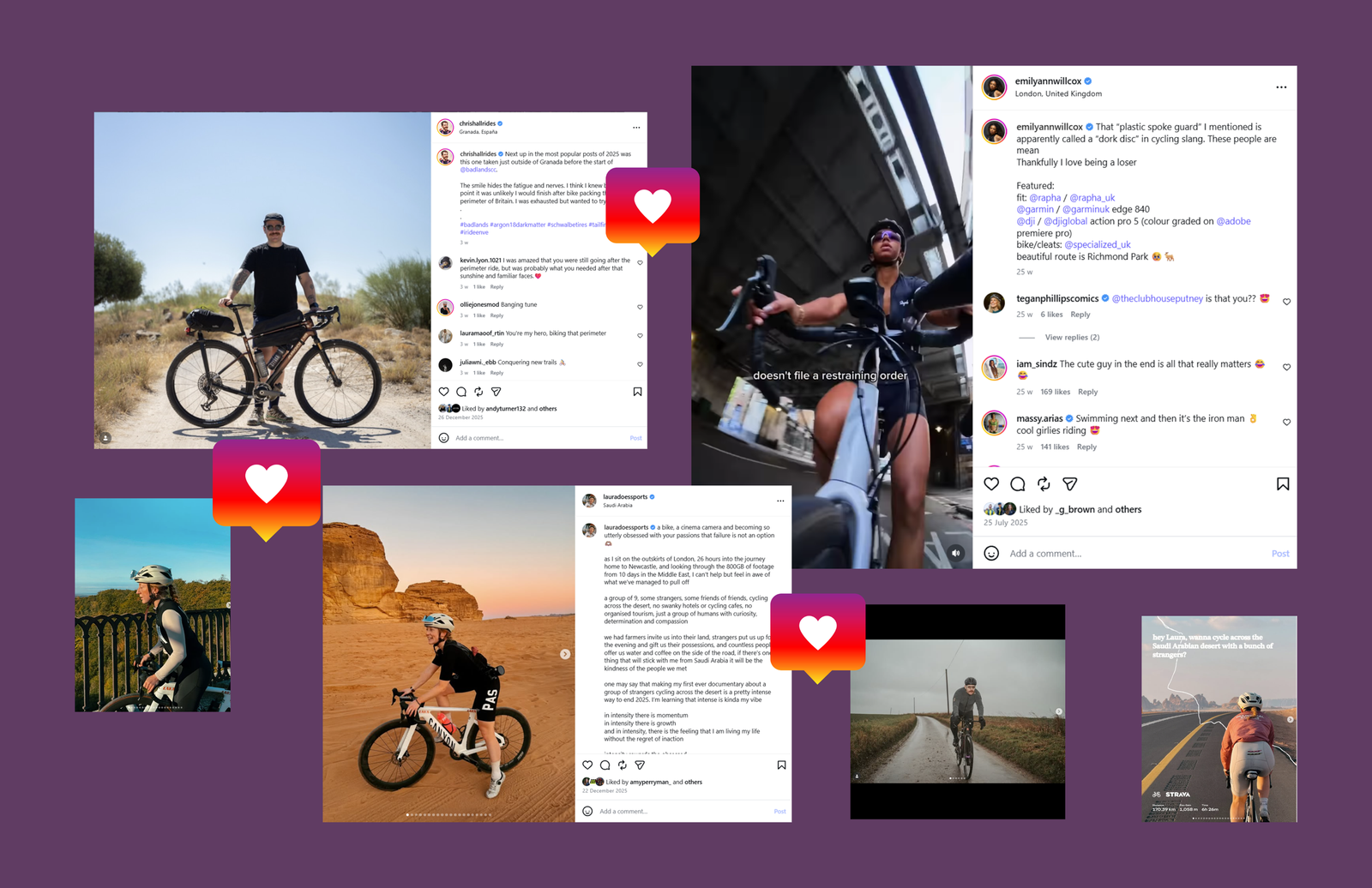
Two cyclists blur across the screen. In perfectly coordinated lycra, they effortlessly clock hundreds of miles without breaking a sweat, chatting into the camera with every 10 kilometres clocked on their high-speed route round Battersea Park, or on paid trips abroad.
I close my Instagram app after the fourth video of these flawless cyclists. It’s all got too much. Why can’t I devote my days to mountain climbs, to developing coordinated outfits with my friends before meeting them for mid-ride coffee breaks? Do we really “all have the same 24 hours,” as British influencer Molly Mae once claimed. Am I just not trying hard enough?
This video “blew up” her account, attracting an additional 4,000 followers to her growing count. I was one of those 4,000. We’ve all known the agony of the ending of a relationship, and that single-minded dedication to our personal betterment after it. I liked her, I liked that she was using cycling as a way to tell stories, and – crucially – I felt like I knew her.
Social media is, in this way, a game of mirrors. The algorithm provides a content maker somewhere in the world just at the right time for it to strike a chord. You feel close to this person, whose experience seems to mirror yours. But that’s where the closeness ends.
“At the beginning I found it actually really difficult to accept brand partnerships, because I felt really guilty about it,” Kirkpatrick told Cycling Weekly. “I didn’t want my page to become about selling to people. But then I got the right things and got into the rhythm of it, and I don’t feel bad about it anymore. As long as I’m telling a good story then I don’t mind.”
Kirkpatrick is now a full-time cycling influencer, with over 30,000 followers. But the very thing that made her followers feel close to her, is the thing that is hard to hold onto. With every new follower, Laura drew attention from more brands including Ford and Insta 360. Her life grew glitzy and I stayed exactly where we started, and the distance between us grew.
“When I was travelling a lot, I felt like I was so unrelatable – I was just popping about, living my life with these cool brand trips,” she explained. “I was like, people aren’t interested because I’m not relatable anymore. But then someone messaged me, and they were like, don’t be silly. Don’t be relatable. Be inspirational.”
“I feel like my role is just to be honest,” she continued. “And I think actually, trying to be relatable is very counterproductive, because then I’m trying to be someone that I’m not because I’m someone that has a lot of dreams, and I’m someone that wants to push boundaries. I want to go and do all these cool things. And if I try to reduce myself to not having those dreams for the sake of maybe relating to someone who can’t, then… I’m not myself anymore.”
Kirkpatrick continues to make engaging content. From riding with her friends in outfits sourced entirely from Vinted, to flashy kits supplied by sponsors, Kirkpatrick’s content has transitioned from relatable to inspirational.
But where does this leave ordinary people wanting to get into cycling? Kirkpatrick’s honest voiceovers might have hooked some potential new cyclists, but where do they go from here, if they lack the perfect lycra, the perfect bike. Are some put off by the idea that you have to look great and have the best stuff to get riding, or are they content to be continually “inspired”? It is hard to say.
Emily Willcox (@emilyannwillcox) doesn’t think this is the inevitable trajectory of the influencer. “One thing that I really consciously did, was make sure that I wasn’t posting anything that seemed that it wasn’t accessible,” she told Cycling Weekly. It’s also a lucrative strategy, and one she attributes to her staggering 644,000 follower count.
There is an art to balancing authenticity with rising success. In July, Willcox released a video that showed her at a bike fitting. The 25-year-old running and fitness influencer was trying out cycling for the first time, and was vocal about the struggles of being a female cyclist, and the associated additional costs. She enhances her everyday RP as she delivers tongue-in-cheek observations of life around her, dripping in innuendo.
“I think my thing with making cycling videos is that I didn’t want to make too many, because I feel like road cycling is really perceived as an elitist sport,” Willcox said.
“You’ve got really posh rich people going on about their £6,000 bikes. So I wanted to make a video about going and buying one, but fill it with jokes about all the extras that women have to buy, like, oh, now I’m going to get a female saddle. My crotch still aches as well, by the way.”
Willcox’s success online has increased her access to brand partnerships and the hard earned privilege of being able to make content full-time. She’s also attractive and athletic. Perfect unattainable influencer-fodder, although her narrations keep her feet firmly on the ground, and her commitment to making accessible content is seeing her platform grow.
“One of my main things when I started running is that I realised I didn’t want to do anything that looked remotely elitist. I didn’t want to be like, I’m running a sub three hour marathon or something. I think that it really alienates people. I think that’s one of the reasons why my audience grew quite quickly, because it was a very honest opinion about the reality of what these things are actually like. Instead of being like I wake up at 4am every day, and then I take my supplements, and then I do a five hour ride.”
While Emily cringes at the title of “influencer”, the impact social media content creators have on the people who consume their videos is huge. On average, British people spend one hour and 37 minutes on social media every day – I’ll admit that it’s often more for me and many of my friends. For mental health campaigner and cyclist, Chris Hall, influencers have the power to put people off the sport as much as they’re getting more riders into it.
“It doesn’t matter who you are, you put a better version of yourself on social media,” he told Cycling Weekly. “There’s always an element of editing.
“There’s a perception that you have to dress a certain way, you have to look a certain way, you have to ride a bike a certain way. One of the things I’m quite proud of is that I’m having a shit time, I’ll say I’m having a shit time.”
Hall’s honest account of life on and off two wheels has garnered a growing base of dedicated followers. After suffering from depression, Hall’s mental health counsellor suggested he talk about his experiences online. “What we found is that actually talking about it helps me, but also seeing that it helps other people helps me as well,” he said.
His first social media success came during a multi-day charity ride through Romania for The Pace Centre, a children’s charity for those living with motor disorders. Then came his perimeter of Britain ride last year to raise money for men’s mental health charity, Movember.
“My big goal has always been to encourage more people to buy bikes, to teach and educate people, especially in bike packing,” he said, though his career in content creation has undoubtedly opened doors for his own cycling career, too.
Hall explained that as brands are increasingly realising the potential of investing in cycling content creation, we’re only going to see more aspirational lives on two wheels playing out on our phones.
From a young age, Kirkpatrick wanted to become a YouTuber. Hall fell into influencing after doing a charity ride, and Willcox continues to take a sideways glance at the industry as she edges evermore into it.
All three influencers are – as all have reminded me – real people behind their beautifully shot Instagram posts. Whether they like it or not, their content could be the reason someone feels inspired to get on a bike or feel like they don’t have the right kit, or the right bike or the right “look” to even start. They are, all the time, “influencing”.
And influencing comes with responsibility. Recently, I watched a troupe of fitness-cum-cycling influencers take press trips to Dubai, showcasing the country’s stunning mountain vistas, with no acknowledgement of human rights concerns in the United Arab Emirates. Sports-washing extends into the sphere of social media, as much as it exists in the peloton. If it’s ok for Tadej Pogačar, it’s ok for a handful of London’s most influential fitness content creators, right?
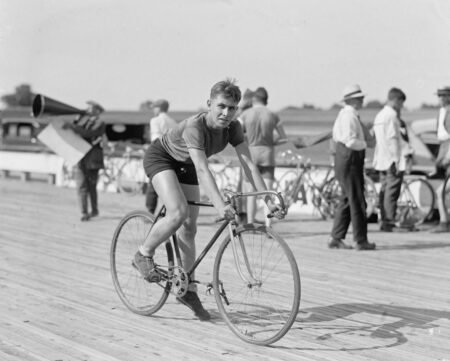
But the truth is, that cycling influencers have always existed, and perhaps they always will. The first were upper class Victorian men and women who would take laps on their bikes around Battersea Park. Over 100 years later, and Battersea still provides the backdrop for own crop of cycling influencers, selling the dream of an outdoors life, just via our phone screens instead.
Read the full article here