




The Western Conference’s third-seeded Denver Nuggets will take on the sixth-seeded Minnesota Timberwolves in the first round of the 2026 NBA playoffs. It’s the third time these teams have squared off in the last four postseasons — the kind of contempt-breeding familiarity that plans the seeds of one of those … what’s the word?
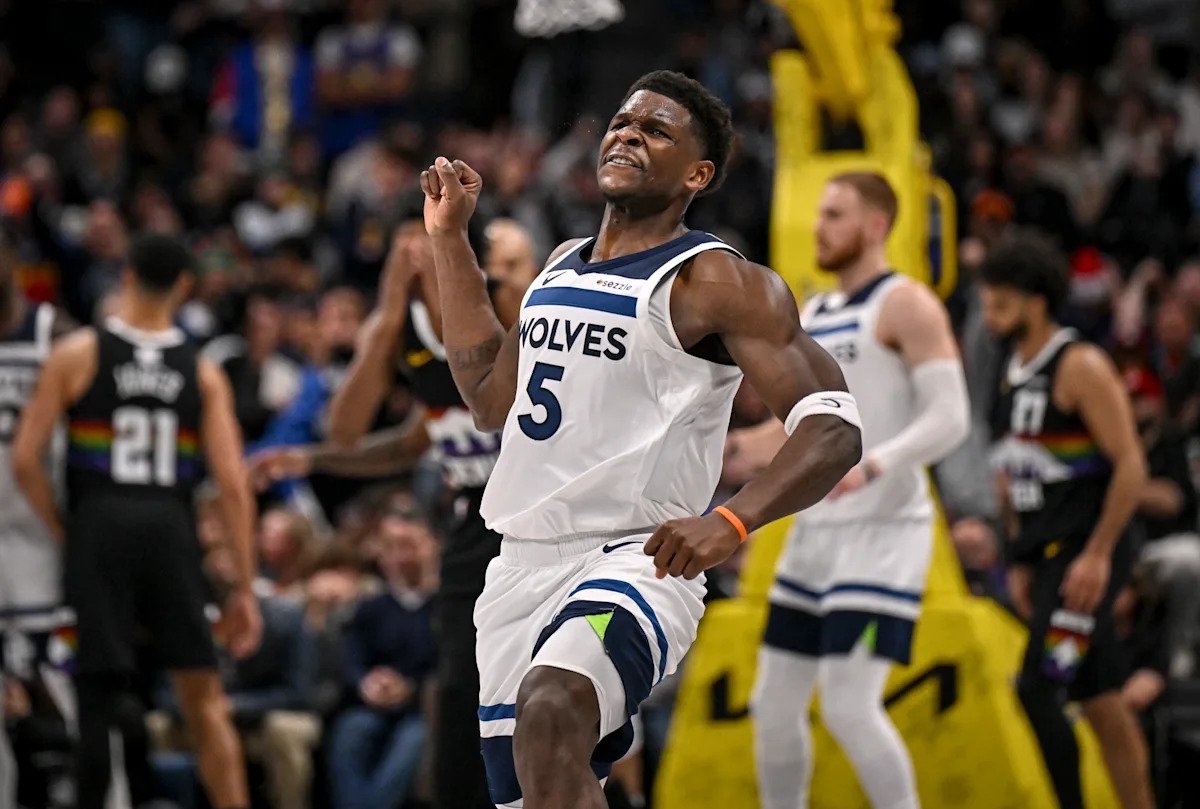
Right: “rivalry.” Thanks, Ant.
The two franchises last faced off in the postseason in the 2024 conference semifinals — an epic series that saw the Wolves stun the hoops-watching world by winning the first two games on the road, the Nuggets respond in kind with three straight wins, Minnesota get level with a whopping 45-point win in Game 6, Denver take a 20-point lead in the second half of Game 7 … and the Wolves outscore the defending NBA champs 60-32 over the final 22 minutes to win a seven-game classic.
Ten of the 16 players who saw the floor in that Game 7 are still around for this series. Let’s all cross our fingers and hope that they’ll give us a fitting encore.
What we know about the Nuggets
They once again have the best offense in the NBA, due in large part to continuing to employ this friggin’ guy:
Nikola Jokić continued to etch his name in the history books this season, joining former teammate Russell Westbrook as the only players to average a triple-double in multiple seasons and becoming the first player in NBA history to lead the league in rebounds and assists in the same season. No player in the NBA creates more points per game for his team, according to Databallr’s tracking; with Jokić on the floor, the Nuggets scored more than 126 points per 100 possessions — a historically elite level of offensive production.
When Jokić and Jamal Murray, an All-NBA candidate after the best regular season of his career, were both in the lineup, the Nuggets torched opponents by 12.1 points per 100 possessions. When they lined up alongside perfect-fit power forward Aaron Gordon, the Nuggets won 77% of their games — a 63-win pace.
The problem: That only happened 26 times this season, as Gordon missed more than half the campaign with persistent hamstring issues, and Jokić missed a prolonged stretch for the first time in his career after hyperextending his left knee. They weren’t the only Nuggets to spend a significant chunk of the season in street clothes, either; wings Christian Braun, Cameron Johnson and Peyton Watson missed a combined 94 games, too.
While spending the year playing Whac-a-Mole with his injury report, head coach David Adelman struggled to find lineups consistently able to get stops. The Nuggets fell from fifth in defensive efficiency through the first month of the season all the way down to 21st by season’s end — the same spot they finished last season, and tied for the worst finish since Jokić’s first season as a full-time starter.
The Denver defense trended up a bit late, flirting with a league-average mark over the final 20 or so games of the season — a stretch that dovetailed with the return of Gordon — while continuing to get buckets at league-best levels. The result: a season-ending 12-game winning streak that, combined with the Lakers stumbling amid late-season injuries to Luka Dončić and Austin Reaves, helped propel Denver into the No. 3 seed.
The good news: That puts the Nuggets on the other side of the Western bracket from the defending champion Thunder, who eliminated them in Round 2 last spring. The bad news: It puts them in line for a second-round showdown with Victor Wembanyama and the Spurs … if, that is, they can get past their old friends from the Twin Cities.
What we know about the Timberwolves
The fundamentals of what’s gotten Minnesota to consecutive Western Conference finals remain largely intact, save for the loss in free agency of Nickeil Alexander-Walker … who, we’ll grant, it’d be real nice to have right about now. (Though his ostensible replacement, trade-deadline addition Ayo Dosunmu, has been pretty excellent since arriving in February.)
The Wolves feature a top-tier defense, with four-time Defensive Player of the Year Rudy Gobert on the back line and All-Defensive wing Jaden McDaniels at the point of attack. They’ve got a high-end big-man rotation (Gobert, three-time All-Star Julius Randle, Sixth Man of the Year Naz Reid) and two-way perimeter players (McDaniels, Dosunmu, Anthony Edwards, Donte DiVincenzo) that head coach Chris Finch can trust in tough matchups. And they’ve got a good-enough offense that can look great on the right night, with Edwards lighting the fireworks.
For the sixth straight season since the Wolves drafted him first overall, Edwards increased both his year-over-year scoring volume and efficiency, finishing third in the NBA in scoring behind only Dončić and Shai Gilgeous-Alexander, and becoming one of just 10 guards ever to average at least 28 points per game on a true shooting percentage (which factors in 2-point, 3-point and free-throw accuracy) higher than 60%. In Edwards’ minutes, the Wolves scored like a near-top-five unit; it was an individual campaign fit for MVP and All-NBA consideration … or, it would have been, had right knee inflammation not sidelined Edwards for 11 of the Wolves’ final 14 games, putting him at 61 for the season and rendering him ineligible for year-end awards.
But while the key components of what’s been one of the West’s best teams remained the same, the Wolves didn’t always look like one of the league’s elite.
They dipped from eighth in offensive efficiency last season to 14th. They stayed sixth in defensive efficiency, but gave up about an additional point and a half per 100 possessions. They fouled more and their defensive rebounding slipped. They took fewer 3s and gave up more looks at the rim. They went 23-25 against opponents above .500, the worst mark of any of the West’s top-six teams, and finished the season playing .500 ball with a bottom-10 point differential over the final 20 games (though injuries to Edwards and McDaniels played a role in that).
Close observers have noted that the Wolves often looked complacent or bored this season: like a collective that was just waiting for the real games to start.
“Yeah, it felt like that at times — like we was just trying to get through the season to try to get to the playoffs,” Edwards said this week. “But we here now, and all the other excuses are out the window. So it’s time.”
All they’ve got to do now is find the proverbial switch and flip it against a three-time MVP. No pressure.
Head-to-head
Denver won the season series, 3-1. The Nuggets kicked things off with a 127-114 victory in the opening week of the season, behind the first of Murray’s five 40-point games of the campaign. They notched another double-digit victory less than three weeks later behind a balanced effort, with four starters scoring at least 20 points, led by a 27-12-11 triple-double from Jokić.
In one of the games of the year, Denver won a Christmas night classic that saw:
-
The Wolves erase a 14-point fourth-quarter deficit;
-
Edwards drill a tough game-tying triple with 1.1 seconds remaining in regulation to send the game to overtime;
-
Minnesota start OT on fire, taking a nine-point lead with 2:58 to go in the extra session;
-
Edwards get two technical fouls, and an automatic ejection, with 20.5 seconds after arguing with the officials over what he felt were some questionable calls in Denver’s favor down the stretch; and
-
The Nuggets finish off a 142-138 barnburner.
The Wolves got their lick back in March, scoring a 117-108 win behind 20-point outings from Edwards and McDaniels, five 3s from DiVincenzo, and an 18-point burst off the bench from Bones Hyland — a former Denver draft pick who wound up outside the Nuggets’ rotation looking in, spent a couple of years on the fringes with the Clippers, and earned his way into the mix in Minnesota as a spark plug initiator in the second unit.
The standard “your mileage may vary” availability caveats apply. Edwards missed the first meeting, and while the Wolves were mostly healthy in the other three, only the final one — the March win — came after the trade for Dosunmu, who’s now a critical piece of their rotation. The Nuggets, meanwhile, were without at least one of their primary perimeter pieces — Gordon, Braun, Johnson, Watson and two-way rookie Spencer Jones — in three of the final four contests.
The one thing that’s been pretty consistent, though? The Nuggets have, per usual, won Jokić’s minutes handily, outscoring Minnesota by more than 10 points per 100 possessions across the four games. Considering Jokić has averaged 39.9 minutes per game over the last three postseasons, the Wolves need to find some way of narrowing that gap if they want to avoid their role in these playoffs being reduced to a mere cameo.
Matchup to watch
The Wolves’ attempts to slow down Jokić
Minnesota essentially developed the closest thing to a blueprint to dealing with Jokić in the 2023 playoffs, stationing jumbo power forward Karl-Anthony Towns on Jokić with Gobert cross-matched onto Gordon to lurk as a perpetual second line of defense. It didn’t pay major dividends in that series, which Denver finished off in five games en route to the NBA championship; it did give the Wolves a fighting chance the following postseason, though, helping limit Jokić to just 45% shooting — 17% from 3-point range — with 17 turnovers against 26 assists in Minnesota’s four wins in that second-round slugfest.
With Towns now in New York, though, the initial assignment goes to Randle — several inches shorter, with a shorter wingspan — and the overall experience hasn’t gone so hot. Jokić averaged 35.8 points per game against the Wolves this season, shooting a combined 24-for-34 (70.5%) from the field against starter Randle and reserve Reid, with a 19-to-9 assist-to-turnover ratio and five shooting fouls drawn, according to NBA.com’s matchup data.
Which is to say: It’s a matchup that leaves the Wolves looking for a little help.
“Probably gotta call God and talk to him for a little bit,” Randle said Wednesday. “Ask him for a few favors.”
While awaiting divine intervention, Minnesota will have to make do with more terrestrial reinforcements. Back in March, Finch primarily played it straight, having Gobert take primary responsibility for Jokić — a matchup with which Jokić has been very (sometimes comedically) comfortable over the years, but in which the Wolves were able to keep Jokić in check just enough to come away with their lone win of the season over Denver.
“I’m comfortable doing whatever the team needs me to do,” Gobert told reporters this week. “And when I’m off him, I’m still on him. It’s really about trying to slow him down as much as we can, but we try to stop the Denver Nuggets as a team. They’re a very smart team. They make a lot of adjustments, and so we have to be able to make adjustments, too.”
Finch has turned over just about every rock he can in search of those adjustments, at one point or another. McDaniels and Edwards have picked up Jokić late in games, when the Wolves want to be able to switch the Jokić-Murray two-man action. Reserve forward Kyle Anderson, now back in Minnesota after a trade from Utah and a buyout in Memphis, pulled shifts on him in the 2023 and 2024 playoffs. Against a Nuggets team that has more shooting than previous iterations — Murray, Johnson, Watson and Tim Hardaway Jr. all shot better than 40% from deep this season, and Gordon has evolved into a consistent knockdown shooter you can’t just comfortably sag off of in the cross-match — Finch may well have to turn over more rocks over the next couple of weeks for the Wolves to have any hopes of slowing perhaps the sport’s toughest cover.
“You know, you can get cute, you can do a lot of different things,” Finch told reporters. “But at the end of the day, it comes down to your ability to be physical and fight [Jokić], and do it every time down, because you’re not going to win all of them.”
If the Wolves can’t win enough of them, though, this series could have a very different ending than the one they won in 2024.
Key question
Who’s going to be healthiest on the wings?
Edwards missed most of the final month of the season with patellofemoral pain syndrome in his right knee, and McDaniels missed two weeks with tendinopathy and a bone bruise in his left knee. They’ve both returned, and both looked more or less like themselves in their most recent action, with Edwards scoring 22 points in 27 minutes in a win over the Rockets, while McDaniels added 16 points, 7 rebounds and 4 blocked shots. Persistent knee injuries can be tricky, though — and the prospect of both Minnesota’s No. 1 offensive option and its top option to defend Murray at the point of attack moving on wobbly wheels is enough to give observers some pause.
For Denver, an awful lot rests on Gordon’s legs. A left hamstring strain compromised him for the conclusion of Denver’s second-round loss to Oklahoma City last spring; right hamstring strains cost him more than half of this season. He’s been back in the fold since early March, averaging 13.5 points, 5.2 rebounds and 2.9 assists in 27.8 minutes per game down the stretch as he ramps up.
The best version of the Nuggets features Gordon bodying up the likes of Randle and Reid, stretching the floor for Jokić, fighting for deep seals in the post against smaller defenders on switches and cross-matches, attacking the offensive glass against a Minnesota team that ranked just 19th in defensive rebounding rate, and generally looking like the picture-perfect missing piece that helped deliver Denver the 2023 NBA title. When he’s running on all cylinders, the Nuggets can beat anybody. When he’s not — and especially with Watson and Jones, Denver’s two other top big-wing defenders, also working their way back from injuries — they can get got.
Prediction: Nuggets in six
I can buy that this Wolves team — with Edwards and McDaniels back, with all its principals rested, with its surfeit of experience with and confidence in this specific matchup — can reach another level under the bright lights of the postseason. I just have an easier time buying that the same’s true of a version of the Nuggets that has Jokić and Murray playing as well as they ever have (which is saying something) and has Gordon healthy and back in the mix.
Series odds
(Via BetMGM)
Denver Nuggets (-350)
Minnesota Timberwolves (+275)
Series schedule (all times Eastern)
Game 1: Sat., April 18, at Denver (3:30 p.m., Prime Video)
Game 2: Mon., April 20, at Denver (10:30 p.m., NBC/Peacock)
Game 3: Thu., April 23, at Minnesota (9:30 p.m., Prime Video)
Game 4: Sat., April 25, at Minnesota (8:30 p.m., ABC)
*Game 5: Mon., April 27, at Denver (TBD)
*Game 6: Thu., April 30, at Minnesota (TBD)
*Game 7: Sat., May 2, at Denver (TBD)
*if necessary
More series previews
East: Hawks-Knicks • Raptors-Cavaliers
West: Wolves-Nuggets • Rockets-Lakers
Read the full article here