





CORTINA D’AMPEZZO, Italy (AP) — Controversy is swirling in curling at the Winter Olympics and it’s all centering on whether the mighty Canadian team is cheating.
Both men’s and women’s teams have now been accused of the same infraction: double-touching the curling stone after it is released.
It comes as the historic curling powerhouse finds its ego bruised. Its mixed doubles team didn’t even play for a medal, and its women’s team cannot afford to lose more matches if they hope to advance.
Here’s a look at the whole controversy and why it has exploded:
What happened at the curling center in Cortina
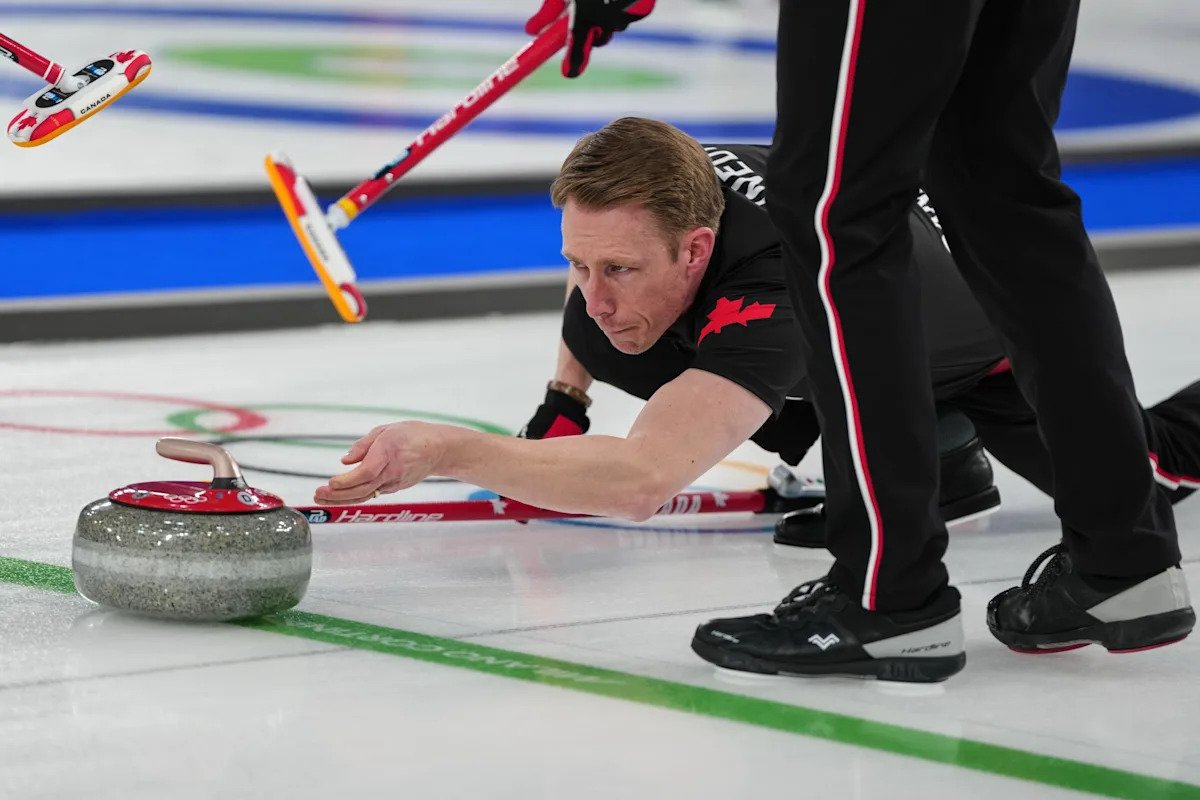
On Friday, Swedish curler Oskar Eriksson accused Canadian curler Marc Kennedy of breaking the rules by touching the rock again after initially releasing it down the sheet of ice. Kennedy blew up, launching an expletive-laden outburst.
That was before video appearing to show a clear double-touch by Kennedy circulated on social media, taken by Swedish public broadcaster SVT. Still, he maintained his innocence. The Canadians won the match, 8-6.
Late Saturday, an umpire accused acclaimed Canadian skip Rachel Homan of the same infraction in Canada’s match against Switzerland. The umpire stopped play and the stone was removed from play. Homan looked shocked and denied the allegation.
Again, video spread on social media appearing to show her double-touch. The Canadians lost to the Swiss, 8-7.
There are rules against double-touching
After the uproar, World Curling clarified that double-tapping is not allowed, issuing a statement: “During forward motion, touching the granite of the stone is not allowed. This will result in the stone being removed from play.”
Here is what the Canadians say
Asked about the footage, Kennedy said: “If somebody said to you, ‘Hey, do you double-touch all the time?’ I honestly, in that split second of a moment, I couldn’t even tell you if I do or not.”
He then suggested the whole thing might have been “premeditated planning to try to catch us.”
“They’ve come up with a plan to catch teams in the act,” Kennedy said.
Homan, meanwhile, postulated that she was being unfairly targeted because of the controversy on the men’s side.
“I don’t understand the call. I’ll never understand it. We’ve never done that,” she said. “It has nothing to do with us.”
Why this is such a big story
As fierce as the competition can be, curling has a quiet camaraderie to it even though there have been scandals (see: Broomgate, a sweeping-related headache that World Curling believes it solved last June). So it sticks out when there are allegations of cheating.
Canada is also the top nation in curling, easily its biggest market and where the biggest non-Olympic competitions tend to take place. They are taking it personally that their integrity is coming under attack in front of a global audience at the Olympics, which touts the values of respect and friendship.
The athletes playing for Canada and Sweden used to be close off the ice – huge rivals, sure, but admiring of each other’s curling skills. Now there’s clear animosity between the teams, which is intriguing for the casual viewer but a sad blow to the curling community.
What is next
Canada’s curlers are where they don’t want to be in the middle of a Winter Olympics: on the back foot, not just questioning their technique – “We’ll make some adjustments, release-wise, if we have to,” Kennedy said – but also srambling to be in the mix for medals at the end of the week.
Kennedy had the worst shot success of Canada’s four players in its only game Saturday, according to tournament statistics. Canada lost 9-5 to Switzerland, a team it was expected to beat.
All eyes are on both teams now. The Canadian men would not face Sweden again before the semifinals, should both teams make it, and that would be must-see TV whether you’re a curling fan or not.
___
AP Olympics: https://apnews.com/hub/milan-cortina-2026-winter-olympics
Read the full article here