



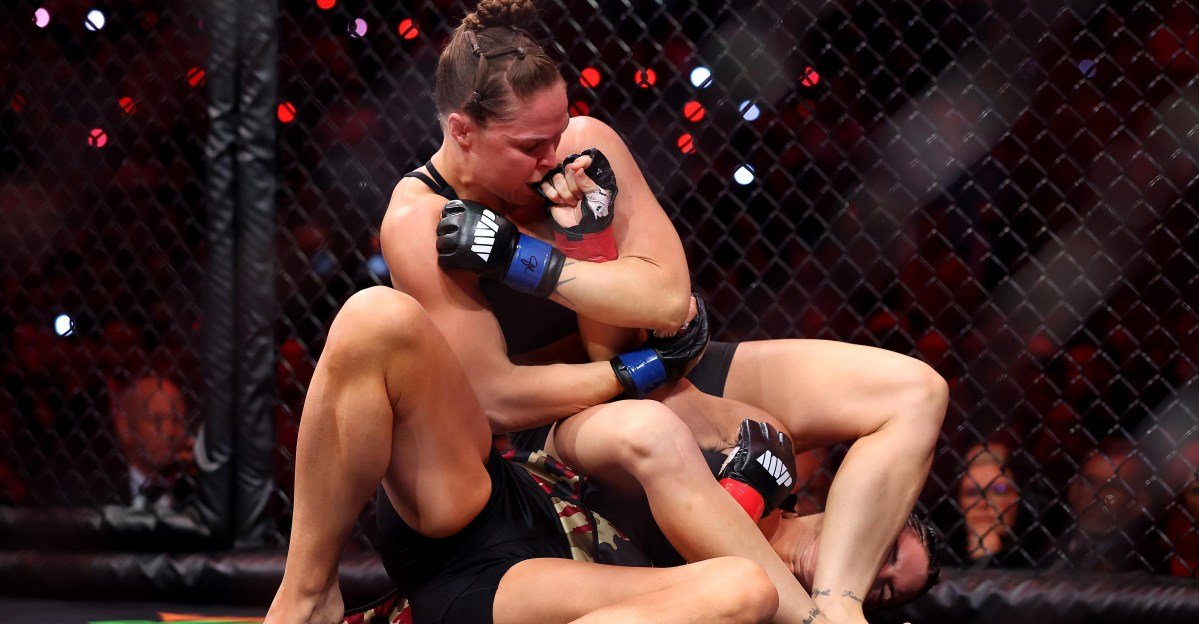
Dana White and Hunter Campbell had a good idea that Ronda Rousey was going to dispatch Gina Carano rather quickly and that ultimately played a part in deciding not to promote the fight, which eventually ended up under Jake Paul’s Most Valuable Promotions with the event airing live on Netflix this past Saturday night.
In her first fight back in a decade, Rousey scored an early takedown and snatched her signature armbar submission to finish Carano in just 17 seconds. Of course, Rousey was a massive favorite heading into the fight and the result wasn’t totally unexpected, especially after the Olympic bronze medalist in judo became a superstar dismantling her opposition in similar fashion after arriving in the UFC.
In the leadup to the event, Rousey routinely bashed Campbell, who is the UFC’s chief business officer, and it turns out her anger might have stemmed from his opinion on the fight against Carano.
“We’re in the true MMA business in a meaningful, consistent basis,” TKO Group Holdings president and chief operating officer Mark Shapiro during the J.P. Morgan Global Technology, Media and Communications Conference on Monday. “When we looked at this potential matchup, keep in mind there’s a real art and skill to matchmaking. When you ask Hunter Campbell and Dana White what they think about that matchup prior to the fight happening, the answers we got back — and I mean Ari Emanuel and myself — was that fight will be over in 20 seconds. They were off by a few seconds.”
Shapiro argued that kind of mismatch and quick ending for a fight that wasn’t ultimately going to build towards anything else with Rousey openly stating she was only returning to face Carano and then retiring again just wasn’t made for the UFC.
“I don’t believe that a fight like that, just the way that it played out, is really good for MMA,” Shapiro said. “Especially because it’s Netflix, and they have such an incredible global audience and it’s a massive audience, a highly engaged audience that is going to sample — depending on what comes up on the front page with Netflix — for them to then go to that fight and think that’s what MMA is, I don’t believe is good for the sport longterm. We saw it that way and decided to pass on it.”
While Rousey maintained that she would never say a bad word about White or the UFC’s former owners, Lorenzo and Frank Fertitta, a huge part of every interview and press conference leading up to the event was spent with her bashing TKO Group Holdings and how the UFC is running these days.
For his part, Shapiro said the company still has the utmost respect for Rousey and her long list of accomplishments but they just had no interest in promoting the Carano fight.
“Taking nothing away from the legend obviously that Ronda Rousey is and the win that she got,” Shapiro said. “I guarantee incredible viewership numbers that Netflix will soon report. But for us, it was more of a stunt than a meaningful MMA event.”
Of course, Shapiro understood why the event appealed to Netflix because the executives behind the largest streaming platform have repeatedly stated that the company is only interested in big marquee events when it comes to sports programming.
Netflix co-CEO Ted Sarandos has stated that the streamer doesn’t want to invest in a full season package for any major professional sport but landing special events like the deal with the NFL to air games on Christmas make perfect sense.
That’s why Netflix was previously pursuing part of the UFC’s broadcast rights package but the network was only interested in the numbered events (pay-per-views) rather than the multitude of Fight Night cards that decorate the calendar.
“It was pitched to us beforehand and we did turn it down,” Shapiro said about Rousey vs. Carano. “That’s to take nothing away from Netflix. First of all, they’re a great partner and clearly they know what they’re doing. Across the board in every genre right now. You don’t get to 300 million or 350 million [subscribers] for nothing. Their content offering is unique and really distinct and really has something for everyone.
“They’re in the big event business. They’ve been very clear about that. They’re not looking necessarily to buy out leagues. That’s why they did the Major League Baseball opener. That’s why they’ll do the Homerun Derby. That’s why they just did a five game package with the NFL. They want big, spectacle events and they saw this as a big spectacle event.”
Read the full article here