




“Hang on, things might get a bit noisy in a minute,” Nathan* told me over a phone call. He was training on Zwift in his apartment in Kyiv (Ukraine). He had just received an alert via Telegram, the platform used to provide real-time war updates, air-raid alerts and official government broadcasts.
Right on cue, the air raid sirens started.
“These happen so often that people tend to ignore it during the day, or they’ve got a good idea of what’s going on [due to the Telegram texts] and make a conscious choice not to respond to it,” he tells me, once again starting to spin up the power on his Wahoo Kickr turbo trainer.
Latest Videos FromCycling Weekly
Russia’s full-scale invasion of Ukraine began in February 2022. Reports list the death toll as close to 500,000 Russian soldiers, 55,000 Ukrainian soldiers and over 16,000 Ukrainian civilians. But, life goes on. And training continues for cyclists like Nathan – who moved to Ukraine in early July this year, and did not want to share his real name – not only inside, but out on the open road, too.
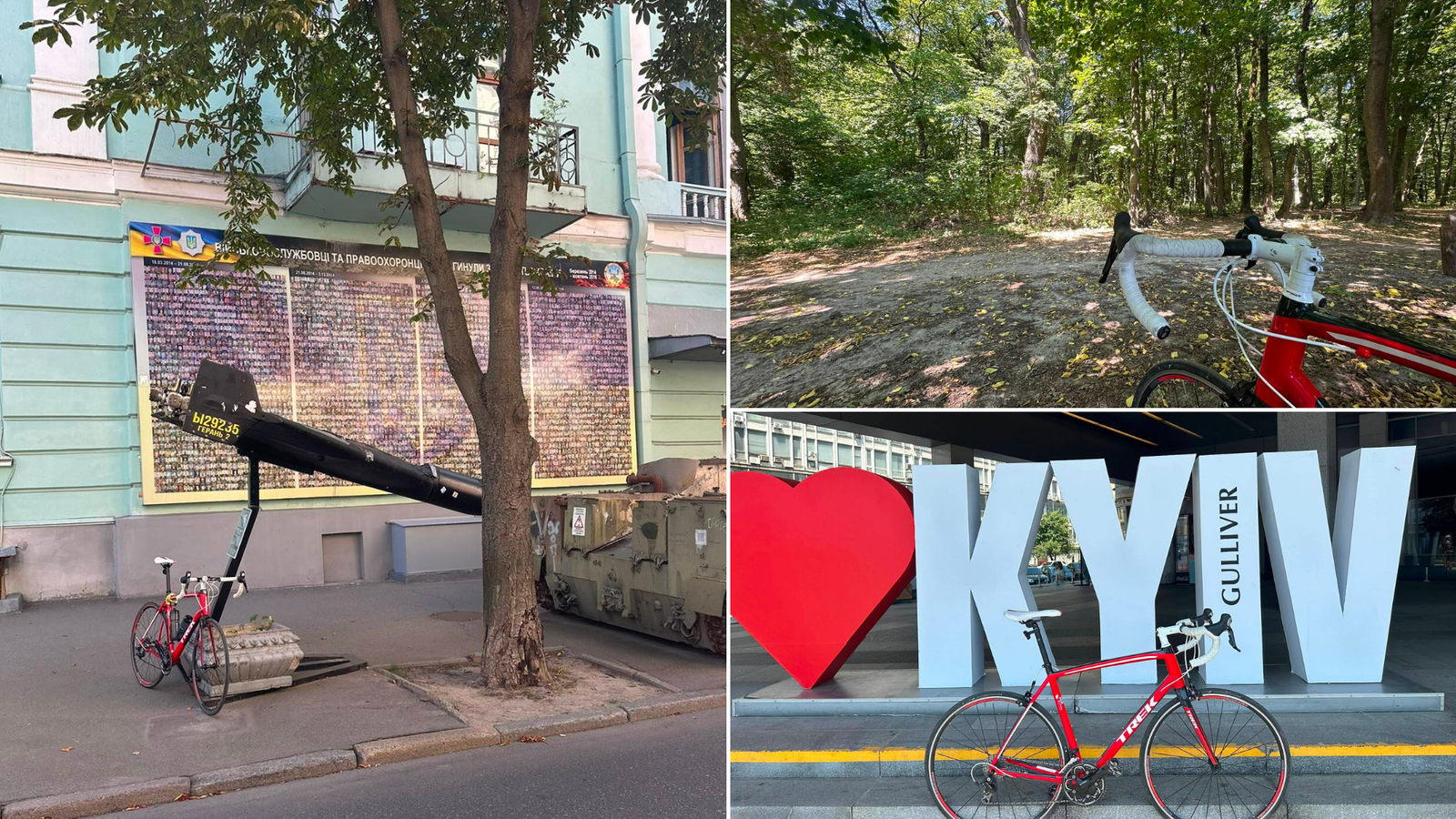
“Most cities have parks. Kyiv is more like a city in a park,” Nathan told me, speaking on the podcast I host, Going Long.
The city is full of parks
(Image credit: Nathan)
“You’re never more than five minutes away from woodland. Last week I went out and went down to the national park in Holisiivskyi Kyiv, and you could have been in the New Forest. Absolutely peaceful, nobody around. And that’s probably 20 minutes by bike from central Kyiv.”
So how safe – or not – does it feel to ride in Kyiv during a period in which Russian attacks on the capital appear to be escalating?
“Because I ride mostly in the woodland and it’s not targeted, I feel perfectly safe – all I see is people out having a good time, sitting on the beach, having a beer by the riverfront,” he says of a population trying to acknowledge its circumstances rather than letting it define them.
“If I went out in a different direction, and went up to some of the squares in town, you would see a lot of devastation. There have been times when sirens would sound as I’ve ridden back into the city, so you head to the metro or to the nearest shelter. Under the law here, you cannot be denied access to a shelter, even if there’s no immediate threat,” Nathan tells me.
Picking the right route, then, is of great importance to cyclists in Kyiv. But rides aren’t restricted to forests and woodland.
“There’s a very active Audax-affiliated cycling club here in Kyiv ” Nathan continues, “I want to pick up a 200 [mile ride], a 400, 600, and there’s a 1,200 or a 1,000 as a qualifier for Paris-Brest-Paris next year.”
Audaxes – long-distance and mass-participation challenge rides – are invariably ridden on the road; does Ukraine have the cycling infrastructure to support such events?
“Every big dual carriageway has a very wide bicycle lane next to it, and a pedestrian path, sometimes combined. It’s segregated from the road, set back from the road, either by bollards or really deep kerbs or whatever.
“When you cross an intersection, there’s a big red lane laid out across the road, and cars actually stop for you. It’s bizarre because coming from the UK, you think everybody’s trying to kill you, so you stop and let the car go. Here, they will stop and wave you on. Car drivers here are incredibly courteous and polite,” Nathan comments.
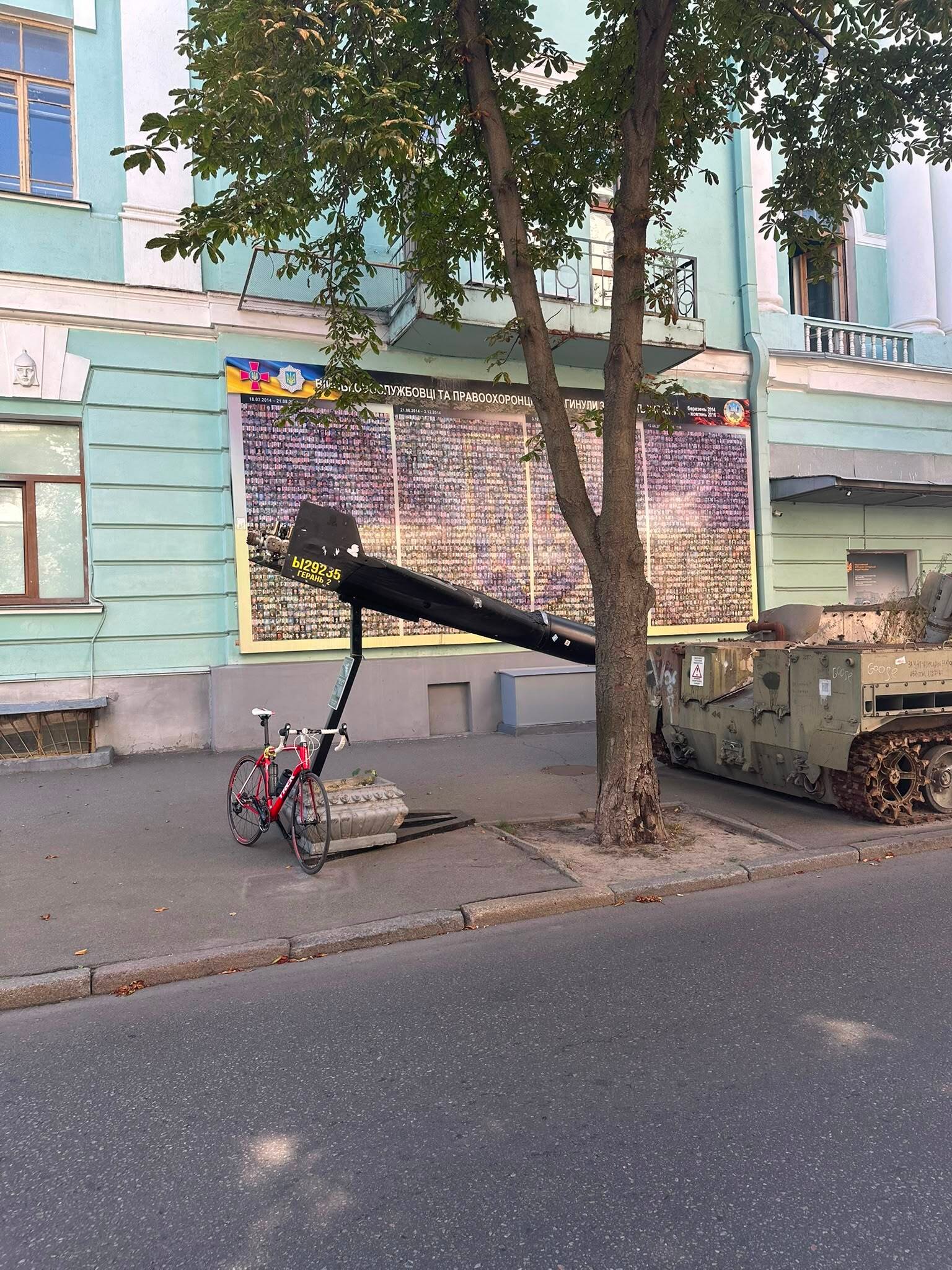

Signs of war are never far away
(Image credit: Nathan)
The club’s next outing takes place on Sunday August 30th, with distances of 50km and 100km available. The event website states that the slogan for 2026 is “keep your balance”, adding, “balance is an important component of cycling. You need to keep your balance, balance your strength and pace. Life in Ukraine is also a balance: peace and anxiety, work and rest, support for family and the Armed Forces of Ukraine.”
Peace doesn’t appear to be on the Russian president’s agenda, and sadly, Ukraine remains as deeply ensnared in battle as it did on 24 February 2022 when Vladimir Putin announced the start of his ‘special military operation’.
Cycling has allowed Nathan to move beyond the immediate reality of the conflict and see Kyiv as its inhabitants do: not just as a city under bombardment, but as a place where people still ride, socialise and carry on with their lives.
“We had an absolutely massive strike last week, like the biggest they’d ever had. It killed quite a few people,” Nathan states, referring to an attack on the city on August 5 which saw 17 people die and a further 44 injured.
“The mood in the office was pretty grim, but then I went out on the bike that night, cycled down the river, and there’s people sitting in the cafes, drinking beer and chatting, and young girls doing selfies, and all the stuff that normal people do in a normal life.”
The cyclists of Ukraine ride on, they continue to balance.
Read the full article here