



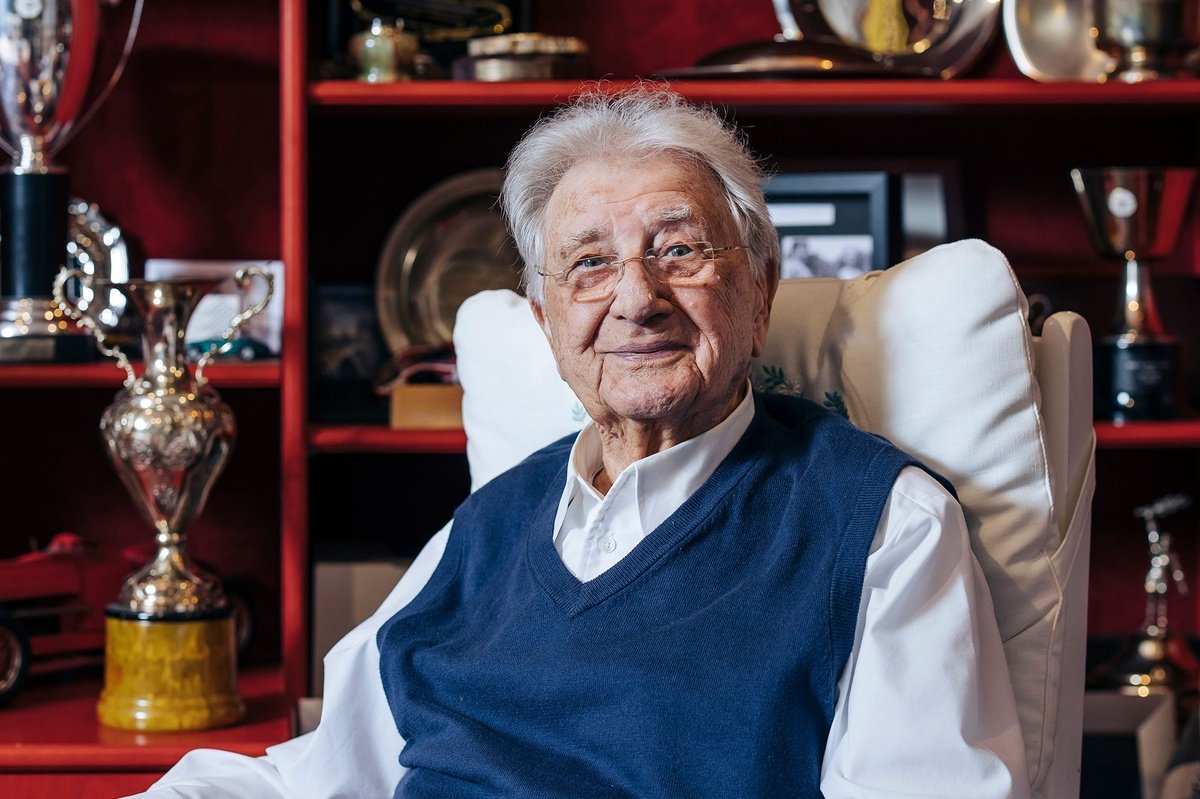
Hans Herrmann, who has died just over a month short of his 98th birthday, will forever be remembered for giving Porsche its first outright victory at the Le Mans 24 Hours together with Richard Attwood in 1970. But that is to overlook the other achievements of his career in both sportscars and single-seaters.
The Stuttgart native enjoyed success with both his home city’s brands, Porsche and Mercedes. In addition to the Le Mans win, Herrmann triumphed with Porsche at the Daytona 24 Hours and twice claimed victory at the Sebring 12 Hours, making him the first driver to win the unofficial triple crown of sportscar racing when he won at Le Mans. It could be argued that he actually took the quadruple, because he also won the Targa Florio road race, another classic on the world championship sportscar trail at the time.
With Mercedes, he started six world championship Formula 1 races as a kind of junior driver after getting picked up by legendary team manager Alfred Neubauer. He’d only started competing in 1952 at the wheel of his own Porsche 356, but two years later was racing alongside Juan Manuel Fangio and Karl Kling in the Silver Arrows grand prix squad. Who knows where his career would have taken him had Mercedes not withdrawn from circuit racing in the wake of the 1955 Le Mans disaster.
That he was a podium finisher in only his fourth world championship start, driving a Mercedes W196 at the Swiss Grand Prix at Bremgarten in 1954, is largely forgotten against the backdrop of the events that came at the end of his career at Le Mans. And not just because of the victory with the factory-prepared Salzburg 917K.
Just 12 months before, he had finished a close second on the Circuit de la Sarthe driving Porsche 908 Coupe with Gerard Larrousse. Herrmann lost out to Jacky Ickx in the JW Automotive Ford GT40 shared with Jackie Oliver by just 120 metres in the days that race organisation gave the winning margin in distance rather than time.
Ickx won a slipstreaming race over the final lap. The Belgian legend knew he had to be behind through Tertre Rouge as he started the last lap in order to get the draft and emerge ahead at the end of the long Mulsanne Straight. He got his timing wrong at the first attempt, crossing the start/finish line before the clock had struck four o’clock. He had to do it all over again, pulling to the side of the road on the exit of the corner onto the straight with an indicator flashing to convince Herrmann that he had a problem to ensure his was the car in the tow.
Hans Herrmann, Juan Manuel Fangio and Karl Kling, Mercedes
Photo by: Mercedes-Benz
The victory for Herrmann and Attwood in 1970 was far less dramatic but much more fraught: they triumphed in a race of attrition held in wet conditions in which there were only seven classified finishers. Their winning margin in was no fewer than five laps.
Attwood had requested Herrmann as his team-mate because “he was one of the oldest guys there and therefore the most sensible”. He also wanted the proven 4.5-litre flat-12 rather than the newly developed 4.9-litre. His conservatism was born of his experiences the previous year: he didn’t like the original longtail-version version of the 917, nor team-mate Vic Elford’s gung-ho attitude. He was frustrated to lose victory in the closing stages on its Le Mans debut in 1969 with transmission failure.
The winning Salzburg 917K qualified 15th, more than a dozen seconds off pole winner Elford in a full-factory 917L long tail. Herrmann insisted that he tried to instil upon Attwood the need to take a cautious approach. “We had to make sure the thing lasted for 24 hours,” he told Autosport in an interview 15 years ago. “That’s why I was feeding it into Richard to take it carefully for the first third of the race.”
Attwood reckoned there wasn’t so much strategy involved: the smaller-capacity engine and the short tail meant the Salzburg entry was “just slow”. It didn’t help that the drivers were forbade by Porsche from engaging first gear in the four-speed transmission at either Mulsanne or Arnage corners. And, besides, there wasn’t much communication between the two drivers. “He didn’t speak English and I don’t speak German,” said Attwood.
Herrmann and Attwood took the lead in the small hours of the morning after the opposition from within the Porsche camp and outside wilted. It moved to the front when Jo Siffert in one of the Gulf-liveried JWA 917Ks buzzed the engine – a 4.9 – on the start/finish straight.
There were still 14 hours on the clock, however, and the conditions were atrocious through to breakfast time on Sunday. “The amount of concentration we had to muster for 24 hours was incredible,” recalled Herrmann. “Physically and mentally it was an immense challenge, because the rain was not predictable.”
PLUS: The slow Porsche that started a Le Mans legend

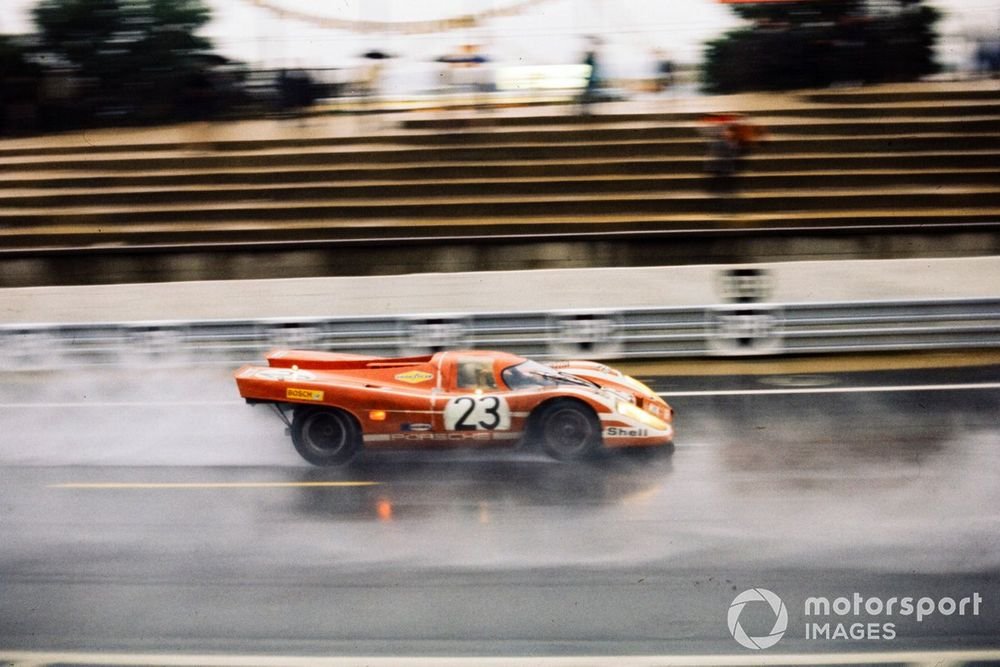
Hans Herrmann / Richard Attwood, Porsche KG Salzburg, Porsche 917 K – Porsche 912.
Photo by: Rainer W. Schlegelmilch / Motorsport Images
Le Mans 1970 would be Herrmann’s swansong. He had made a promise to his wife as he left for the track: he would retire from the cockpit, aged 42, if he won. He stuck to his word.
Herrmann entered – and won – his first race in the 1.5-litre 356 Coupe at the Nurburgring in 1952. The following year he was crowned German Sportscar Champion and also raced for Porsche, claiming second in the up to 1.5-litre class at Le Mans aboard a 550 Coupe shared with Helmut Glockler. Motorsport would become his career rather than taking over the family cafe business: he was trained as a confectioner after the Second World War, during which he had briefly been conscripted before deciding to go AWOL as the end of the conflict neared.
The same season he made his grand prix debut at the wheel of a Veritas RS in the Formula 2 era of the world championship after two appearances with the car in non-points races. His rapid rise took him to Mercedes for 1954.
Herrmann’s single-seater career didn’t end with Mercedes’s withdrawal from motorsport. He raced sporadically in F1 for a number of privateers as well as Porsche, amassing 18 world championship starts up to 1966 when he drove a F2 Brabham for Roy Winkelmann in his home grand prix at the Nurburgring.
One of his best seasons in sportscars came in 1960 when he won two of the five races that made up the World Sportscar Championship at the wheel of Porsche 718 RS60 Spyders: he triumphed at Sebring with Olivier Gendebien sharing the driving and the Targa Florio with Jo Bonnier. He notched up seventh at the season-opening Buenos Aires 1000Km and fourth at the Nurburgring 1000Km in the days when only a manufacturers’ title was awarded.
The 1968 season, the year of his Daytona victory and his second win at Sebring, was another successful one for Herrmann. He drove both 907Ls that finished first (along with four other drivers) and second at Daytona, shared the Sebring victory with Siffert in a short-tail version of the car and also won the Paris 1000Km at Montlhery in a 908 co-driven by Rolf Stommelen, one of his team-mates at Daytona.
Herrmann, who also raced touring cars for Abarth in the first half of the 1960s, was involved in number of scrapes during his career. He broke his leg at Casino Square in practice for the 1955 Monaco GP with Mercedes and famously drove under a closed level-crossing in front of a fast-approaching train during the 1954 Mille Miglia on the way to the first class win for Porsche in the event. He also walked away from a spectacular accident at the 1959 German GP at Avus when the brakes failed on his British Racing Partnership BRM P25.
We want to hear from you!
Let us know what you would like to see from us in the future.
Take our survey
– The Autosport.com Team
Read the full article here