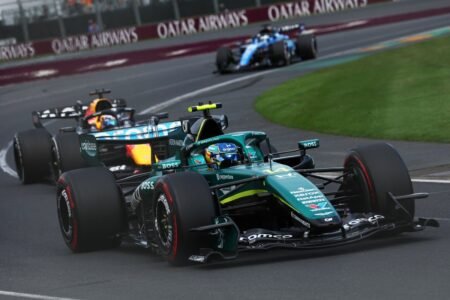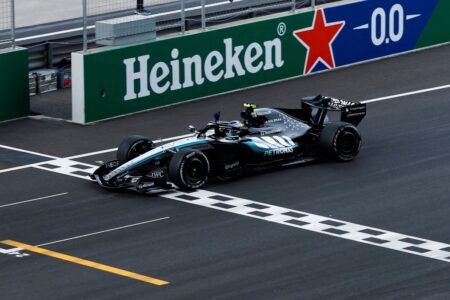





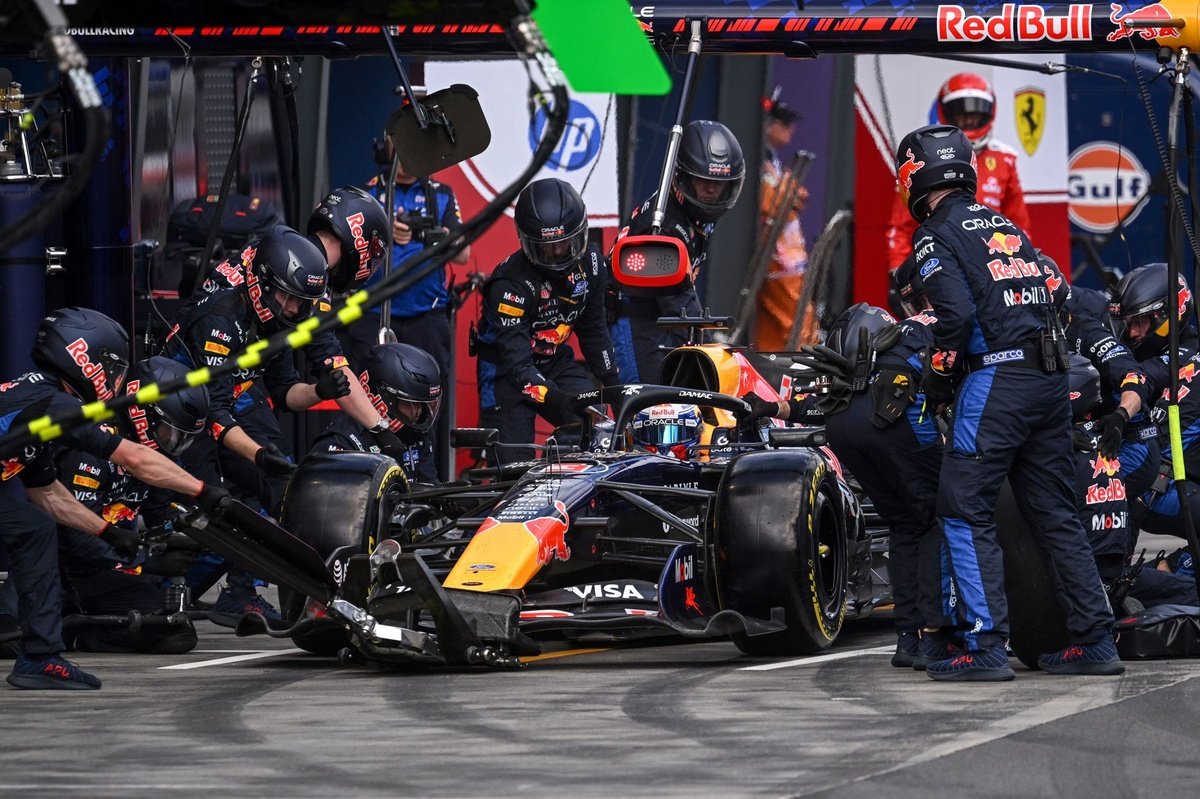
Pitstop strategy is often a decisive factor during Formula 1 grands prix with Hungary in 2019 being a classic example of that. Max Verstappen attempted to make the one-stopper work, but eventually fell short to the two-stopping Lewis Hamilton, who completed a late charge on fresher tyres for victory.
Obviously the debate of a one-stop versus two-stop contest has been ongoing throughout the years, but it’s a dilemma teams have yet to face in the current 2026 campaign. The season is now only two rounds old, but Australia plus China were both won by Mercedes on a simple one-stopper while many of the other front runners completed the same strategy, as tyre wear is less at the start of these new regulations.
That can be put down to various reasons. The first is Pirelli producing stronger rubber, having dropped the softest C6 compound with just a range of C1 to C5 of the lighter, narrower tyres. But the biggest factor is the radically different chassis, as the regulated minimum weight has dropped by 32kg with significantly less downforce.
This means there isn’t as much load going through the rubber, particularly in corners, as drivers are often having to lift and coast to preserve battery with the power units now relying on a near-50:50 split with electrical energy. All of this has resulted in slower lap times – pole in China last year was 1.423s quicker than 2026 – meaning tyre durability is higher than on the monstrous ground-effect machines.
But it is only the start of a new rules cycle and amid many calls from drivers to make tweaks to these imperfect regulations, Pirelli motorsport boss Mario Isola has said there is the option to change the tyre range to widen up strategic possibilities.
“The target for the new tyres was similar to last year, so to have a mix of one-stop, two-stop with the three compounds suitable for the race,” said Isola, who will depart the Italian manufacturer this summer, in China.
“So we were working around this concept to try to generate the same situation as last year, not knowing exactly which was the performance of the new cars and how the new cars were operating the tyres or using the tyres.
“There is a different footprint, there is a different torque, there are different elements. Now we have, and I believe that in any case we have not been far from ideal in Melbourne and here as well, so choices for the first races are still good choices.
Mario Isola, Racing Manager, Pirelli Motorsport
Photo by: Mark Sutton / Motorsport Images
“Obviously we are collecting data, but when we were testing there, looking at the result of the test, Bahrain is supposed to be C1, C2 and C3 probably looking at the result from the pre-season test, it was possible also to go C2, C3 and C4 – so one step softer.
“We will consider that in general, so if in some circuits we need to go one step softer, there is the possibility to change the selection. We sent a draft selection to the teams and they have an idea for all the season but we can change the selection in agreement with the FIA, so there is still the possibility to move, a little bit, the selection on the hard side or most probably on the soft side.”
Isola added that it strikes resemblances to 2017, which had a driver win with the one-stop strategy on 13 of 20 occasions. This came after F1 introduced various regulation changes, such as tyre width increasing by 25% to improve mechanical grip, but obviously that resulted in better durability. As a result, Pirelli introduced a wider range for 2018 – in came the hypersoft rubber – to try and create more strategic possibilities.
But it is far too early to say that the Italian manufacturer should do the same for 2027, particularly as with any regulation switch, teams will continuously develop their cars through the year.
“There is also this element that cars that are running now are probably quite different from cars that are going to run in the second half of the season,” said Isola.
“That means that if the cars are much quicker, also the stress on the tyre is much higher and the selection could be ideal. So there is a rate of development that is quite steep at the beginning. We know that from past seasons.”
We want to hear from you!
Let us know what you would like to see from us in the future.
Take our survey
– The Autosport.com Team
Read the full article here