






Billed as “The War of the Worlds” or the “Martial Arts Championship of the World,” the bout was promoted as the ultimate clash between boxing and professional wrestling. Ali, then 34, entered as the undisputed heavyweight champion after knocking out Richard Dunn the previous month. Inoki, a 33-year-old catch wrestler trained by Karl Gotch, had built a reputation by challenging martial artists from different disciplines in an effort to prove wrestling’s superiority.
The promotion generated enormous worldwide interest. Ali reportedly earned about $6.1 million for the fight, while Inoki received roughly $2 million, staggering purses for the era. An estimated 1.4 billion people watched around the world through television broadcasts and closed-circuit screenings, making it one of the most-watched combat sporting events ever staged.
What fans didn’t know was that the rules had been drastically altered in the days before the contest. Restrictions negotiated by Ali’s camp prevented Inoki from using many of his wrestling techniques. He could not throw, tackle or grapple freely, and could only kick if one knee remained on the canvas. Those last-minute changes completely reshaped the fight.
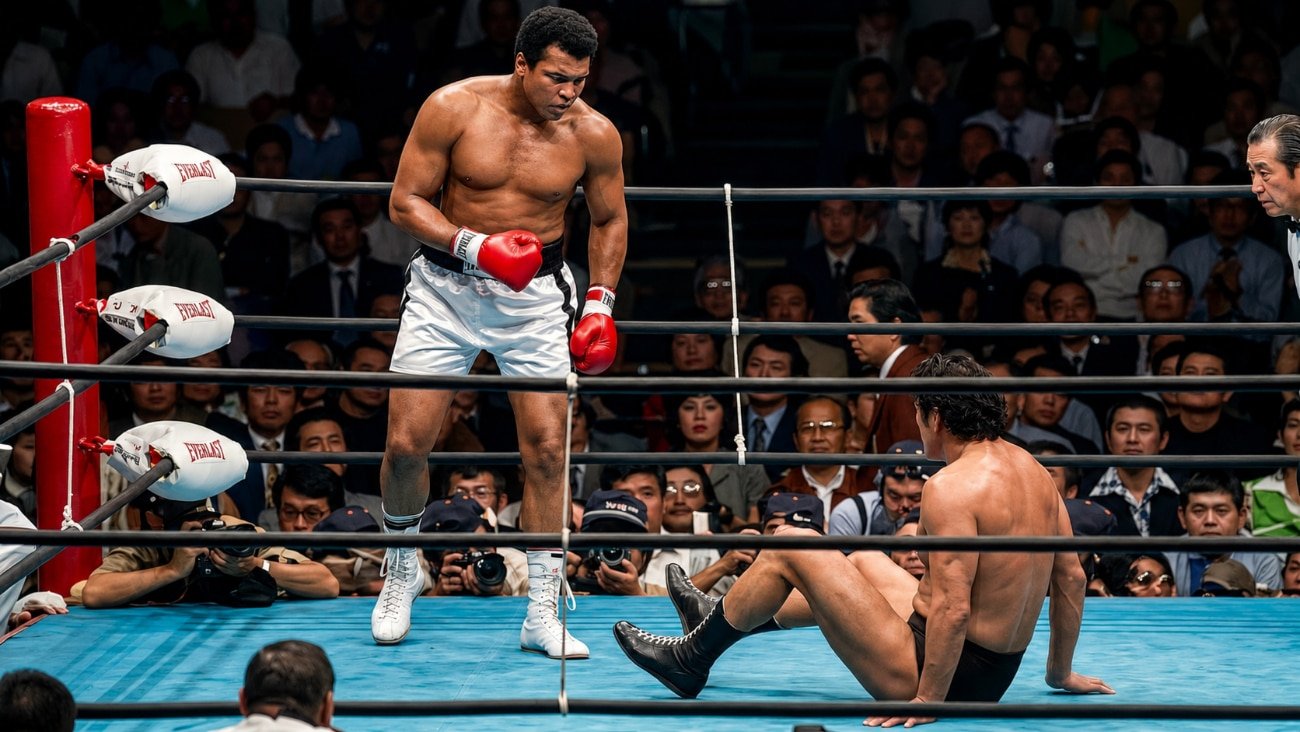
When the opening bell rang, Inoki immediately adopted an unconventional strategy that would define the contest. Spending almost the entire fight on his back, he repeatedly slid toward Ali and attacked the champion’s legs with kicks while staying outside punching range.
Ali circled, taunted and urged Inoki to stand and fight, shouting insults including “Coward!” and “Stand up like a man!” But the Japanese star refused to abandon a tactic that steadily inflicted damage while minimizing his own risk. By the middle rounds, Ali’s left leg had become badly bruised, swollen and bleeding from the constant punishment.
Heavyweight champion Muhammad Ali faced Japanese wrestling star Antonio Inoki at Tokyo’s Nippon Budokan on June 26, 1976, in a 15-round boxer-versus-wrestler contest billed as “The War of the Worlds” and the “Martial Arts Championship of the World.”
When the final bell sounded, the judges returned a split draw. The judges scored the bout a draw after 15 rounds. Many spectators responded by throwing rubbish into the ring and chanting, “Money back!” Newspapers and boxing writers criticized both the fight and its restrictive rules after the event.
Yet history would ultimately judge the contest differently.
Inoki’s relentless leg kicks left Ali hospitalized with severe swelling, blood clots and an infection that affected his mobility for the remainder of his career. More importantly, the fight demonstrated both the fascination and the flaws of cross-discipline competition.
The fight is widely regarded as an early step toward modern mixed martial arts. Japanese promotions such as Pancrase and PRIDE Fighting Championships later built on the concept of cross-discipline competition under more complete rulesets.
Although remembered as an awkward and frustrating contest, Ali vs. Inoki ultimately became one of the most influential fights ever held—not because of what happened inside the ring, but because it changed the direction of combat sports for decades to come.


Read the full article here