




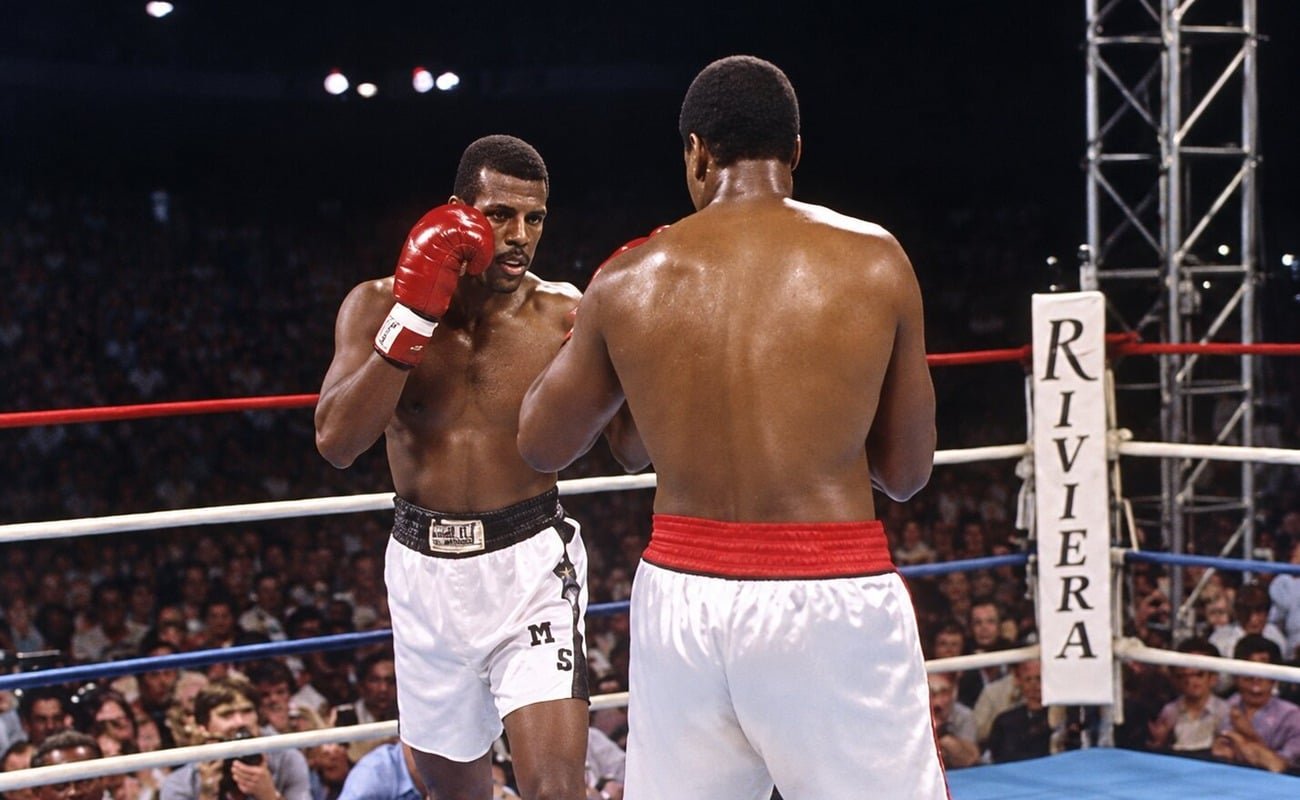
Michael Spinks shattered Larry Holmes’ pursuit of boxing history on September 21, 1985, taking a 15 round unanimous decision at the outdoor arena of the Riviera Hotel and Casino in Las Vegas.
Holmes (48-0, 34 KOs) entered the ring needing one victory to match Rocky Marciano’s iconic 49-0 mark. Another successful title defense would equal Joe Louis’ division benchmark of 20 consecutive defenses. The 35-year-old champion walked into the ring as a 6-1 favorite against a challenger moving straight up from the 175-pound ranks.
Spinks (27-0, 19 KOs) had unified the light heavyweight division, yet history stood firmly against him. Predecessors Archie Moore, Billy Conn and Bob Foster had all tried and failed to conquer reigning heavyweight kings. Spinks tipped the scales at a lean, conditioned 200 pounds after completing an intensive program under conditioning specialist Mackie Shilstone. That regimen relied on track sprints, resistance work, and targeted caloric intake.
The conditioning strategy paid off instantly. Rather than transforming into a traditional heavyweight slugger, he transported light heavyweight agility into the sport’s biggest division.
Holmes established control in rounds one and two through his signature left jab, but Spinks quickly dismantled that timing. The challenger utilized sudden lateral dips, unpredictable head slips, and varied foot angles to vacate the center line. Holmes soon found himself pawing with the lead hand rather than snapping the punishing, rhythmic jab that carried his long title reign.
Spinks exaggerated the champion’s hesitation by constantly switching directions and firing counters from unorthodox stances. His looping overhand right came over Holmes’ habitually low lead guard. Though the blow lacked true concussive force to stagger the heavyweight champion, the persistent threat forced Holmes to freeze after jabbing instead of letting combinations fly.
The second half of the bout produced a classic scoring issue. Holmes pressed forward and scored with the heavier singular wallops, but chasing Spinks proved far different from trapping him. Holmes struggled to cut the ring off cleanly, allowing the challenger to fire quick bursts and escape along the ropes.
Spinks exploited the optics of those sequences perfectly. In the closing thirty seconds of tight frames, the challenger launched quick flurries across Holmes’ guard, shoulders and face before skipping outside. Many blows landed on leather, yet the sheer flurry gave ringside officials eye-catching closing activity.
Holmes spent the final rounds hunting for an equalizer. Lingering back trouble surely restricted his mobility, but the mental burden of chasing Marciano’s ghost also took a toll. When Spinks refused to crumble during early skirmishes, Holmes cast aside the methodical rhythm that had grounded his championship dominance.
CompuBox numbers supported the challenger’s work rate, recording 318 landed shots out of 697 attempts for Spinks, against 248 of 567 for Holmes. Neither fighter suffered serious physical trauma over the 45 minutes of action.
Judges Harold Lederman and Dave Moretti turned in cards of 143-142, while Lawrence Wallace submitted a 145-142 tally, awarding Spinks the unanimous decision. Lederman noted that his scorecard sat deadlocked through fourteen rounds, with Spinks sealing the victory by outworking the champion in the final three minutes.
The loss hit Holmes hard, and the bitter aftermath carried over to the post-fight press gathering.
“I’m 35 fighting young men, and Rocky was 25 fighting old men. To be technical, Rocky couldn’t carry my jockstrap.”
Holmes later apologized for the remark. Spinks edged Holmes again via split decision seven months down the road, yet this initial Las Vegas clash holds lasting historical importance. Spinks demonstrated that an undersized champion did not require brute force to topple a giant. Precise conditioning, persistent lateral angles, and unrelenting activity were enough to pull an elite heavyweight completely out of his comfort zone. Holmes was carrying years of accumulated resentment that finally boiled over that night in Las Vegas.
The outburst had very little to do with Michael Spinks as an individual and almost everything to do with Holmes feeling chronically disrespected throughout his entire championship reign.
First, Holmes spent seven years reigning in the inescapable shadow of Muhammad Ali. When Holmes dominated a faded Ali in 1980, the public never truly forgave him for beating their icon. Instead of receiving unconditional praise as an all-time great heavyweight, Holmes routinely faced lukewarm crowds, critical press, and constant comparisons to fighters from past eras. He felt he had carried the heavyweight division with absolute professionalism without ever receiving the adoration given to Ali or Joe Frazier.
Second, the Marciano obsession amplified that frustration tenfold. Leading into the Spinks bout, the media spotlight fixated almost entirely on Rocky Marciano’s 49-0 mark rather than Holmes’ own historic accomplishments. Marciano’s family and older sports columnists openly rooted for Holmes to lose so the record would stay untouched. To Holmes, the comparisons felt inherently unfair. He saw himself as an active champion taking on prime contenders while Marciano had built his late record against aging legends like Joe Louis, Jersey Joe Walcott, and Ezzard Charles. When the decision went against him, that perceived injustice exploded into the infamous jockstrap remark.
Third, Holmes genuinely believed he won the fight. In his mind, he had walked Spinks down, landed the heavier and more damaging punches, and dictated ring position for fifteen rounds. To lose his heavyweight title, his unblemished record, and his historic milestone on a controversial decision based on what he considered slapping flurries felt like outright theft.
Rather than processing the setback in private, Holmes walked into the press room exhausted, injured, and deeply wounded by the sudden collapse of his historical quest. The irony, as you noted, was immediate: had he shown grace in defeat, the boxing public likely would have rallied around him for dropping a razor-thin decision at age thirty-five. By lashing out at Marciano, he instantly turned public sentiment against himself and alienated the very fans who were ready to appreciate his career.
When you watch the tape without audio or crowd influence, Holmes undeniably delivered the heavier, more authoritative blows. His right hands snapped Spinks’ head back, while many of Spinks’ combinations bounced harmlessly off Holmes’ high guard, forearms, or shoulders.
In traditional championship boxing scoring, effective aggression and clean, hard punching are supposed to carry the round. Holmes was the man moving forward, controlling center ring, and delivering the thudding shots that looked like actual heavyweight punches. The wire services saw it that way too, which is why the Associated Press and United Press International both scored the fight for Holmes.
Where Holmes ran into trouble with the ringside judges was purely optic. By following Spinks without cutting the ring off, he let Spinks dictate the visual tempo. When Spinks threw a four-punch flurry in the final twenty seconds of a round, even if three hit gloves, it created the illusion of dominance right as the bell rang. The judges rewarded that busy, awkward hustle over Holmes’ patient, single-punch stalking.
Losing a world championship on shoe-shine flurries when you landed the only hard shots of the night is enough to make any champion see red. It explains entirely why Holmes was so raw at the microphone afterward, convinced he had been robbed of Marciano’s milestone by judges who favored activity over real damage.
Read the full article here