




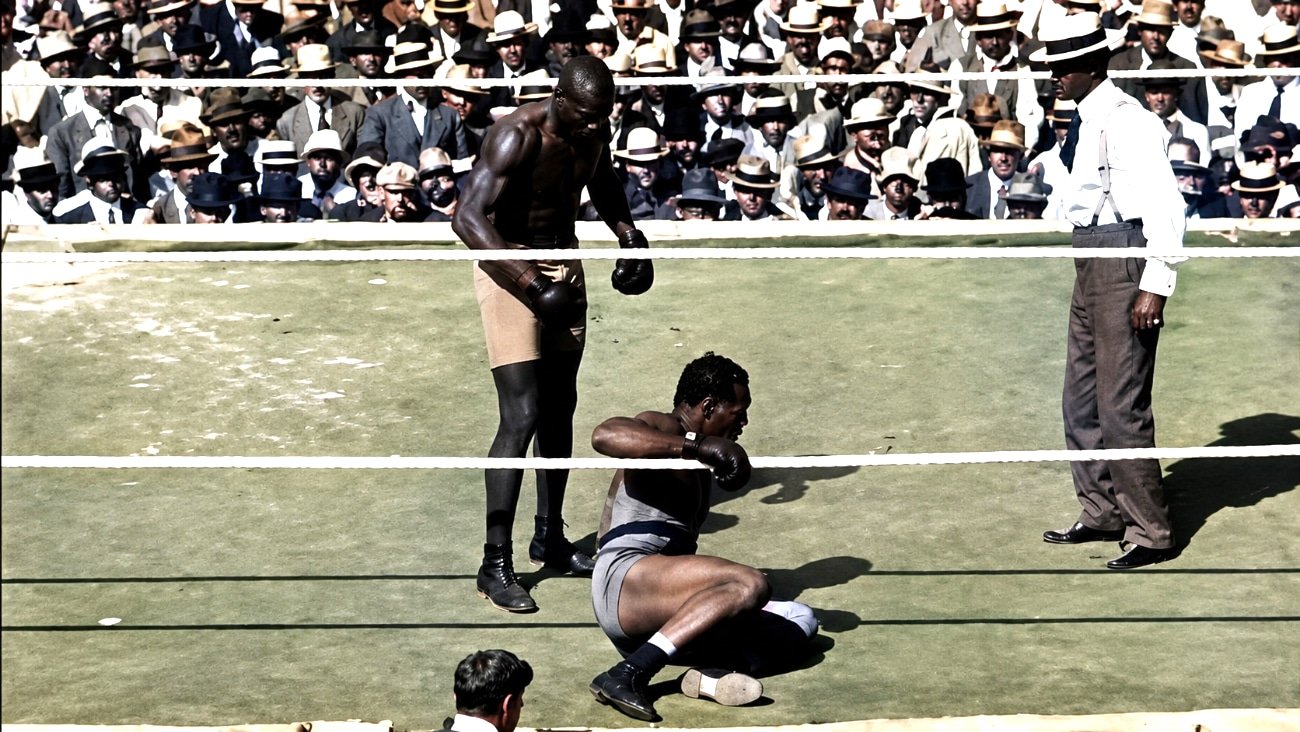


Billed as the “Fight of the Century,” the contest was about far more than the heavyweight title. Johnson, the first Black heavyweight champion, entered the ring carrying the hopes of Black Americans while facing intense hostility from much of white America. Jeffries had ended a five-year retirement to challenge Johnson after being promoted as the “Great White Hope,” with many believing he would restore the heavyweight championship to a white fighter.
An estimated 20,000 spectators packed a specially constructed outdoor arena in Reno, while newspapers across the United States devoted extensive coverage to the contest.
The purse exceeded $100,000, an extraordinary figure for the era.
Johnson entered at roughly 208 pounds, giving away nearly 20 pounds to the 227-pound Jeffries, but size proved irrelevant once the opening bell rang.
Early rounds: Johnson takes command
Jeffries opened by moving forward behind steady pressure, but Johnson answered with disciplined defense, tying up the challenger on the inside and landing the cleaner punches.
Johnson relied on disciplined defense, tying Jeffries up whenever the challenger closed the distance before answering with crisp counters as they separated. His defensive ability frustrated the former champion almost immediately.
By the fourth round, Johnson later recalled that he sensed the fight had already turned decisively in his favor after landing a clean uppercut. He famously remarked that he could see “the old ship was sinking” as Jeffries’ confidence began to disappear.
From rounds five through fourteen, Johnson steadily widened the gap.
His footwork, timing and ring generalship repeatedly left Jeffries chasing the fight. Whenever the challenger managed to close distance, Johnson tied him up before landing clean punches as they separated.
Jeffries continued pressing forward, but his offense became increasingly ineffective. His face swelled from Johnson’s accurate punching while fatigue began slowing both his hands and feet.
Johnson, by contrast, remained relaxed throughout much of the bout. Contemporary reports described him smiling at times and even taunting Jeffries as he continued picking him apart with precise combinations.
Former heavyweight champion Jim Corbett, working Jeffries’ corner, attempted to encourage his fighter throughout the contest, but nothing changed the momentum. Johnson dictated virtually every exchange while taking very little meaningful punishment himself.
Round 15: The finish
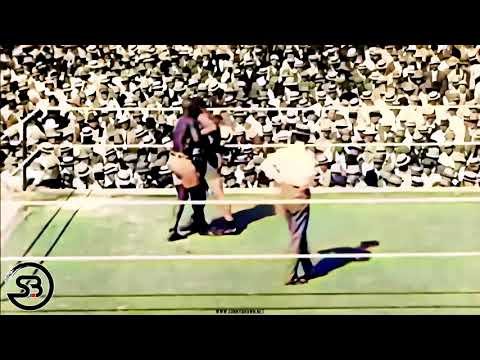
The end finally came in the 15th round. Johnson trapped Jeffries near the ropes and unleashed another sustained attack. A series of clean punches sent Jeffries crashing to the canvas for the first knockdown of his professional career.
Jeffries struggled back to his feet, only to be dropped again as Johnson pressed the attack. After another knockdown left the challenger helpless, Jeffries’ corner threw a towel into the ring to prevent further punishment.
The referee stopped the contest at 2:20 of the 15th round, awarding Johnson a technical knockout victory while preserving Jeffries from suffering an official knockout defeat.
Johnson had retained the heavyweight championship in emphatic fashion after thoroughly outboxing one of the greatest heavyweights of the previous generation.
A victory that changed more than boxing
The aftermath extended far beyond the ring. Johnson’s victory was greeted with celebration in many Black communities, but it was also followed by racial violence in cities across the United States.
Riots broke out in more than 50 cities across over two dozen states during the following days. More than 20 people were killed, hundreds were injured, and numerous assaults and lynchings were reported.
Authorities soon moved to suppress screenings of the official fight film, fearing it would inflame further violence. Those efforts eventually led to federal restrictions on transporting boxing films across state lines, a ban that remained in place until 1940.
Jeffries retired for good following the only defeat of his career. Johnson remained heavyweight champion until losing the title to Jess Willard in 1915, though his career later became overshadowed by legal troubles outside the ring.
Johnson’s win over Jeffries still stands as one of boxing’s most important results. In the ring, it confirmed Johnson’s superiority; outside it, the reaction showed how deeply race shaped the event and its aftermath.

Read the full article here