


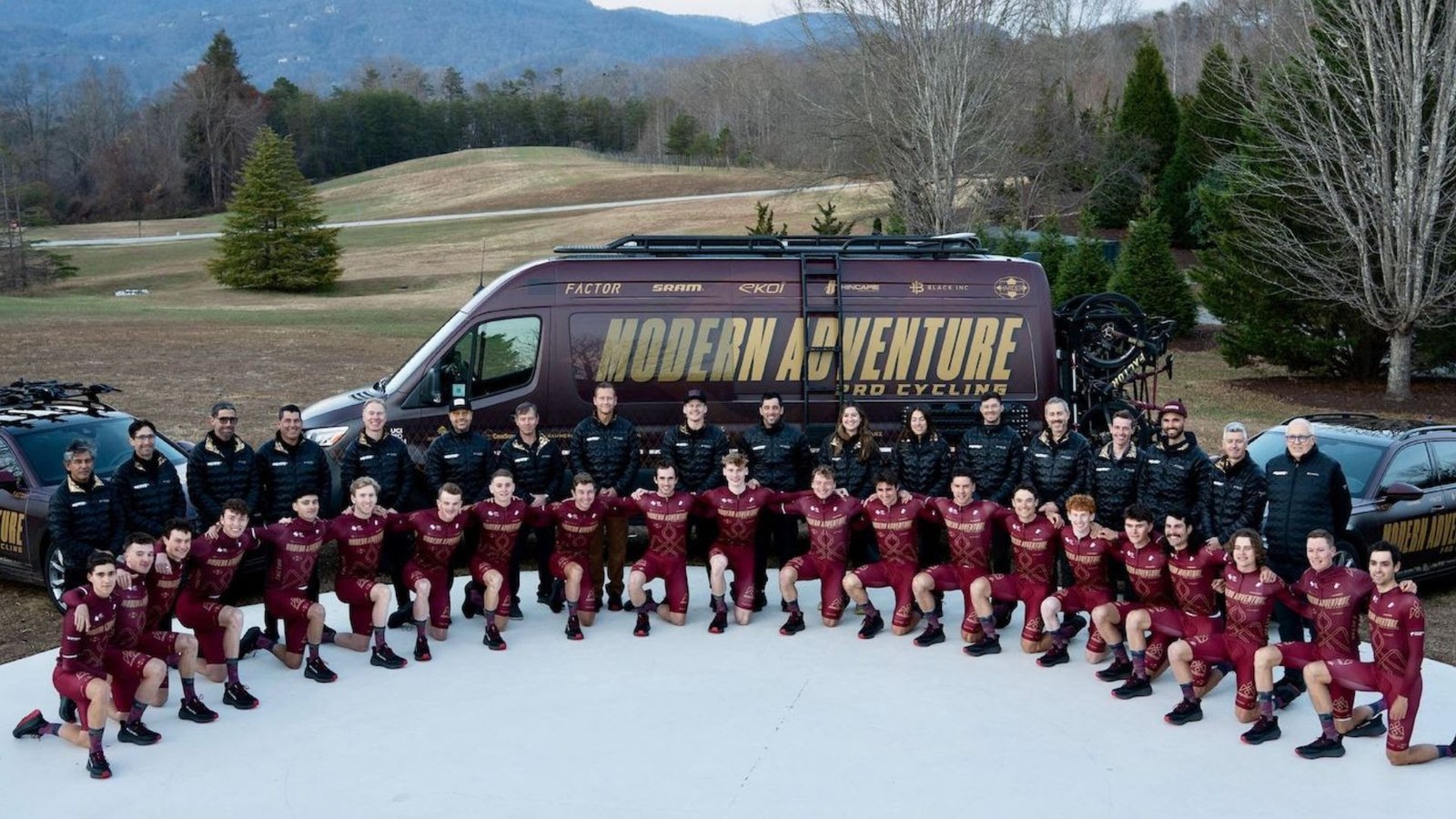
In ten days’ time, the newest American UCI Pro Road Team, Modern Adventure Pro Cycling, will get its first real taste of world-class competition.
Lining up at the AlUla Tour in Saudi Arabia, the programme’s debut comes early and without illusions. While the roster features ample talent, this is not a team of headline names, nor a project expecting instant results. But for a team still in its infancy, the invitation alone matters; a first opportunity to see how the team’s ambitions hold up when placed directly in the deep end.
“It’s a big deal to be invited to an ASO race as a first-year team,” team founder George Hincapie tells Cycling Weekly. “We don’t take that lightly. We know we’re lining up against some very big names. For me, what matters is that we don’t get pushed around, that we ride together, and that we make a statement about how we race.
“I’m not telling the guys we need to win AlUla or win our first race. I just want us to ride together as a team, to learn, to trust each other. If we do that, I’ll be happy. Any results on top of that are a bonus.”
Since the team was introduced last June, it has been, in Hincapie’s words, “full gas.” Relentless travel, meetings with race organisers, conversations with partners, recruitment calls, and a (not-so) quiet campaign to convince everyone that Modern Adventure is serious, credible and worth investing in.
“It’s been a lot,” Hincapie says. “But now we’ve got a really great group, not just riders, but staff too, and things are running smoothly. I’m pretty happy with how it’s all coming together.”
It’s an ambitious aim, framed in the language of “hope,” “vision” and a “new era.” But the programme itself is rooted in something more pragmatic: a clearly defined structure, experienced leadership, and a long runway that prioritises sustainability over immediate results.
“I’ve been quite happy at home,” he says. “Doing our grand fondos and the podcasts and spending time with the family. But this [project] really appealed to me because it’s a long-term plan. I have a six-to-eight-year commitment, and it really gives me time to plan. It doesn’t give me much pressure to go after only results in the first couple of years. The fact that we have that runway gives me a lot of hope.”
‘I have nothing to hide’
For Hincapie, committing to a long-term project meant surrounding it early with people he trusts to help build it carefully.
The ownership group includes George and Richard Hincapie alongside longtime friend and business consultant Dustin Harder. The management and performance structure reads like a reunion tour of American cycling’s recent past, with Bobby Julich as performance coach and former WorldTour pros Alex Howes and Joey Rosskopf, alongside domestic stalwart Ty Magner, stepping into directeur sportif roles.
Factor Bikes has signed on as a long-term partner, with David Millar personally involved in shaping the project.
If those names ring certain bells for you, you’re not alone. These are names tied to an era of cycling that still provokes scepticism, to say the least, and the comment section on previous articles about the team reflected that.
“I don’t read the comments,” he says. “But I hear about them. And they’re actually very motivating.”
His story is public. He has acknowledged past doping. He has even written a book about it. He believes, firmly, that he is also part of cycling’s transition away from that culture.
“I have nothing to hide,” he says. “Even when I get [negative] comments, I know what I’ve done for this sport, and I know that I’m not going to let that hamper my goals and my hopes for the sport.”
That belief becomes personal when he talks about his son, now 17 and close to turning professional.
“I know he’ll never have to make the decisions I had to make,” Hincapie says, and the same goes for the riders on his team. “It’s a completely different culture now, and our riders know that.”
Hincapie points out that the technology, training and nutrition are so advanced now that “it’s superseded any kind of sketchy stuff that went on back in the day.”
Meet the Team


For all the familiar names behind the scenes, the riders themselves are much less recognisable, and that’s by design.
“We don’t have huge names on the roster,” Hincapie says. “But we have guys we believe we can help reach their full potential.”
Modern Adventure’s roster reflects its mission. Twelve of the 20 riders are American, ranging from seasoned domestic pros like Robin Carpenter and Scott McGill to raw teenage talent just beginning to test themselves internationally.
There’s a deliberate mix of riders who have survived team closures, riders stepping up from development squads, riders whose careers have stalled, and those whose careers haven’t even started yet.
“I’m excited about Riley Pickrell,” Hincapie says, pointing to the Canadian sprinter who arrives from Israel–Premier Tech. “He didn’t get many opportunities last year, but when he did, he took them. We’re all-in for him when he has a chance.”
Then there’s Brit Leo Hayter, the former Ineos rider who will return to road racing after stepping away from the pro peloton to address mental health challenges.
Others he mentions with equal enthusiasm include South-African Stefan De Bod, who’s spent six years on the WorldTour; Byron Munton, another South African who netted a stage win and third overall at the Tour of Portugal last year; and young Americans Cole Kessler and Ezra Caudell, with a lot of raw talent and U23 jersey potential.
“There’s a bunch of names that I’m excited about that haven’t really done anything yet, but I think they will be names that we can follow in the future,” Hincapie says.
Read up on the full roster, here.
Hincapie says his approach to building the team has been shaped by experience. He has lived through small programmes becoming giants, pointing to Team BMC as an example.
“I know what it takes,” he says. “Obviously, it takes money and it takes a good leadership team behind it, but hopefully that experience that I got while in my racing days will help get the team to where I want it to be.”
That also includes the team’s culture: a bus where riders laugh, a team built on trust and a place where the sport’s relentless demands are balanced by enjoyment.
“The best teams I was on weren’t just successful,” he says. “They were fun. That matters more than people realise.”
Why now?


American road cycling is fragile. Races disappear as often as they appear. Development pathways are scarce. And the sport has long struggled to recapture the excitement of the Greg LeMond era or of Hincapie’s years racing alongside Lance Armstrong.
Hincapie sees that as an opportunity more than a deterrent.
“I think it’s as good a time as any to start a team and from scratch,” he says. “American road racing is not so hot at the moment, and hopefully, having a team with a lot of American riders is going to help invigorate the sport in the US, and get more people into the sport.
“We’ve got several world-class professional American cyclists on the scene already, and hopefully this team will help with that as well.”
Asked why Americans should still care about cycling, his answer is simple.
“Cycling is very exciting, very hard to predict,” he says. “There’s danger, there’s tactics involved. It has a little bit of everything. It takes the best things from all sports and makes it into one.”
Recent moments of U.S. success, like Sepp Kuss’s 2023 Vuelta win, have shown what’s still possible. Sustaining that interest, Hincapie believes, comes back to representation and visibility.
The team’s race schedule remains vague. They’ll race in Europe, wherever invitations come. North America, wherever racing still lives or is being rebuilt, such as the Maryland Cycling Classic and the rebirth of the Philly Cycling Classic. Road races, gravel events, whatever helps the team be seen.
“We’re going back to the basics,” he says. “Hustling our way into races. Making our presence known. Building from there.”
Read the full article here