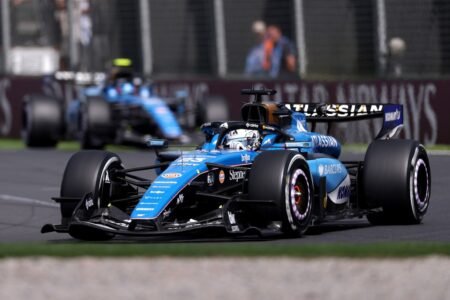

Pre-race predictions were confirmed at the 2026 Formula 1 opener in Melbourne. Mercedes appears to have made a significant step forward compared to the competition, with rivals such as Ferrari, McLaren and Red Bull estimating at least half a second of deficit to make up. A challenge that is anything but simple, although it is also true that, due to its characteristics and current strengths, the Australian track tends to amplify certain gaps.
The advantage was even clearer in qualifying, when the W17 put a full eight-tenths between itself and the group formed by the other three top teams – interestingly separated from each other by less than a tenth. In the race, the picture changed only slightly: Ferrari was the only team able to keep up with the Silver Arrows, while McLaren fell further behind, hampered by several problems.
The key point is that the nature of this advantage does not come from a single factor, but involves several interconnected areas that enhance one another. That is also why, despite sharing the same power unit as the Woking team, the gap remains rather large for now. Of course, it cannot be ignored that today the Mercedes engine seems to have made a small step of advantage over its rivals, but that is only part of the story.
Over a single lap it became clear that, with only seven MJ allowed by the FIA to reduce the need for excessive lift-and-coast, not only the contribution of the internal combustion engine has become crucial, but also how energy is used and recovered. This is the first major topic, because in this area Mercedes currently appears to enjoy an advantage over its rivals, especially on fast tracks with few braking zones and when little energy is available.
When the time came to turn up the engine mode and reveal the true qualities of this power unit, the W17 began to fly – especially on the straights – clearly pulling away from its rivals. In the zones where the most evident derating had been recorded on Friday, on Saturday the drop in speed was far more limited and linear, without the need to rely excessively on lift-and-coast or sacrifice other parts of the lap.
This suggests not only that Mercedes interpreted energy management on such a critical circuit flawlessly, but also that the internal combustion engine – especially when it reaches certain peaks – can provide significant support, reducing the stress on the MGU-K in the most delicate areas, allowing the MGU-K to assist in reducing turbo lag, particularly for those who, like Mercedes, have focused on efficiency.
George Russell, Mercedes, Andrea Kimi Antonelli, Mercedes
Photo by: Sam Bloxham / LAT Images via Getty Images
On a fast track, the combination of these factors created the perfect storm, and it should not be forgotten that the German marque has worked on this power unit for years, developing its models and building a broader knowledge base than its customer teams. In this respect there is an interesting element: to recharge, the W17 does not rely so much on lift-and-coast, but rather on super clipping with the rear wing open, thus arriving faster at the braking zone. This becomes an important factor for two reasons that highlight another quality of the car.
Under the current regulations, the FIA allows up to 350kW of energy recovery under braking or in phases where the throttle is not fully open, such as medium- to low-speed corners or during lift-and-coast at the end of straights. By contrast, for safety reasons, the charging limit through super clipping is set at 250kW.
This difference is far from marginal and pushes teams to carefully evaluate what and where it may be more advantageous from an energy-management perspective. If, for example, Ferrari appears to rely more heavily on lift-and-coast to recover energy, Mercedes instead decisively focuses on super clipping as the main recharging option, especially on qualifying laps.
Having outlined the differences, it is also necessary to understand how they influence driving. Lift-and-coast allows higher charging limits, but it logically takes time to reach the 350 kW value for safety reasons. This also implies a different way of driving the car: extensive lift-and-coast means arriving at the braking zone with a lower speed and then using the brakes less during corner entry.
Now, beyond the qualities of the SF-26, this is one of the reasons why Ferrari has consistently been among the fastest in terms of mid-corner speed in the Turn 6-7 chicane. Where Mercedes was still in the braking phase – because it tends to carry braking deep into the corner – the Ferrari was already close to the acceleration phase, allowing it to maintain a higher minimum speed through the corner.
The W17 works the opposite way. The tendency is to rely more frequently on super clipping and extend the braking phase by carrying braking into the corner, in a way similar to last year. It is a very different approach, and to sustain it while still maintaining good mid-corner speeds – since the obvious risk is understeer – you need an effective chassis and good balance.


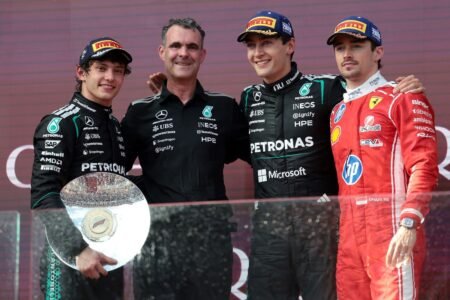
Charles Leclerc, Ferrari, George Russell, Mercedes
Photo by: Sam Bagnall / Sutton Images via Getty Images
This topic was also highlighted by McLaren boss Andrea Stella, who pointed out both the gap in hybrid usage (also linked to different gearbox management and usage philosophies) and how the MCL40 lacks pure aerodynamic downforce, stressing that the W17 is much stronger than it may appear in cornering.
Taken together, these elements have ended up enhancing Mercedes’ strengths on one of the tracks that will probably highlight the pure qualities of the W17 the most.
Shanghai, for example, will represent a different challenge: the Chinese circuit does feature a long straight, but also fast sweeping corners and numerous opportunities to recharge the battery, so it is not among the most energy-demanding circuits of the year.
We want to hear from you!
Let us know what you would like to see from us in the future.
Take our survey
– The Autosport.com Team
Read the full article here