




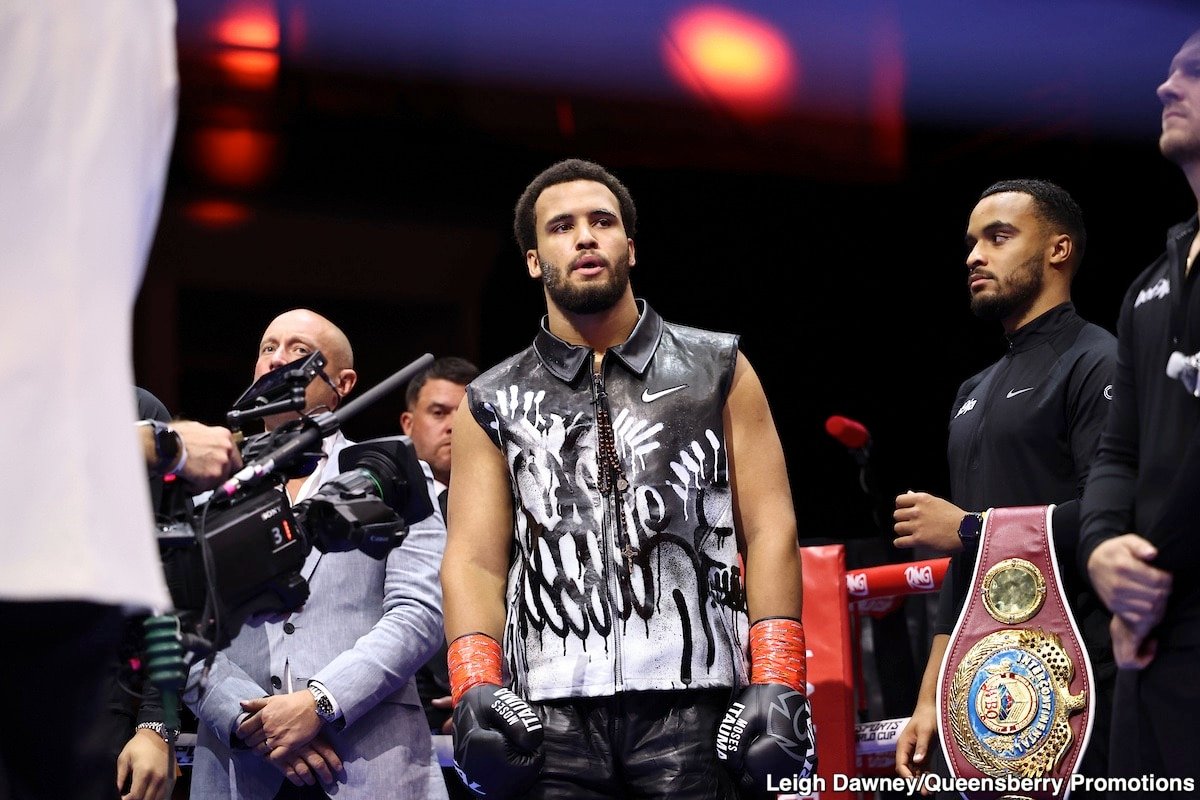


Solving the Itauma Problem
Hearn’s response is deliberate. He says he has two heavyweights who can “rock with him.” Not outbox him or outthink him, but rock with him. That language gives the game away.
“I’ve got to find some heavyweights that can rock with him over the next three or four years, and I’ve got two that I think will really rock with him,” said Hearn to talkSport Boxing.
Itauma’s rise has been built on fast destruction. Most of his opponents have folded once the tempo spikes and the left hand lands clean. If you are constructing an answer, you start with durability and power. You look for size, heavy hands, and someone who won’t panic when the early shots arrive. That is what Hearn appears to be building.
Australian Olympian Teremoana Teremoana is presented as the nearer-term option, with Hearn floating a six-to-twelve-month window. Teremoana has wiped out his early opposition, but he has yet to operate under real pressure. The knockouts look good on paper, yet they do not tell you how he reacts when a fight turns uncomfortable.
Then there is 18-year-old Leo Atang, whom Hearn openly admits needs time. He is ten fights into his career with four stoppages and obvious upside, but he is still a teenager in a division where physical maturity changes everything. If Atang is ever to fight for a world title, Hearn has already suggested it would be against Itauma.
That’s brave matchmaking talk, and it also tells you who this whole conversation is built around.
It isn’t Tyson Fury or Anthony Joshua setting the tone for this age group, and it isn’t Oleksandr Usyk either. The measuring stick for this new generation is a 21-year-old Queensberry prospect, which is a shift you would not have predicted two years ago if you follow how these cycles usually move.
The risk in this strategy is obvious. Building a fighter around solving one opponent can narrow development, because if you train mainly to survive a puncher, you might neglect other parts of his game. Itauma is not just heavy-handed. He is quick to close distance, he sets traps, and he cuts the ring in ways that force mistakes.
If he keeps adding patience and variation, the fighter we see in 2026 could be very different from the one they are studying today.
Timing is the other issue. Itauma is moving toward world level immediately, Teremoana is being pencilled in for next year, and Atang is further out. If Itauma reaches contender status before either man has tested himself against seasoned operators, the theoretical matchup becomes harder to sell as competitive.
Right now, the balance is clear. Itauma dictates urgency, and others are adjusting their plans around him.
That does not mean Hearn is wrong. Heavyweight boxing changes quickly, and one punch can rewrite reputations. But until one of his prospects proves he can handle genuine resistance, talk of “rocking with him” remains blueprint rather than proof.
Influence Without a Title
Itauma has already forced a rival promoter to design fighters with him in mind. That is influence before a world title, and in heavyweight boxing, that kind of pull usually belongs to champions.
Whether Matchroom’s anti-Itauma project produces a genuine threat is still unknown. For now, it confirms something simpler. Moses Itauma is no longer just a prospect on the rise. He is the problem others are trying to solve.
Read the full article here