




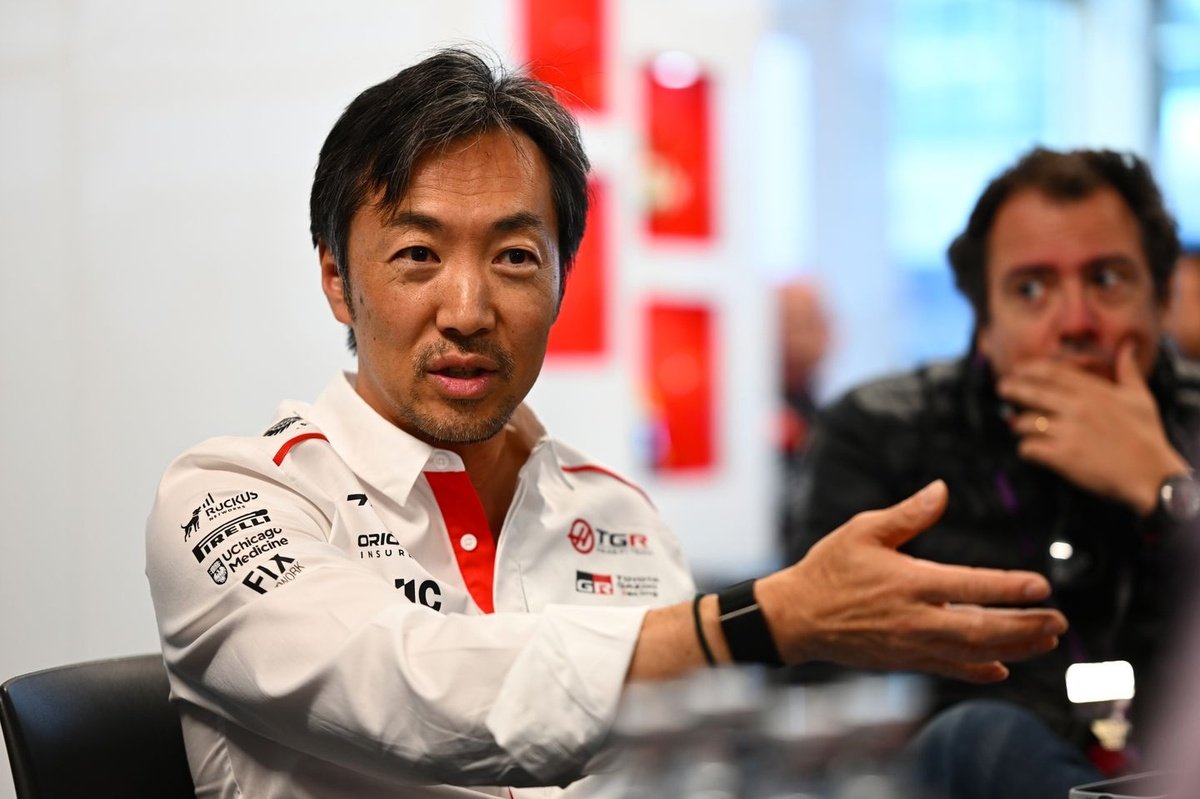
Haas team principal Ayao Komatsu says efforts to improve the racing in Formula 1 shouldn’t lead to escalating costs amid talks to increase 2027’s budget cap.
F1’s 2026 era has gotten off to a flawed start due to crippling compromises caused by the high reliance on electric energy from the new power units. In a battle to optimise lap times, the need to recharge the battery multiple times per lap is forcing drivers into counter-intuitive driving techniques. Meanwhile, high closing speeds as cars run out of energy on the straight are a lingering safety concern.
After making smaller energy deployment refinements in Miami, F1 stakeholders are currently in the process of discussing more significant changes to the technical and sporting regulations that would involve tweaks to the power unit hardware for 2027.
On the table is a move to a roughly 60-40 split between V6 power and electric energy, which could be achieved by raising fuel flow and reducing the energy deployment limits, while increasing battery capacity to avoid cars running out of electric energy as often as they do now.
However, raising the fuel flow would force teams to redesign fuel tanks and potentially force them to alter their chassis design, while many outfits had been planning to carry over their 2026 design to save costs. Haas team boss Komatsu felt that any moves that would increase costs for the teams would take things in the wrong direction, though.
Haas F1 pitstop practice
Photo by: Guido De Bortoli / LAT Images via Getty Images
“The thing I’d like the FIA and F1 management to hear about the team’s point is about the cost,” Komatsu said. “It’s ridiculously expensive. These PU regulations are already so expensive, so to then do certain things for next year’s regulations… If this is going to cost every team an extra five million, 10 million, that’s certainly not the right direction for us. I think for me, from the team’s side, we need to simplify, reduce the cost in every area.”
As part of the proposal, there are discussions over a one-off increased cost cap allowance so teams can absorb a potential chassis change without having to redirect development resources. But Komatsu feels any cost cap creep defeats the purpose of having a budget restriction in the first place.
“This is the problem. I don’t want to increase the budget cap,” he argued. “Already this year’s budget gap is a lot higher. And then to have another reason to, again, increase another two million, another five million, then it’s not a budget cap anymore.”
When asked if he felt meaningful changes to improve the on-track product were still possible for next year, given teams have already embarked on their 2027 car projects, Komatsu replied: “I think it just depends on the degree of the changes. If we work out parameters where it doesn’t necessarily change the whole current PU homologation, the design changes fundamentally or the battery size changes, that kind of thing, then I think it is possible.
“This is what we’re trying to do this year as well, right? When we changed the regulations for Miami, we wanted to do it in a way that people who got it right for this year don’t necessarily get penalised. We’re only looking at safety stuff, things like the speed differential and also looking at certain parts of the regulations where it’s just so sensitive that driver cannot drive to the limit on the qualifying.”
We want to hear from you!
Let us know what you would like to see from us in the future.
Take our survey
– The Autosport.com Team
Read the full article here