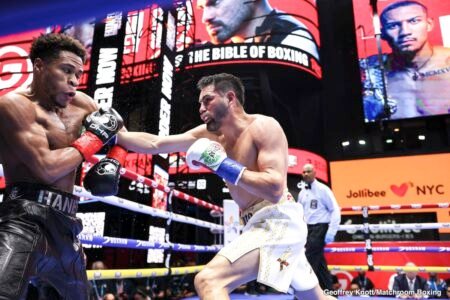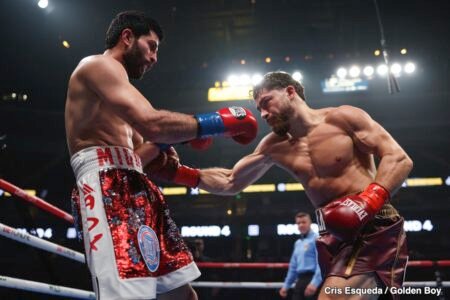


That’s important because southpaws get used to moving a certain way. For years, the safe move has been to circle left and stay away from the right hand. After years of doing it, the movement stops feeling like a choice and starts feeling like instinct.
Against another left-hander, that same step can carry you straight into a left hand.
Tim Bradley pointed it out in his breakdown. When two southpaws meet, the movement that usually keeps them safe can put them directly in the line of fire. If either man drifts that way out of habit, he is walking into the other man’s best punch. That fits this matchup.
Russell fights like a man who wants to take space. He flicks the jab, dips, and steps in behind it. He does not wait long. Hiraoka prefers to give ground, set traps, and fire back when the other man reaches. He is comfortable stepping back and letting the fight come to him.
Russell’s forward push can overwhelm opponents, but stepping in on another southpaw also brings him into range of the straight left, a punch Hiraoka throws with authority and one Russell himself relies on just as heavily. If one of them falls into that old habit of circling the same way, he is going to give the other man a clean look.
That is why the fight looks closer than the betting line might indicate, because Russell can control long stretches with pressure while Hiraoka only needs one clean shot to turn a round, and both men are accustomed to being the left-hander who controls that angle.
On February 21, that lane belongs to both of them.


Read the full article here