




The FIA will now hold off on removing the straight mode between Turns 8 and 9 at the Formula 1 Australian Grand Prix amid pushback from the teams.
For 2026 F1 has introduced active aerodynamics, with cars lowering both their front and rear wings on predetermined straights. That measure is aimed to help alleviate the drastic energy harvesting requirements of the new power units, which rely much more heavily on optimal battery usage.
Albert Park’s opening weekend featured five of those zones, including the snaking section following Turn 8, which leads into the high-speed Turn 9-10 combination.
Some drivers commented in Friday night’s drivers’ briefing that their car’s downforce when straight mode is activated is so low that they risk losing control over their cars through the curved approach to Turn 9, especially in traffic.
After analysing data overnight, the FIA decided unilaterally to remove the zone altogether ahead of Saturday’s running, starting with third free practice.
But following heavy pushback from a number of teams after the decision was announced, Autosport has learned the FIA has now walked back that decision, at least for now. The track will remain as it was for FP3, including the fourth straight mode zone, after which further analysis will take place before qualifying.
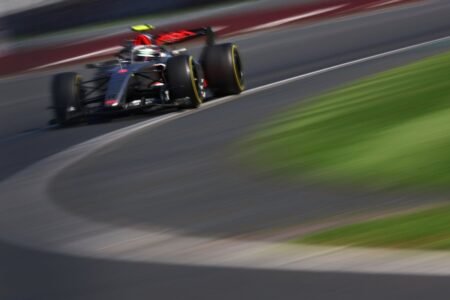
Gabriel Bortoleto, Audi F1 Team
Photo by: Andy Hone/ LAT Images via Getty Images
The FIA has since confirmed the U-turn in a statement: “Following the feedback received in the last hour from Teams and Drivers, and additional analysis contributed by Teams, the decision to remove Straight Mode zone #4 for Albert Park is rescinded.
“For the avoidance of doubt, this amendment is effective immediately, and Straight Mode activation Zone 4 will be in used in FP3. Further evaluation will take place during and after FP3.”
Explaining the initial decision to make the change in the first place, the FIA’s single-seater director Nikolas Tombazis said: “On most of the circuits these [zones] are fairly straight forward, they are in genuine straight areas of the circuit.
“On three or four circuits in the year, one of which is Melbourne unfortunately, they also include some zones which are fairly curved, as happens on the fourth straight mode zone here in Melbourne between corners 8 and 9. So, we had a meeting yesterday with the drivers and some expressed a concern that the downforce in that area was a bit too low, especially if they were fighting for position with other cars and they felt they could risk losing control of the car in such conditions.
“As, of course, safety is number one for us, we decided following some analysis to err on the side of caution and to remove the fourth straight mode zone here for Melbourne, starting from FP3 and of course for qualifying in the race.”
The reason why this situation has come up now is because the 11 different car designs all lose different amounts of downforce and drag once the wings are opened, and the FIA has only learned after Friday’s two free practice sessions that some cars were marginal on downforce through Melbourne’s fourth straight mode zone. But as the FIA agreed the matter was a safety issue, it decided to effectively change the race track overnight unilaterally.


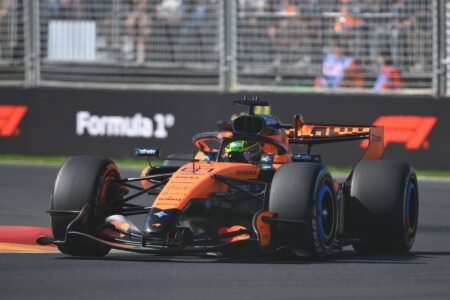
Andrea Kimi Antonelli, Mercedes
Photo by: Mark Thompson / Getty Images
“We are for the first time gaining detailed knowledge of the magnitude of downforce reduction, some teams are experiencing on the straight mode activation, so this is new information for us and for some of the cars that is quite a big downforce reduction, more than we had perhaps envisaged,” Tombazis said.
“This effect is not the same for all cars, but we couldn’t just act on a few cars and say: ‘Well, you need to change your set-up’ and not another’s, because we wouldn’t have a robust enough criterion and it’s short notice to do that, so that’s why we felt it had to be an action for all cars and not for some cars.”
Teams were only informed on Saturday morning, roughly two and a half hours before FP3, that the governing body has effectively changed the race track. What’s more, the long flat-out section between Turn 8 and 9 is crucial for energy harvesting, so it would force engineering teams to rethink their energy strategy and general car set-up.
When asked if he was expecting any pushback from teams, which duly arrived, Tombazis acknowledged his phone had been “vibrating” throughout his media availability and admitted the change penalised teams who had done their homework correctly.
“Some teams may argue it penalises those who have taken that factor into account, and that is true,” he said. “But, as I say, we acted on this on the basis of safety, so we couldn’t go and say: ‘Well, your car, you’re losing too much and you need to make a change, and your car is OK’. We didn’t feel we had a good enough criterion to do that.”
Tombazis said the same issue would present itself at three other circuits on the 2026 calendar, but with more time to prepare the FIA could come up with a more robust plan to regulation the minimum downforce levels when the straight mode is activated. It could also decide to make the straight modes shorter to reduce the downforce and speed difference between the two modes.
Photos from Australian GP – Saturday


Australian GP – Saturday, in photos

Australian GP – Saturday, in photos

Australian GP – Saturday, in photos

Australian GP – Saturday, in photos

Australian GP – Saturday, in photos

Australian GP – Saturday, in photos

Australian GP – Saturday, in photos

Australian GP – Saturday, in photos

Australian GP – Saturday, in photos

Australian GP – Saturday, in photos

Australian GP – Saturday, in photos

Australian GP – Saturday, in photos

Australian GP – Saturday, in photos

Australian GP – Saturday, in photos

Australian GP – Saturday, in photos

Australian GP – Saturday, in photos

Australian GP – Saturday, in photos

Australian GP – Saturday, in photos

Australian GP – Saturday, in photos

Australian GP – Saturday, in photos

Australian GP – Saturday, in photos

Australian GP – Saturday, in photos

Australian GP – Saturday, in photos

Australian GP – Saturday, in photos
We want to hear from you!
Let us know what you would like to see from us in the future.
Take our survey
– The Autosport.com Team
Read the full article here