




It’s often debated whether hitter hot streaks can be sustained. However, we know that breakout performances come from players with a mixture of luck and skill. To identify the players to discuss, we’ll use the Yahoo player rater for the past two weeks to provide a small sample to choose from. Besides those hot hitters on the player rater, we’ll discuss other hitters generating plenty of buzz throughout the fantasy baseball community.
Most of my analysis focuses on hitter skills, luck factors and other underlying metrics that could be contributing to the player’s outcomes. As we gather more data, I plan to have hitter leaderboards with advanced stats to identify any risers or fallers.
Cam Smith, OF, Astros (64% Rostered)
Smith has been providing power and speed this season, as his skills suggest. Plate discipline has been a concern, given Smith’s 72.5% contact rate in 2026, similar to 73.8% (2025). If hitters struggle to make contact, we want them to crush the ball when they finally do. That’s how Smith makes an impact, given his elite 77.6 mph bat speed and 76.2% fast swing rate (percentage of swings at 75 mph or higher). That’s over 3.0 mph faster in his bat speed compared to his rookie season in 2025.
Cam Smith bat speed distribution. (Photo by Corbin Young/Yahoo Sports)
We’ve also seen Smith make an adjustment in his batting stance by having a more neutral stance (0 degrees) after being 10 degrees open. He also moved seven inches farther back in the box, helping with potential pitch identification. Although the pull rates (34-37%) and flyball rates (30-34%) have remained similar, Smith has been attempting to elevate and pull the ball based on his swing path metrics.
That’s evident in Smith’s attack angle increasing to 12 degrees (2026) from 8 degrees (2025), plus his pull direction moving 4 degrees toward his pull side.


Cam Smith’s 15-game rolling average. (Photo by Cam Smith/FanGraphs)
Smith flashed elite speed (96th percentile) and athleticism in the outfield, being a strong defender, given his 99th-percentile Outs Above Average. That’s notable because Smith’s stolen base opportunity rate spiked to 26% early in 2026, up from 7% in 2025.
All told, Smith possesses the tools to put up a 20/20 season as a floor, if the playing time sustains.
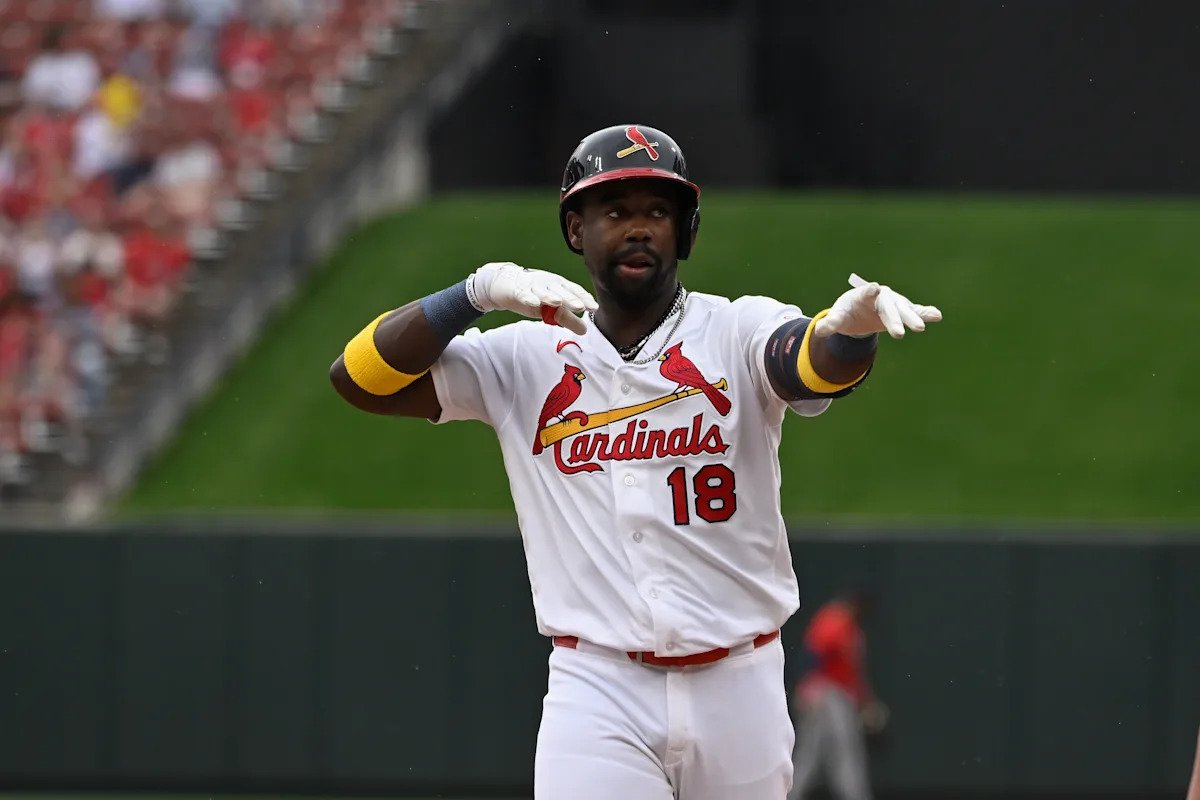
Jordan Walker, OF, Cardinals (88% Rostered)
I’ve mentioned a few times on X/Twitter that Walker has made significant swing and stance changes, especially after spending time at Driveline Baseball throughout the offseason. Walker has been using a significantly narrower batting stance, with 20.8 inches between his feet in 2026, compared to 28.7 inches in 2025. He used to have a batting stance that was 17 degrees open, but became more closed to 11 degrees in 2026, as seen below:


Jordan Walker batting stance changes. (Photo by Corbin Young/BaseballSavant)
The red or wide foot placements indicate his stance when he impacts the ball, or bat-to-ball intercept point, as Baseball Savant labels it.
That helped Walker improve his ideal attack angle rate to 61.1% (2026), up from 47.7% (2025). We highlight that because the ideal attack angle rate is the percentage of swings between 5 and 20 degrees. That suggests Walker is making more consistent swings in those ideal attack angles, which should lead to better outcomes.
In other words, Walker’s inputs and skills have improved, coinciding with positive outcomes.


Jordan Walker’s 15-game rolling average. (Photo by Corbin Young/FanGraphs)
Like Smith, Walker’s tools have been known, evidenced by his elite 78.1 mph bat speed. Hitting too many groundballs has been an issue for Walker, but he’s lowered his groundball rate to a career low (33.3%) in 2026, over 10 points below his career average (47%). Where the swing changes and ideal attack angles have translated the most are the barrels, given his 15.7% barrel rate per plate appearance in 2026 after hovering around 6.5% throughout his career.
This is a significant swing change for Walker, which can translate into 35-40 home runs based on his skills. Walker made significant and legitimate changes that are worth buying into, whether as a hold or trade for in fantasy baseball.
Sal Stewart, 1B, Reds (88% Rostered)
Stewart was a highly-touted prospect heading into the 2026 season. So far, Stewart has been productive early, with 7 home runs, 3 stolen bases and a .328 batting average. Though Stewart doesn’t have high-end bat speed, he combines strong plate discipline (78.4% contact rate) with his ability to barrel the ball (career 13.1% barrel per plate appearance rate).

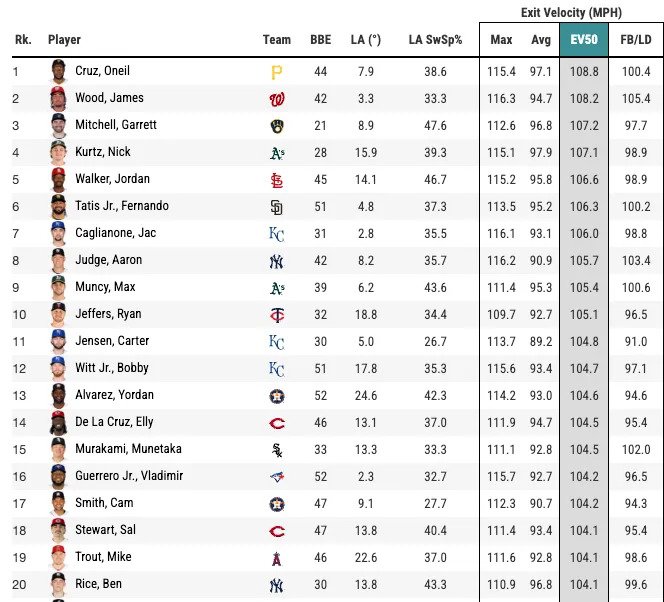
Leaders in EV50 as of April 15. (Photo by Corbin Young/BaseballSavant)
Furthermore, Stewart ranks 18th in Exit Velocity 50 or EV50 at 104.1 mph as shown above, which is the average of the hardest 50% of the player’s batted balls, giving us a more reliable metric than average exit velocity. That puts Stewart near strong power hitters like Yordan Alvarez, Ben Rice, Elly De La Cruz and Vladimir Guerrero Jr.
I wasn’t sure if the 17 stolen bases from Triple-A in 2025 would stick around, but we’ve seen a respectable 13% stolen base opportunity rate, which should lead to 10-15 stolen bases across a full season.
The projection systems aren’t doing Stewart justice since he should be a five-category producer. Stewart’s skills support the early-season production.
Chase DeLauter, OF, Guardians (82% Rostered)
DeLauter was crushing home runs early in 2026, leaning into a pull-heavy profile (55.6%). He had a 50% rate in the minors in 2024, but it was at 35.5% throughout the minor leagues in 2025. Plate discipline has been a strength for DeLauter, rocking an 83.2% contact rate and 6.9% swinging-strike rate. DeLauter’s 103.3 mph EV50 (No. 31) has been similar to Matt Olson, Matt Wallner, Kyle Schwarber and Pete Alonso.
That’s legitimate power from DeLauter, who boasts average bat speed (72 mph) while swinging in the ideal attack angles 57.4% of the time. The data suggests DeLauter has a strong hit tool with consistent swings to put the ball into optimal launch angles. Groundballs were an issue for DeLauter in the minors in 2025 (45.8%), but he has been hitting the ball in the air more in 2026, given a 44.4% flyball rate.
Injuries have been an issue for him throughout his career, including a core muscle injury that required surgery in 2025, fracturing a bone in his foot in April 2024 and a sprained right big toe in June 2024. That doesn’t include a broken left foot in college at James Madison. DeLauter fouled a ball off his foot in early April 2026, which raised alarms before he hit a home run after resting for a couple of days.
Fantasy managers might want to bail on him, due to the hot start and injury risk. However, DeLauter’s skills have supported the early-season breakout, so it’s not fluky production.
Josh Bell, 1B, Twins (38% Rostered)
We discussed Bell as a strong hitter waiver wire option heading into Week 3 based on volume. Over the past two weeks, Bell has been rated as one of the best hitters on the Yahoo player rater. Bell’s .324 BABIP has been fueling the .268 batting average in 2026. That’s significantly higher than Bell’s career BABIP at .284, so we know luck has been in his favor. Interestingly, Bell’s contact rate dropped to a career low at 72.8%, nearly 5.0 percentage points below his career norm.


Josh Bell’s 15-game rolling average in contact rate and BABIP. (Photo by Corbin Young/FanGraphs)
Bell’s contact rate could be small sample noise, especially with the BABIP spike. However, it’s worth highlighting that Bell has been pulling the ball at a career-high rate (48.4%) and hitting more flyballs (47.5%) in 2026. For context, Bell’s pull rate sits over 7.0 percentage points higher than his career average, with the flyball rate (52.5%) nearly 20 points above the career norm.
That further aligns with Bell’s career-high 32.4% pulled air rate, over two times his career average (14.1%).


Josh Bell’s 15-game rolling average in pull and flyball rates. (Photo by Corbin Young/FanGraphs)
If hitters often hit the ball on the ground, we want them to crush flyballs and line drives. Unfortunately, Bell’s 93 mph exit velocity on flyballs and line drives in 2026 dropped from 96.7 mph (2025), 93.6 mph (2024) and 94 mph (2023). Like the totality of Bell’s career, there have been inconsistencies with his production and underlying metrics, showing 2025 might be an outlier.
Use Bell as a hitter streamer, though he can be replaceable for another hitter streamer later in the season. Essentially, ride his production for as long as it lasts, because there have been actionable early changes in his launch angle and pull rates.
Read the full article here