


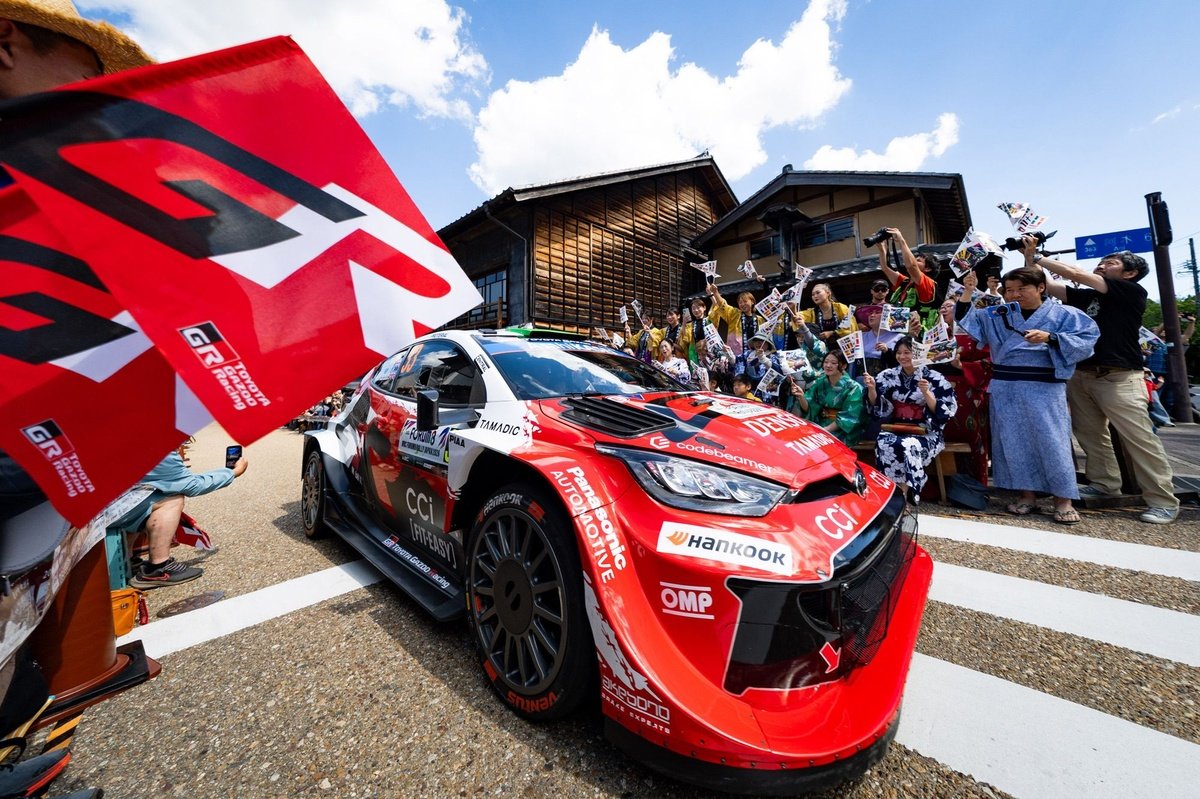
Elfyn Evans tamed Rally Japan’s tricky asphalt stages to claim his second win of the World Rally Championship season after fending off reigning world champion Sebastien Ogier.
Evans and co-driver Scott Martin produced a faultless display throughout the 20 asphalt stages to become the most successful driver in Rally Japan history by taking a third event win by 12.8s from Ogier.
Toyota dominated the final asphalt rally of the Rally1 era by locking out the top four positions as Sami Pajari claimed a fifth podium of the year in third [+51.4s] with home hero Takamoto Katsuta in fourth [+1m03.5s].
“What a great weekend. Huge thanks to the team. Amazing car again on tarmac. Long way to go and too early to talk about that [championship]. We have to just enjoy this one,” said Evans, who leads the championship by 20 points from Katsuta.
With the rally moving from an autumn to a spring date, crews had expected a hot dry rally, however overnight rain on Thursday created surprising damp conditions on Friday morning.
Toyota’s Oliver Solberg kicked off the rally by grabbing early lead after winning the opening test, before Evans came to the fore as the championship leader made his road order count. A stunning time in the Isegami’s Tunnel stage vaulted Evans from fourth to the lead, an advantage that would grow to 15.7s over Solberg at the end of Friday.
Despite rising temperatures and tyre wear becoming increasingly difficult to manage, Evans never lost the lead for the remainder of the rally, although he did come under heavy pressure from Solberg.
Solberg took the fight to Evans, winning two of Saturday morning’s stages to close the gap to 10.6s as the crews headed to a midday tyre fitting zone.
However, the Swede’s hopes of victory vanished when he lost control of his GR Yaris in stage 10 and clouted a pole, causing terminal damage to his GR Yaris’ right-rear suspension. It was his third crash on asphalt this season which led Ogier to suggest that his team-mate was taking too much risk.
Solberg’s untimely exit handed Ogier second position but the nine-time world champion was left to rue his poor road position, while also struggling to get the hard Hankook tyre to work in his favour.
Ogier was surprisingly unable to find a solution to put serious pressure on Evans, who was able to manage the final six stages to claim victory.
Sebastien Ogier, Vincent Landais, Toyota Gazoo Racing WRT Toyota GR Yaris Rally1
Photo by: Toyota Racing
Pajari continued his impressive run of podium finishes after finally finding a way to unlock pace from his Toyota on Saturday afternoon.
It proved to be another Rally Japan to forget for Katsuta, whose victory bid unravelled on the opening stage when he ran wide on a damp patch and clipped a bank resulting in a puncture. The Japanese driver was frustrated that his route note crew had not informed him of the conditions.
The puncture compromised his tyre strategy in the damp and another off in stage three further dented his hopes. Katsuta managed to recover from sixth to fourth where he remained at the finish.
Solberg rejoined the rally on Sunday where he salvaged the maximum 10 bonus points for winning Super Sunday and the Power Stage.
Adrien Fourmaux had banked on Rally Japan being a completely dry rally so when the overnight rain arrived on Thursday, the Frenchman was compromised by a decision to opt for an aggressive dry set-up.
However, as the rally progressed, Fourmaux’s set-up direction paid off when the stages became dry, emerging as the top Hyundai runner after stage nine on Saturday. Fourmaux was regularly the fastest of the Hyundai drivers on his way to finishing fifth.
Hyundai knew that it would be on the back foot in Japan given the i20 N’s overwhelming weakness has been its performance on asphalt rallies. It came as a surprise to see Thierry Neuville run as high as fourth ahead of the Toyota’s of Pajari and Katsuta on Friday morning.
Neuville managed to find a balance that worked in the damp conditions, but as the roads became dry his feeling and confidence behind the wheel evaporated as Hyundai was forced back onto the hard tyre. A handbrake failure on Saturday afternoon further hampered his performance.
The Belgian slid down the order to sixth with his frustration clear to see after revealing that the car was again “underivable” in the low grip, dry asphalt on Sunday.
In what is the last of his three scheduled WRC appearances this year, Hayden Paddon drove smartly in a first Rally Japan start on asphalt. The New Zealander made progress as the rally progressed but was left to settle for seventh. It is unclear if Paddon will drive Hyundai’s third entry on gravel later this year.
Jon Armstrong finished as the top M-Sport-Ford runner in eighth. The Northern Irishman was fortunate to survive a graze with the barrier on Saturday, and an intercom issue caused by sweat getting into the system.
However, Armstrong had the pace advantage over Josh McErlean, who rounded out the top 10 after losing more than two minutes to a wheel change in stage five.
The WRC2 battle went right down to the wire with Lancia’s Nikolay Gryazin taking the win after Alejamndro Cachon spun while trying to claw back a 2.8s deficit.
We want to hear from you!
Let us know what you would like to see from us in the future.
Take our survey
– The Autosport.com Team
Read the full article here