




Charlie O. Finley had a lot of crazy ideas during his time as owner of the Athletics. Some of the ideas, like having a designated hitter for the pitcher, night games for the World Series, ball girls manning the foul lines and brightly colored uniforms were ahead of their time. He also had radio broadcasts of Athletics’ games piped into bathrooms at the stadium, so people could still hear the action while answering the call of nature. Seems common sense now, but back then, things were different.
Some of Finley’s other ideas were, shall we say, unusual. He had a flock of sheep, eating the grass on the berm behind the outfield wall. He had a shepherd too. He had a mechanical rabbit named Harvey, who would pop out of the ground and deliver balls to the home plate umpire. Harvey startled more than one unsuspecting batter.
He had a Missouri mule, nicknamed Charlie O. (of course) who often traveled with the team and occasionally made a foray into hotel lobbies and restaurants. Finley was a strange cat.
One of his worst ideas was his conviction that the Athletics were losing so many games (compared to the Yankees) because the right field wall in Municipal was 325 feet away from home plate. The right field wall in Yankee Stadium, which had been grandfathered in, was a mere 296. Finley was 100% convinced this was the problem. Forget that the Athletics couldn’t hit for much power, or that their pitching staff was loaded with sore armed rejects from other teams. Forget that they probably had at least ten players who shouldn’t have been in the majors at all.
Finley’s solution to this was twofold: The first was to shorten the fence in right to 296 feet to match Yankee Stadium. Finley called it his “Pennant Porch”. This stunt lasted all of two exhibition games before Major League Baseball put its foot down and made Finley revert the fence back to 325. In response, Finley painted a line in the outfield grass and had the announcer bellow “That would have been a home run in Yankee Stadium” every time an Athletic hitter pushed one past the 296 mark. That stunt died a quick death as well, as opposing hitters were surpassing the line more frequently than Athletic hitters.
The second solution, which was a good one, at least in theory, was to bring in some power hitters. In that vein, Finley acquired two of the American League’s most prolific long ball hitters, Jim Gentile and Rocky Colavito.
There’s been ten men named Rocky who have played major league baseball, including one of my favorites, Rocky Bridges. Rocky Colavito is the most successful of that group.
On November 18th, 1963, the Athletics sent the popular Jerry Lumpe, Ed Rakow and Dave Wickersham to Detroit for Colavito, Bob Anderson and $50,000. Colavito’s salary for the 1964 season also happened to be $50,000. Remember that tidbit.
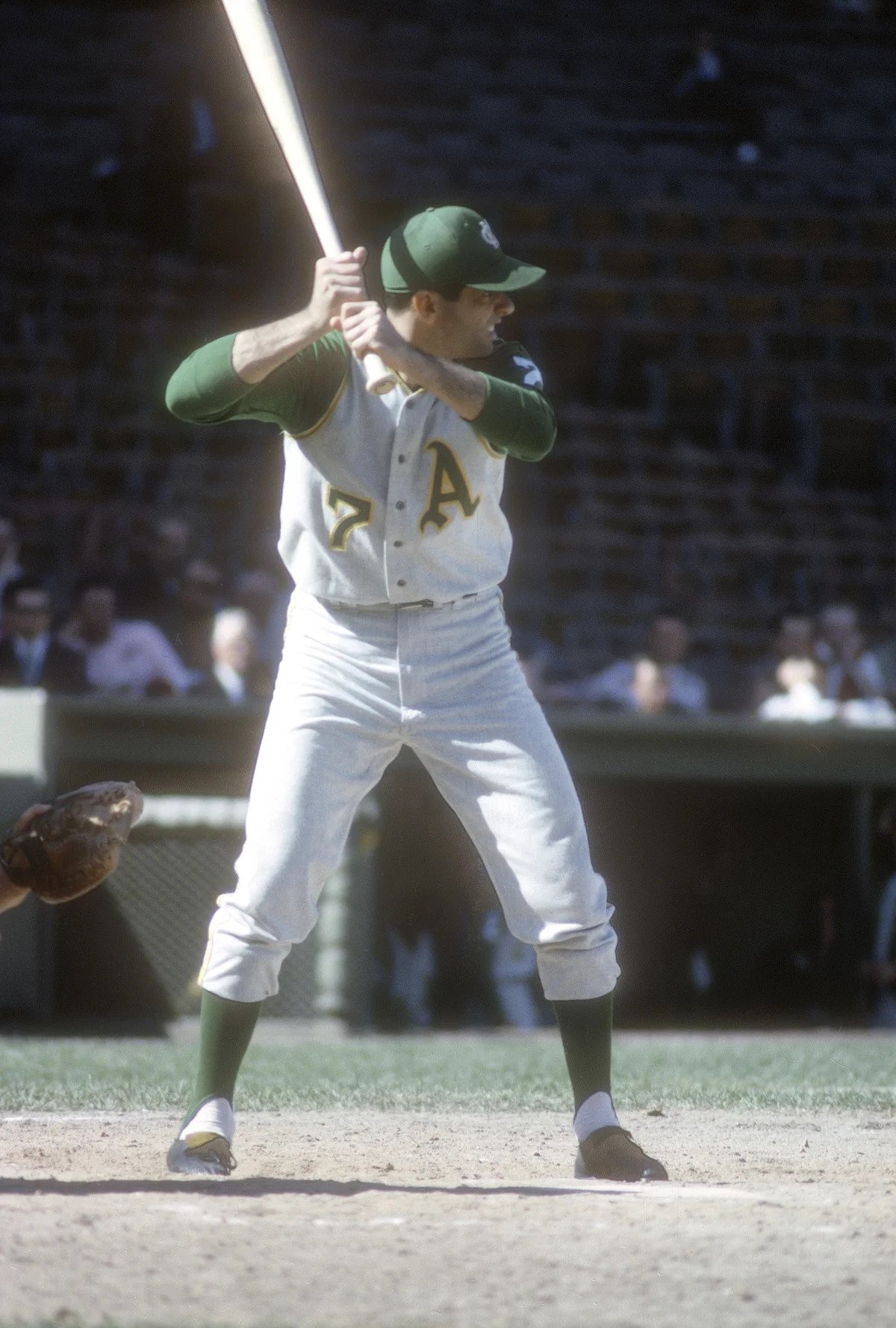
By the time he pulled on an Athletic uniform, Colavito was already an established star.
He had been a high school dropout, signed by the Indians as a 17-year-old, after a workout at Yankee Stadium. Colavito, known as The Rock naturally, was a strapping 6’3, 190-pound specimen with a cannon attached to his right shoulder. The Indians scout watched him fire missiles from the outfield and figured they could teach him to hit. Colavito is often overlooked when baseball scribes talk about who had the strongest outfield arm of all time. Clemente seems to be the gold standard. Bo Jackson had a cannon. Dave Parker could wing it. When his head was screwed on straight, Yasil Puig could bring it. Colavito could throw with any of them. Colavito could easily throw a ball over the center field fence from home plate. If that doesn’t impress you, try it sometime.
Colavito got into five games as a 21-year-old, then blossomed into a star at the age of 22.
He became an icon in Cleveland, hitting 129 home runs with 373 RBI in his first four full seasons. He electrified fans with his strong arm, often gunning down any runner foolish enough to challenge him.
The Tribe crushed their fanbase when they traded Colavito to the Tigers prior to the 1960 season. The Rock spent four years in Motown and didn’t miss a beat, mashing another 139 home runs and driving home 430.
When he came to Kansas City for the 1964 season, the Athletics were getting a bona fide star. The Rock did what he was paid to do, hitting 34 long balls and driving home 102. His slash was an impressive .274/.366/.507. He made the American League All-Star team and was worth 4.1 WAR.
Colavito’s best game as an Athletic came on July 22nd, at Minnesota. He went 3 for 4 with two home runs and four RBI with 9 total bases, part of a 6 to 4 Athletic win. Colavito had a fifteen-game stretch in June without a home run and another 14-game dry spell in late August/early September, which probably had Finley questioning his strategy.
The Rocky Colavito experience was short lived. On January 30th, KC sent him back to Cleveland as part of a three-way deal with the White Sox. The Athletics picked up Mike Hershberger, Jim Landis and Fred Talbot. The Indians sent Tommy Agee and Tommy John to the White Sox. As David Spade would say, “Daaaanng”.
The Athletics should have just flipped Colavito to the Indians for John and Agee. Why did the Athletics trade him? Was it because Finley realized that more home runs didn’t translate into more wins or was it because now Finley would be on the hook for Colavito’s 1965 salary?
Colavito bounced around a bit at the end of his career, first Cleveland, then the White Sox, then off to the Dodgers and finally 39 games with the Yankees in 1968.
He ended his career with almost 45 WAR and was a nine-time All-Star.
He did some coaching in retirement and spent several seasons coaching with the Royals. He was a hands-on participant in the Pine tar game, trying to spirit George Brett’s bat away from the umps and he once got arrested with Royals manager Dick Howser after a traffic stop. I remember seeing Colavito at the Stadium in those days and was always in a state of awe, having heard of his exploits from my father, who was a big Indians fan back in the day.
Colavito was immensely popular wherever he played. Late in life he struggled with Type II diabetes, which eventually cost him his life. He passed away on December 19th, 2024, at the age of 91.
Less than two weeks after picking up Colavito, the Athletics sent their All-Star first baseman Norm Siebern to the Orioles in exchange for the 30-year-old Gentile and $25,000. So, Finley got two sluggers and essentially had their old teams paying their 1964 salaries. I can’t think of anything more Charlie O. Finley than that.
When he was younger, Gentile was a highly thought of, and desired, minor-league star. He originally signed with the Dodgers but was blocked by Gil Hodges. Roy Campanella nicknamed Gentile “Diamond Jim” because he thought him a diamond in the rough. Campy had a good eye for talent. The Dodgers held onto Gentile, always asking for too much in return, while he destroyed minor league pitching. He didn’t get a real shot until he was 26, when Baltimore acquired him. He responded by hitting .292 with 21 home runs and 98 RBI in just 138 games. He made his first All-Star team, finished second in the Rookie of the Year vote (behind teammate Ron Hansen) and picked up some down-ballot MVP votes. Over the next three seasons, Gentile was one of the league’s steadiest power hitters. He led the American League in RBI in 1961 with 141, while bashing 46 home runs.
Giving up Siebern was a big price, having developed into an All-Star himself. He was a year younger than Gentile and though he had some power (a career high 25 bombs in 1962), he wasn’t quite in Gentile’s power class.
In retrospect, the trade worked out well for both teams. Over a season and a half (174 games) with Kansas City, Gentile hit 38 home runs and drove home another 93. He was worth about 2.1 WAR during his KC tenure. Siebern also made the All-Star team for the Orioles, his last, and over 256 games in Baltimore, was worth 4.5 WAR.
Gentile was a streaky home run hitter, often going 8-10 games without a dinger, then hitting four or five over the next week.
He had a terrific game against Boston on June 7th, 1964, at Municipal, going 3 for 4 with two home runs, five RBI and nine total bases.
He duplicated that feat against the Indians on August 30th.
In those days, the Athletics were in a near constant state of flux. On June 5th, 1965, they gave up on their power experiment and sent Gentile to the Houston Colt 45’s for pitcher Jim Hickman and utility infielder Ernie Fazio. Hickman appeared in 13 games for Kansas City, while Fazio got in 27 games in 1966.
Gentile toiled in Houston for parts of two seasons before ending his career with Cleveland in 1966, where he was reunited with Colavito. Gentile played for AAA San Diego Padres of the Pacific Coast League in 1967 and 1968, but finding no takers for his services, went to Japan and closed out his career with one season playing for the Osaka Buffaloes.
He had a solid career, worth 17 WAR and six All-Star appearances. His numbers would have been better had he not been marooned in the Dodgers’ minor league system during his younger prime.
In retirement, he did some managing in the minor leagues during the early 2000’s. Gentile remains one of the oldest living Athletics, currently at the age of 91.
The 1963 Athletics hit only 95 home runs (last in the American League) and scored 615 runs. The pitching staff gave up 704, which kept them in some games. The 1963 staff gave up 156 home runs, which was middle of the pack in the American League.
The 1963 team finished with a 73-89 record (Their second highest win total while in Kansas City).
The 1964 Athletics, with Gentile and Colavito on board, hit 166 home runs (3rd most in the league) but only scored 621 runs. The pitching staff gave up 836 runs, the most in the league by a fair margin. The 1964 staff gave up 220 dingers, 39 more than the next closest team. Gulp. That led to a disastrous 57-105-1 season. Turns out having a shorter fence or more power hitters wasn’t the problem after all.
The power bump did nothing for attendance. The 1963 Athletics drew 762,364, good for 8th in a ten-team league. Despite jacking more long balls, the 1964 team only drew 642,478 to Municipal, a 16% decline.
I think about the 1964 season often, with the Royals’ announcement that they are moving in the fences for the 2026 season. The other team hits too, you know. Who knows, maybe it’ll work out.
Read the full article here