





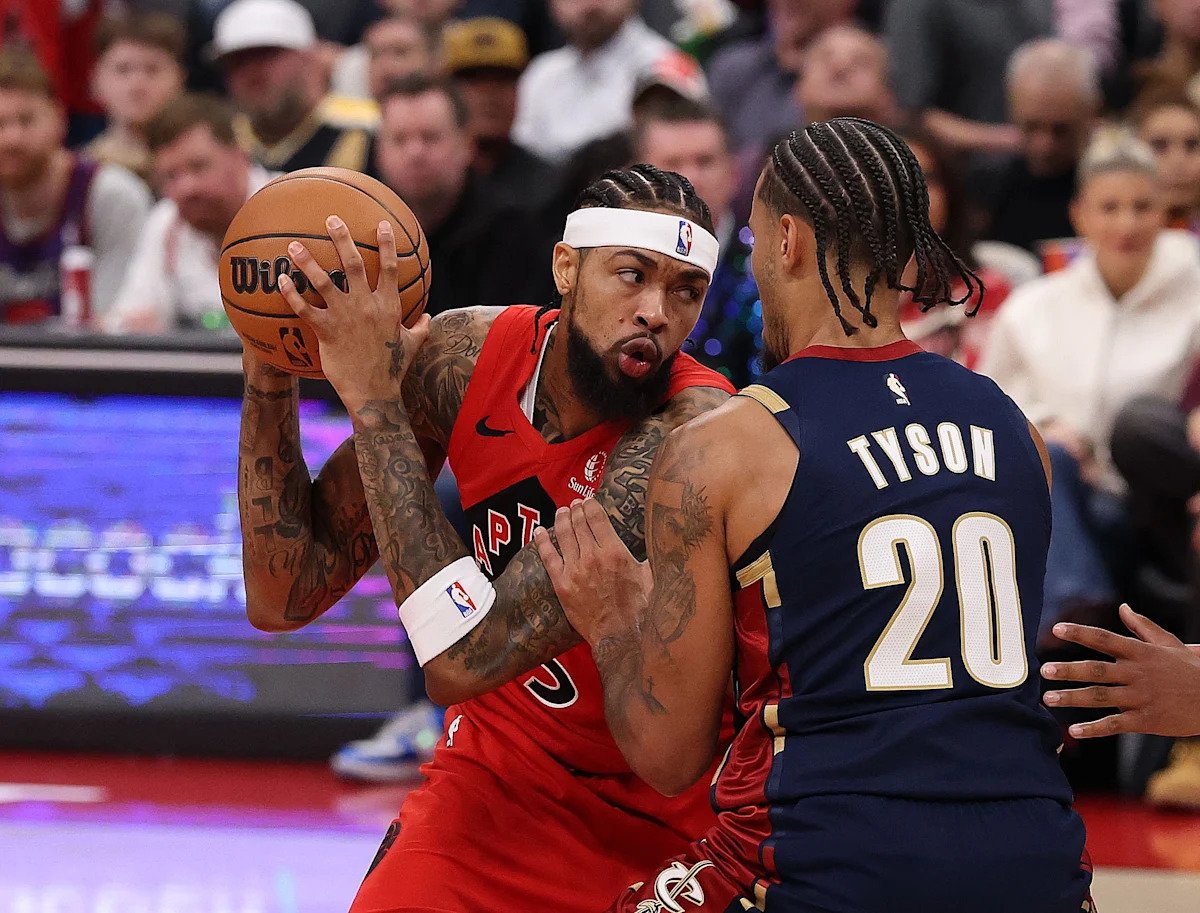
The Cleveland Cavaliers will take on the Toronto Raptors in the first round of the playoffs starting on Sunday. The Cavs lost all three of their regular-season games to the Raptors, but each came before December. Let’s take a look at what the numbers say about this Raptors team.
Overall team efficiency
The Raptors have simply been a solid team on both sides of the ball, although they’re better defensively. What they do on that end heavily influences their offensive attack. So let’s dive into the defensive numbers first.
Key defensive metrics
Toronto is excellent at two things defensively. They force turnovers, and they keep teams from getting out in transition.
The Raptors induce turnovers on 16% of defensive possessions. This translates to 8.8 steals per 100 possessions.
Scottie Barnes (1.4 steals per game) and Immanuel Quickly (1.3 steals per game) have excelled in this area. Both are physical at the point of attack and have active hands in passing lanes.
The Raptors are also committed to getting back in transition and are good at stopping the ball on the break. This has led to them giving up transition opportunities to their opponent on just 13.3% of their defensive possessions, which is the second-fewest in the league.
NBA offenses are built and conditioned to score in transition. There are few teams better at keeping opposing offenses from doing so than the Raptors.
Scoring in the half-court is considerably more difficult than doing so in transition. Toronto has a 96.7 defensive rating in the half-court that ranks 11th in the league. That isn’t outstanding, but their ability to force teams into consistently going up against their set defense is a win on its own.
Key offensive metrics
Toronto’s defense kickstarts its offense. Their focus on one end is mirrored on the other.
It’s difficult to be a team that runs in transition, while also not getting burned on that end yourself. The Raptors have done that as they’re third in offensive transition frequency and second in points added in transition per 100 possessions.
Support us and Let ‘Em Know with Homage!
Anything bought from the links helps support Fear the Sword. You can buy the Let ‘Em Know shirt HERE. You can also shop all of Homage’s Cavs gear HERE.
Your offense is going to be better in transition than it is in the half-court. Being able to generate shots in the open court is almost always better than the alternative. That’s worth highlighting because the Raptors aren’t elite at capitalizing on all of their transition looks.
They’re 15th in points added per 100 transition possessions. That means that they’re middle of the road in transition efficiency, but being able to get in the open court so often helps offset that. Ideally, you’d like to be great at both — as the Indiana Pacers were last season — but running this much does completely change how you guard them, as the Cavs saw in their three meetings this season.
The Raptors do this while limiting giveaways. They’re seventh in the league in turnover percentage and are fifth-best in opponent points off turnovers. Being able to protect the ball is imperative when playing fast, and it helps keep their opponent from getting fastbreak looks against them.
Where do the Raptors struggle?
The Cavs’ three-point defense has been an issue all season. The Raptors aren’t a team that can really exploit that. Toronto doesn’t shoot threes at volume — 25th — and they don’t shoot it particularly well when they do generate looks.
The most efficient ways to score are the rim, the free-throw line, and from beyond the arc. The Raptors only excel in one of those areas. They take the ninth-most shots at the rim and have the eighth-best percentage (68.5%). However, that doesn’t translate to getting to the line.
If they aren’t getting to the rim, they mostly settle for in-between shots. They’re taking a higher percentage of shots in the midrange than they are from three. You don’t see that often. Toronto is only one of four teams that take more midrange shots than threes. The other three teams aren’t known for having great offensive processes: the Sacramento Kings, Houston Rockets, and Dallas Mavericks.
Defensively, they don’t do a great job of keeping teams from getting to the basket and are prone to fouling them. This is partially due to a roster construction that is built more around wings than strong interior defenders.
The best three-point defense is limiting outside attempts. The Raptors don’t do that at a high level.
How to beat the Raptors
The Cavs need to keep the Raptors’ offense from running on them. This means they must limit turnovers and emphasize getting back defensively.
Since James Harden’s debut, the Cavs have done a good job of protecting the ball. They’ve been seventh in the league in offensive turnover percentage (13.1%) in that time. However, they’ve struggled with keeping opponents from getting out and running against them. They allow their opposition to attack in transition on 16.1% of their possessions since Harden’s debut, which ranks 20th in the league. Keeping the Raptors in the half-court is a must, considering that’s where a high percentage of their points come from.
Offensively, the Cavs need to keep focusing on their strengths since the Harden trade. They’ve done a better job of getting to the rim, drawing fouls, and generating three-point looks since the beginning of February. All of which are things the Raptors have struggled with.
Additionally, the Harden trade has boosted the Cavs’ half-court offense. They’ve attacked in transition the third fewest in the league since Harden’s debut. Instead, they’ve opted to operate in the half-court and have been exceptional at doing so. Since the beginning of February, the Cavs have registered a 104.7 offensive rating in the half-court, which is good for third in the league since that time.
If the Cavs can keep Toronto from getting out in transition and continue to execute at a high level with their half-court offense, they should win this series.
Stats taken from stats.nba.com and cleaningtheglass.com.
Read the full article here