



All baseball thought experiments coming from know-nothings outside of the organizations (like me) suffer from a lack of information. Trade daydreams or hot-stove free agent woolgatherings are limited to public information, certainly missing relevant details such as unofficial or non-public budget constraints, internal evaluations of prospects, culture concerns or planned transactions that would make the well-thought out idea a non-starter for either side.
So, let me start this thought experiment by saying, no, Randy Arozarena will certainly not be the Mariner’s first full-time designated hitter since the Boomstick terrorized the AL West (and Kendrys Morales before him). But, in a frictionless closed-system hypothetical, I think it might not be such a terrible idea. I think it could work.
The role of the designated hitter has changed pretty notably over the last decade or so. OUT are the David Ortizs and the Nelson Cruzs of the world, veritable sluggers who make the most of their five minutes of on-field time – IN is the “using the DH as a rotating half-rest day for your fielders and otherwise you’re using it for your next best hitter” Era, aka the Dominic Canzone/Ryan Bliss/Leo Rivas as DH Era.
There’s a lot of reasons for this change in philosophy. Part of it is the post-Moneyball $/WARification of the sport, the compulsive need by ownership groups to squeeze every ounce of Efficiency that they can out of their virtuously hard-earned and sadly-spent dollars. Why spend $35 million for 3.0 WAR from a player when you could instead get 1.5 WAR for only $15 million and save $20 million instead? And designated hitters produce less value, overall, by way of their lack of any defensive production, even when they are above-average hitters. But – get this – they used to get large contracts that didn’t account for this. They had been overvalued! Can you imagine?! Hiss!!
Instead of dedicating that position to a player who doesn’t provide you with other value, teams have mostly been using that spot as a method of volume management. If you could use it as a day for players like Cal, Julio, Randy etc. to get off their feet and hopefully keep them fresher for the marathon that is the MLB season, that’s a win in and of itself, even if it means you’re putting a replacement level player there on other days, and not maximizing your offensive production. This led to the discovery of the now-well-documented and oft-discussed “DH penalty”, the phenomenon that when players appear as the DH, they underperform their non-DH appearances by about 14 points of wOBA, or six runs over a full season. Now there’s even less incentive to slot someone in as the everyday DH, if they are likely to underperform anyways.
If you’re interested in reading very good baseball writing, I’d highly recommend this fantastic article that explores this topic by Hannah Keyser at The Ringer. One of the most interesting bits from this piece, though, is that in 2024, research by Baseball Prospectus’ Russell Carleton showed that the DH penalty disappears for players who take more than 75% of their at-bats as a designated hitter. It really only exists in the now-common time-share situations.
If you have a player who excels at the plate, but is passable in the field, it appears that you can use them as your DH most of the year, penalty-free, and still have them as a defensive option when other players do need a rest day.
This, of course, all leads us back to Randy Arozarena: Designated Hitter.

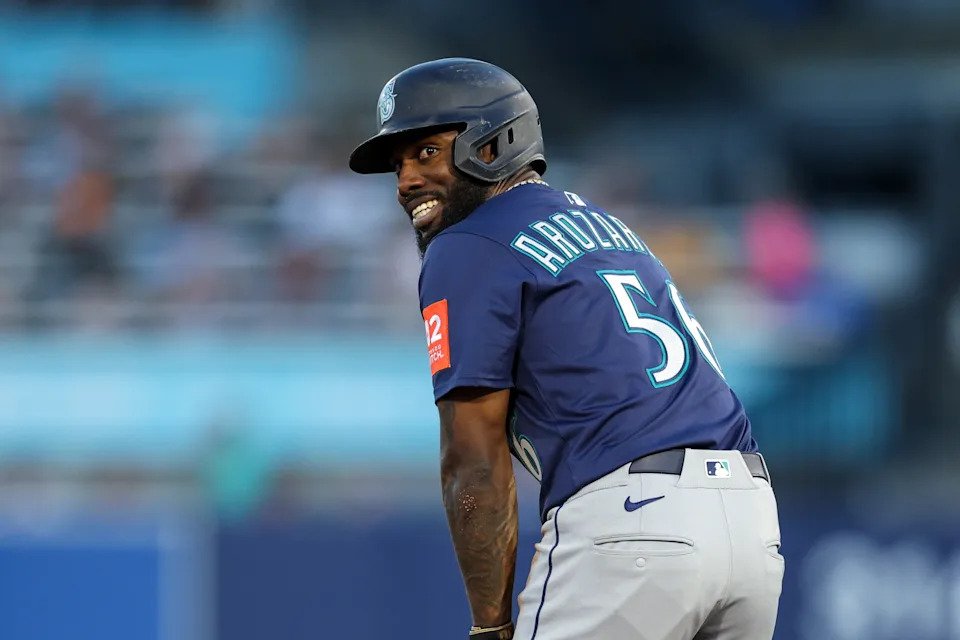
2025 Randy was, by overall contribution, a net positive in the batters box, though he can easily be split into Good and Bad. He hit the ball hard (90th percentile in hard-hit rate at 50.6%!), but not particularly often (30% whiff rate! 27% strikeout rate!). When he actually got wood on the ball, he tended to barrel it up, but left a lot of potential production on the table – he swung at less pitches in the zone than league average (62.6% vs 67%), and made less contact than league average when he did swing (75.9% vs 82.7%).
His batting value, overall, was in the 67th percentile last year – above-average, but lower than any year since 2021, his first full season in the league. It was a down year for what you’d expect from him.
Similarly, his overall baserunning value (0 total runs added, 42nd percentile in the league) looks rather pedestrian, but is, under the hood, buckwild: he was the 11th best basestealer in the league! Randy added 17 total net bases added above average. That’s worth about 3 runs over the season. Good!
Randy also managed to be the 6th worst (or, 308th best) in the other category that composes the bulk of baserunning value, extra bases taken. He was thrown out about 10% of the time that he tried to take an extra base, despite taking less attempts at that extra base than Savant calculates he should have. That 90% success rate is the 8th worst in the league, putting him below Cal, Eugenio, Keiburt Ruiz…but at least, mercifully, ahead of Alejandro Kirk. Barely. Bad!
Defensively, he continued to be the below-average outfielder that he has been steadily declining towards since his career started.


It does not spark joy.
What to make of all this? Despite the eye telling me that Randy is an exciting, dynamic player who Makes Stuff Happen, owner of the rare, electric power-speed combo, everything else tells me he’s actually far more of a Three True Outcomes guy. Among qualified batters last year, his TTO% (percentage of at-bats that end in a walk, strikeout, or home run) was 27th at 39.8%, vs a 33.7% league average. If you’re curious, there were only two Mariners ahead of him, both likely guessable: Cal was 4th in the league at 48.9% and Eugenio was 11th at 44.3.
I dunno. An TTO-type corner outfielder in his 30s who ain’t corner outfielding so good? Maybe even has had a couple relatively down years at the plate, and could use a little boost at the plate? Smells like DH material to me.
We don’t even need to look too far from home for a somewhat plausible comparison.
sits down in backwards-facing chair, youth pastorily You know who else was a terrible defensive player for the Mariners in a contract year?
Jorge Polanco was a stalwart for the Twins since his full-time debut in 2016, making his money as a reliable hitter (and certainly not as the pretty terrible infielder he has been since the start). His production at the plate, though, had been on a slow decline for years before cratering in his first season with Seattle in 2024, when he played through the knee injury for more or less the entire year. His wRC+ had declined year-over-year from 2021 at 124 to 118, 116, 92.
After being re-signed by Seattle before 2025 to play third base, Polanco ended up spending most of his time at DH last season (89 appearances at DH vs 43 defensive appearances). This was likely a decision made to protect his off-season patellar tendon repair after some early season soreness lingered in his knee. And boy, oh boy, did it work some wonders for him, both on the field and in the pocketbook – he hit for a 132 wRC+ last year and signed a $40mm/2 years contract with the Mets to DH and play some first base this offseason.
It’s a common thread for injury to spark the move to DH. Keyser’s article includes interviews with a few former star outfielders who recently have made the transition from playing the field regularly to full-time DHing: Bryce Harper, Andrew McCutchen, Giancarlo Stanton, to name a few. All three had serious injuries that precipitated the move.
This wouldn’t be the case for Randy, who is presumably healthy enough to keep playing in the outfield, quality of that play aside. But for a player who is now on the wrong side of 30 (typically the beginning of the decline on the aging curve) and more likely to suffer injuries, a proactive move to a position with less wear and tear on his body could help to keep him as available as he was last year, when he appeared in 160 games. If it allows him to focus his energy on the aspects of the game where he does and can bring value, even better.
While players don’t often become better hitters when they transition to DH, part of that is selection bias – most players are already on the wrong side of their aging curve when they make that transition. The better question is whether the move lessens the drop-off in their offensive production.
This is, unfortunately, an area where the research falls thin. If I didn’t have a full-time job? You can safely bet I’d spend several days drowning in data and trying to see whether a move to DH flattens aging curves re: offensive production. I am sad to say that I do not live this ideal life.
All this to say: Randy is looking more and more like a DH-type of fella. It would be worth seriously considering replacing him in the field if you had someone (or someones) who could provide league-average defense, and maybe even league-average offense. Ideally, this would help Randy to return to being the great hitter he was before, but even if it helps him to maintain his level of production from last year, that would be a win.
This, though, is where my original plan for this article fell apart at the seams and where I stayed up hours later than I ought to have – it’s the Raley and Refsnyder of it all.
I tried so hard to make Randy Arozarena, Designated Hitter work. I really did. I tried Harrison Bader, Mariners Starting Left Fielder, but it turns out that 2025 Bader was a fraudulent BABIP merchant. I tried Jarren Duran for Ryan Sloan + Michael Arroyo + Lottery Tickets. This was too complicated and I got too sleepy to explore it fully, plus I’m not great at trade proposals. I tried Stanton Spends $180mm Over Six Years on Cody Bellinger. This only works in an imagination that ignores the evidence that Seattle’s ownership and, to some lesser degree, management, is much more preoccupied with maximizing $/wins, as opposed to, well, wins. This far exceeded even my own typically-unbound silliness.
“Let’s make this work.” This sentence tormented my poor Google Doc. I couldn’t even sort of make it work in any meaningful way. Because, as it turns out, for all of the reasons why Randy Arozarena, Designated Hitter might not work (including that, in a contract year, there’s almost no way that he would willingly depress his own value and earning power), the main reason that it can’t work is that the organization has not built enough depth and production in the outfield to sustain it, nor are they likely pursue it.
Maybe it’s best to say that, in a healthier organization, with the appetite to spend more money in order to win more games than other teams, Randy could safely make this move to designated hitter. A franchise dissatisfied with giving regular at-bats to, for instance, Mitch Garver, Dominic Canzone and Donovan Solano could make it work. They could pursue the options necessary to let Arozarena play this position where he might provide the most production to the team without it also meaning that replacement-level players are patrolling the outfield grass.
This is all without mentioning how rocky the major league depth chart is in the other corner, or how thin and distant the farm is. With this year being Randy’s last year of his rookie deal and Seattle unlikely to re-sign him, the outfield in 2027 and onward is looking grim.
If you read this and feel that this all seems outside the scope of a 40-in-40, you’re probably right. But as I read and thought more about Randy Arozarena, the more I feel that DH Randy could be the best version of him in 2026, and maybe onward. A version of him that I am compelled by, drawn to, yet one I’ll never see. A version of him that is less about the literal position he plays, and more about what he represents. DH Randy is a lovely, haunting specter from another timeline, singing promises, floating just out of reach.
If the Mariners continue to get reliable availability, above-average production at the plate, and not any worse defense than we’ve seen in years past from Arozarena…well, that would obviously be no great disaster. It’s a lot better than we’ve seen in left field for most of the last twenty years! But it’s hard not to want more, and to feel that a truly championship-caliber team would see a lot less of Left Field Randy and a lot more of DH Randy.
Read the full article here