




We wrote about sleeper starting pitchers, and now we’ll discuss potential breakouts heading into the 2026 fantasy baseball season. Sometimes there’s overlap in sleepers and breakouts, but the main difference involves confidence in a player breaking out in the following season. To define breakout starting pitchers, we’re looking at players who could drastically outperform their draft cost in the following season.
[Join or create a Yahoo Fantasy Baseball league for the 2026 MLB season]
The draft market could be discounting this player, or we found skills to support a repeat or an improved level heading into the 2026 season. Here, we’ll provide five breakout candidates at the starting pitcher position based on the advanced data and underlying metrics.
MacKenzie Gore, TEX
MacKenzie Gore was the only starting pitcher with three pitches eliciting a swinging-strike rate at 18% or higher. That includes Gore’s slider (19.5%), changeup (20%) and cutter (18.8%). It’s worth noting that Gore introduced a cutter in 2024, which he primarily threw to right-handed hitters (6%) in 2025, as his fourth-most thrown pitch. It was a small sample of Gore’s cutters, but they were effective for whiffs against righties and weaker contact (.253 wOBA, .259 xwOBA).
MacKenzie Gore pitch percentage versus RHB by season. (Photo by Corbin Young/BaseballSavant)
Gore changed his pitch mix against left-handed hitters, showing he understands that he needs to throw his best pitch (slider) more often. That’s evidenced by Gore throwing his slider 44.3% of the time against left-handed hitters (2025), up from 4.9% in 2024. Historically, Gore relied heavily on the four-seamer against lefties in 2024 (52.3%) and 2023 (57.1%).

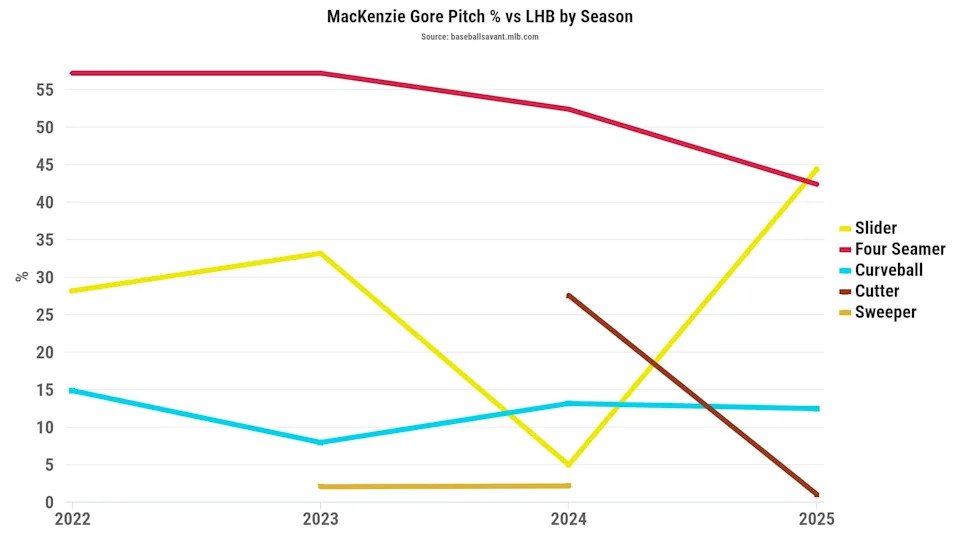
MacKenzie Gore pitch percentage versus LHB by season. (Photo by Corbin Young/BaseballSavant)
Gore’s pitch mix change against lefties should continue to be fruitful because hitters destroyed the four-seamer in 2025 (.451 wOBA, .387 xwOBA) and 2024 (.385 wOBA, .373 xwOBA). Theoretically, Gore’s four-seamer should generate more whiffs and better results, given the movement profile. Gore’s four-seamer has above-average induced vertical break (IVB) with elite extension (89th percentile).


MacKenzie Gore 4-seam location and results. (Photo by Corbin Young/MLB.com)
That suggests Gore’s four-seam locations could improve since he tends to throw it in the zone too often. When Gore threw the four-seamer in the zone in 2025, it led to a 12.6% swinging-strike rate, .367 wOBA and .382 xwOBA. Unfortunately, that’s not much better than when Gore throws the four-seamer outside the zone (.364 wOBA, .371 xwOBA). That hints at Gore’s four-seamer being unable to elicit weak contact, partially because it lacks arm-side fade.
Thankfully, Gore likely knows that and continues to evolve his pitch mix to lower the four-seam usage. Beside the whiffs, Gore’s control can be an issue, with a 37% ball rate in 2025. The wild card in Gore’s favor involves the significantly better defense behind him on the Rangers. Last season, the Rangers’ team defense ranked first in defensive runs saved (DRS), while the Nationals (Gore’s former squad) ranked 27th. In Outs Above Average, the Rangers ranked sixth and the Nationals ranked 29th.
Gore should provide plenty of strikeouts and a potentially improved WHIP, which could be better than his career norm (1.40). If Gore posts a 1.25 WHIP, there will be tons of value in the improved team context in 2026, as a starting pitcher breakout and sleeper. It’s a low-risk, high-reward draft selection.
Ryan Weathers, NYY
Injuries have been a problem for Ryan Weathers, who hasn’t logged 100 innings throughout his five MLB seasons. In a small sample of 38 innings, Weathers posted a career-best swinging-strike rate (13.6%) after missing nearly 150 days (144) on the injured list for a strained forearm and lat strain. We saw Weathers’ four-seam velocity reach 96.9 mph in 2025, a career high. During a recent spring training outing, Weathers threw his four-seam harder, averaging 98.5 mph against the Nationals.


Ryan Weathers spring training breakdown. (Photo by Corbin Young)
It might be scary for a pitcher with an extensive injury history to be ramping up their velocity early in spring training. However, we know that increased velocity can be beneficial from a whiff and weak contact standpoint. Notably, Weathers’ changeup and sinker were thrown over 1.5 mph harder in his recent spring training performance. Weathers made a pitch mix change by lowering his four-seam usage and bumping up sweeper usage. Monitor that adjustment, though it could be small-sample noise.
The main concern for the changeup would be losing downward movement with the additional velocity. Theoretically, it could lead to fewer whiffs, especially to right-handed hitters. For context, Weathers’ changeup elicited a 20.7% swinging-strike rate, over five percentage points above the league average.

Ryan Weathers pitch percentage versus LHB. (Photo by Corbin Young/BaseballSavant)
In Weathers’ spring training outing, he tinkered with throwing more sweepers, particularly to lefties (45%). Weathers threw sweepers 27.8% of the time in 2025, but we saw him experiment with heavy sweeper usage at 35.1% in 2024 against left-handed hitters. That would be an optimal approach because Weathers’ sweeper remains one of his best pitches, allowing a .221 wOBA (.153 xwOBA). Interestingly, the changeup was relatively effective against lefties (.250 wOBA, .184 xwOBA). Weathers threw his changeup more against left-handed hitters in 2025 (18.3%) across a small sample, up from 10.8% in 2024.
Weathers has been going past pick 200 as one of the final picks in drafts. Expect his ADP to rise, but the price bakes in the injury risk for a potential breakout season in 2026. The increased velocity, pitch mix change and improved team context support the upside scenario.
Trevor Rogers, BAL
We need to go back to 2021, when Trevor Rogers had an ERA under 4.00, before the 1.18 ERA in 2025. There will be a regression for Rogers, given his 3.56 xERA. The four-seam velocity improved to 93.1 mph in 2025, up from 91.9 mph in 2024 and much closer to the 93-95 mph before that. Rogers boasts an above-average 12.7% swinging-strike rate, headlined by his slider (17.6%) and changeup (14.3%).

Trevor Rogers swing/miss percentage. (Photo by Corbin Young/BaseballSavant)
The changeup used to be nastier, with peak seasons generating a 20% swinging-strike rate (2023) compared to a career average at 15.4%. Rogers’ changeup possesses an above-average movement profile, similar to the peak seasons for whiffs. That suggests there’s a good chance Rogers’ changeup whiffs bounce back to the near-elite levels in 2026.


Trevor Rogers changeup location and results. (Photo by Corbin Young/MLB.com)
Interestingly, his changeup has been decent but not dominant against right-handed hitters, particularly in terms of contact quality. That’s evident in Rogers’ changeup, which allowed a .248 wOBA (.308 xwOBA) in 2025, slightly better than in 2024 (.334 wOBA, .300 xwOBA). We typically find changeups being effective against opposite-handed hitters, especially if they can generate whiffs. Overall, Rogers tends to locate the changeup well, low and below the zone against righties.


Trevor Rogers sinker location and results. (Photo by Corbin Young/MLB.com)
However, it’s worth highlighting Rogers’ changeup found success against left-handed hitters (.166 wOBA, .244 xwOBA, 17% swinging-strike rate) in the small sample of 136 changeups over the past two seasons (2024-2025). Since Rogers throws from a low arm angle (22 degrees), his sinker seems to tunnel with the changeup and fade toward his arm side at an above-average rate. However, Rogers tends to struggle with the sinker command, given the sporadic heatmaps and inconsistent outcomes over the past two seasons.
Rogers added a sweeper in 2025, throwing it 11% of the time versus left-handed hitters and 6.4% of the time against righties. The sweeper is a slower version of the slider, with downward movement that’s nearly identical, yet sweeps over two inches toward his glove side compared to the slider. Although it’s Rogers’ fifth-most-used pitch against either side of the plate, it provides something different, more toward his glove side than the rest of his arsenal.
Rogers already showed us the potential ace-like upside in 2025 across 109 innings. Assuming the outcomes regress, there are still above-average strikeout skills. We could argue that Rogers already broke out in 2025, but the draft price around pick 150 suggests drafters don’t believe in sustainable success in 2026. Prioritize Rogers as a potential full-season breakout starting pitcher where he significantly outperforms his projected value.
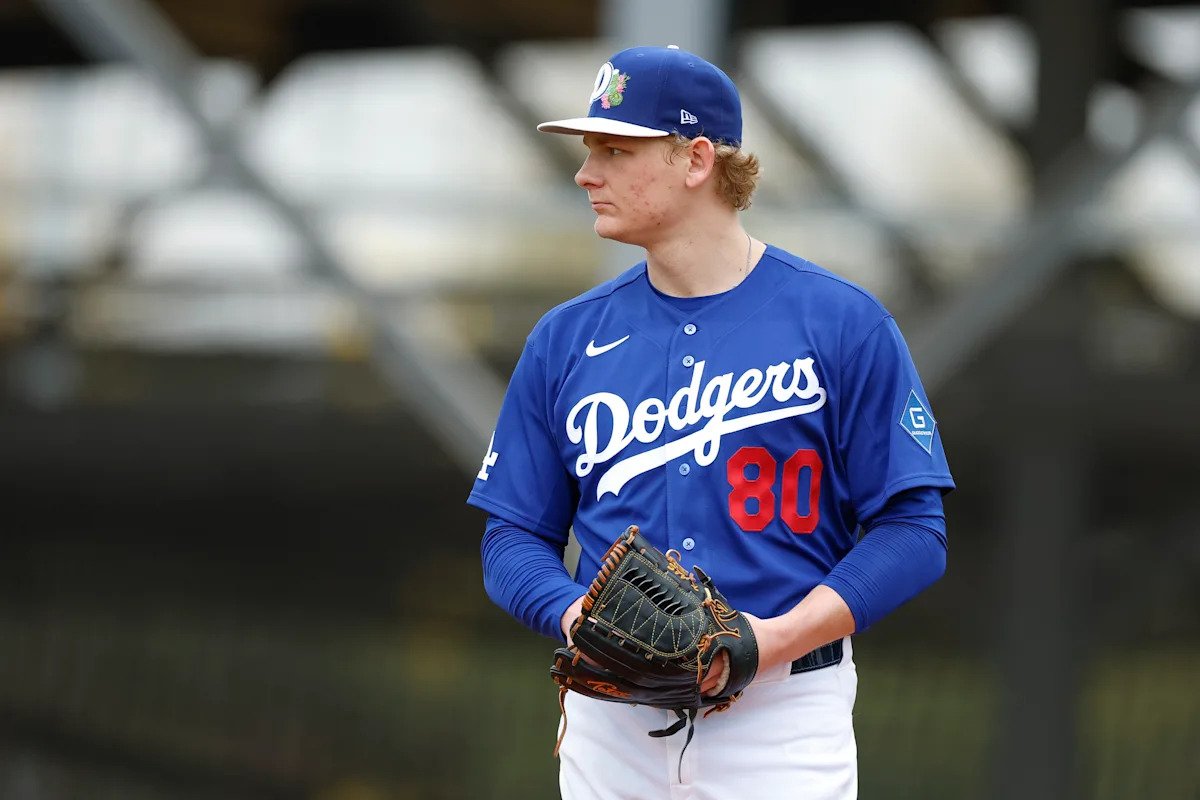
Emmet Sheehan, LAD
Like Rogers, some might say Emmet Sheehan already broke out in 2025 after a 73-inning sample with a 2.82 ERA, 0.97 WHIP, 23% K-BB%, and 16.2% swinging-strike rate. That’s near-elite upside for a starting pitcher, though it’s a limited sample throughout his MLB career. We can’t emphasize enough how rare it is to find a starting pitcher with a swinging-strike rate at 16% or higher. In 2025, Sheehan trailed Tarik Skubal (16.8%) as the only two starting pitchers with a 16% swinging-strike rate, with a minimum of 50 innings pitched.


Emmet Sheehan 10-game rolling average. (Photo by Corbin Young/Fangraphs)
For context, Blake Snell (16.3%) and Garrett Crochet (16.2%) reached that mark in 2024, with Spencer Strider (18.9%) and Tyler Glasnow (16.4%) as the only two in 2023 with a swinging-strike rate at 16% or higher. During Sheehan’s debut season, his slider (19.6%) and changeup (22%) were nasty pitches in terms of swinging-strike rate. For context, the slider and changeup were 3-7 percentage points above the league average in swinging-strike rate.
However, we saw Sheehan’s slider take a step forward, eliciting a 23.3% swinging-strike rate. Meanwhile, Sheehan’s changeup regressed to a 13.6% swinging-strike rate in 2025. Sheehan threw from a higher arm angle (35 degrees) in 2025 compared to 30 degrees in 2023. That coincided with Sheehan’s changeup losing over 4 inches of arm side fade. Thankfully, Sheehan continued to find success via the changeup against left-handed hitters, allowing a .155 wOBA (.201 xwOBA) in 2025.

Emmet Sheehan average horizontal break. (Photo by Corbin Young/BaseballSavant)
If Sheehan’s slider and changeup can be above-average pitches for whiffs and weak contact, that would unlock another level. That’s mainly because he already throws a four-seamer that added over 2 inches of induced vertical break (17.9 inches). Sheehan’s four-seam went from mediocre to above-average in IVB in 2025, as a heater he locates in the upper third of the zone.


Emmet Sheehan 4-seam location in 2024 and 2025. (Photo by Corbin Young/MLB.com)
Sheehan’s strikeout skills can reach those near-elite levels, though it’s a matter of health and volume for him in 2026. Assuming the ratios regress, Sheehan should have a breakout season where he hits career highs across most categories, even if it’s on a per-inning basis. That said, drafters haven’t been sleeping on Sheehan, as he currently holds an ADP of 155.3, and that could climb.
Nick Lodolo, CIN
Nick Lodolo had his best season in 2025, but the draft market has been cautious on him heading into 2026. Maybe it’s because Lodolo’s skills have been consistent (boring) and his home park remains in Cincinnati (one of the best hitter’s parks in MLB), but there are several aspects to like in Lodolo as an SP2 or SP3 with upside. Lodolo lowered his arm angle in 2025 (15 degrees) compared to around 19-22 degrees. That leads to Lodolo’s pitch movement profiles being heavier into horizontal movement.

Nick Lodolo pitch percentage versus RHB. (Photo by Corbin Young/BaseballSavant)
Lodolo’s changeup (14.1%) and curveball (19.5%) have been key pieces of his arsenal from a swinging-strike standpoint in 2025, similar to his career averages. Interestingly, Lodolo started throwing more changeups to right-handed hitters in 2025 (27.5%) compared to 2024 (20.2%). The changeup continued to be one of his better pitches against righties (.246 wOBA, .301 xwOBA) as one of three pitches, allowing a wOBA under .300, including the four-seam (.258 wOBA, .249 xwOBA) and curveball (.259 wOBA, .233 xwOBA).


Nick Lodolo induced pitch movement profiles. (Photo by Corbin Young)
Lodolo’s curveball has been his only pitch that moves toward his glove side, coming from a lower arm angle. He relied heavily on the curveball in 2025 (43.8%) compared to 2024 (37.3%) and 2023 (49.5%) against left-handed hitters. That aligns with the quality outcomes via the curveball against left-handed hitters, leading to a .263 wOBA (.166 xwOBA) in 2025 compared to a .271 wOBA (.180 xwOBA) in 2024.
Interestingly, Lodolo continued to lower his arm angle when throwing the curveball from 18.8 degrees (2024) to 15.9 degrees (2025). He has been using a slightly lower vertical release point with the horizontal release fluctuating throughout his career. Although it’s unusual, Lodolo’s curveball has been his best pitch, ranking 13th in Stuff+ for curveballs among pitchers with 100 innings pitched.
Hunter Greene (48 ADP) and Chase Burns (127 ADP) have been garnering tons of love in the Reds’ starting rotation. However, don’t forget about Lodolo, who goes later in drafts, but hasn’t been valued as a potential breakout starting pitcher in 2026.
Read the full article here